



























































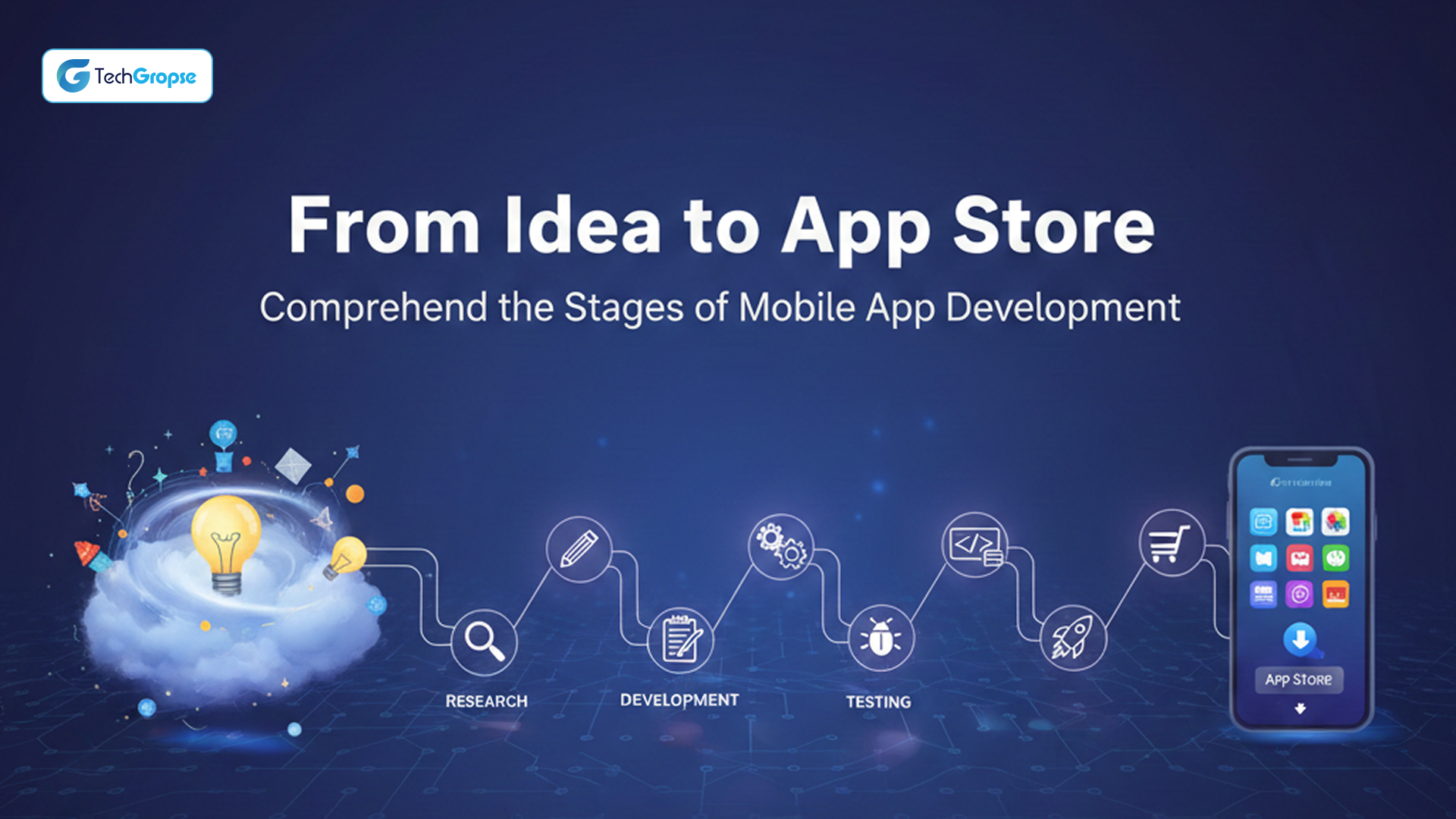
A mobile app development process might seem a simple game, but not every Tom, Decan, & Harry can accomplish it. You need to have rational knowledge, a budget idea, and a phenomenal team at hand to get the vision fulfilled.Â
So, in this blog, we will give you a well-researched idea on why understanding mobile app development is first required, and what the steps are for successful mobile app development.Â
Let’s explore!
Why is a Comprehensive Breakdown of Mobile App Development Required?
So, now you must understand why a comprehensive breakdown of mobile app development is required before initiating the project.Â
Clear Project Visibility
With a clear breakdown of mobile app development, you get a transparent visibility of the development stages, line of progression, key responsibilities, and deliverables.Â
Structured Planning & Budget
Not only the structured framework of the development process, but you also need to understand the resource allocation, budget involvement, and cost-cutting for strategic budget management.Â
Mitigates Development Risk
Stay away from internet threats and non-compliance activities with a bifurcated understanding of the mobile app development and the respective sprints.Â
High Quality & Scalability
To make the solution infrastructure scalable and of top-notch quality, you have to get a rational picture of the mobile app development stages.Â
Maintenance & Support Planning
A clear draft of mobile app development helps you understand the requirements and planning of maintenance and support.Â
Know the Comprehensive Breakdown of our Mobile App Development Sprints
Understand how TechGropse capitalizes on multiple stages of development to offer you the best product for your business.Â
Market Research & Analysis
This is the pre-stage of the actual development, where you figure out the market factors, eventually determining the app’s success. Gathering accurate market data is an important part of this stage, especially when analyzing competitors, customer trends, and industry insights. Businesses exploring automated data collection can consider a scraping API alternative to gather publicly available information more efficiently during market research.
- Evaluate market scope
- Draft project goals
- Recognize the target audience
- Understand industry trends
- Finalize sprints & stages
Requirement Gathering
In this stage, you accumulate the tangible and intangible resources for the seamless execution of mobile app development.Â
- Identify features & functionalities
- Mark non-functional requirements
- Document use cases
- Tech-stack selection
- Allocate tech experts
UI/UX & Prototypes
This stage is all about building the wireframe and strengthening the related factors.Â
- Build wireframes
- Craft intuitive mockups
- Visuals & clickable prototypes
- User navigation journey
- Design & re-design workflow
Core App Development
This is the actual coding stage of the sprints, where you execute both frontend and backend development.Â
- Set up development infrastructure
- Frontend development
- Backend development
- APIs & third-party services
- Integrate security features
App Testing & QA
This stage will ensure that the application is ready with no glitches or errors.
- Functional testingÂ
- Load testingÂ
- Speed testing
- Performance testing
- Data protection measures
Deployment & Launch
Here we deploy and launch the application on the respective stores.Â
- Prepare final app builds
- Configure servers and the production environment
- Ensure app store compliance
- Submit for review and approval
- Monitor launch performance
Post-Delivery Maintenance
After-launch support and maintenance are all about fixing the errors and bugs to sustain the quality and continuity of the application.Â
- Feature update
- Bug fixing
- Performance optimization
- OS compatibility updates
- Fix speed issues
Explore the Cost of a Mobile App Development Project: Market Analysis to Maintenance & Support
Before you make a tentative estimation of your mobile app development cost, know what percentage of the budget would be allocated in each stage of development.
| Development Stage | Key Activities | Estimated Cost Share (%) |
|---|---|---|
| Market Analysis | Market research, competitor analysis, and idea validation | 5–10% |
| Requirement Gathering | Feature listing, scope definition, documentation | 5–8% |
| UI/UX Design & Prototyping | Wireframes, visual design, and clickable prototypes | 10–15% |
| Core Development | Frontend & backend development, API integration | 40–55% |
| App Testing & QA | Functional, performance, and security testing | 10–15% |
| Deployment & Launch | App store submission, infrastructure setup | 3–5% |
| Maintenance & Support | Bug fixes, updates, monitoring, enhancements | 15–25% (annual) |
Conclusion
TechGropse is a leading mobile app development company with 10+ years of experience in the software development industry. Our technology experts have not only delivered projects to the major business downtowns, but across 25+ geographical locations.Â
If you are looking for high-end mobile app development stages, our developers are the best in the business, whom you can hire for your projects.Â
FAQs
The key steps in mobile app development include market research, ideation, UI/UX & prototypes, core development, testing & QA, deployment & launch, and app maintenance & support services.
With comprehensive & end-to-end market research, audience analysis, user feedback, and business scope evaluation, you can validate the app idea before development.
Although the time required to develop a mobile app depends on the application’s complexity and integrated features, the cost of mobile app development typically ranges from $15,000 to $350,000.
The time-to-market of a mobile app depends on the application size, listed features, target audiences, and industry served. Ideally, the time to develop a mobile application should be around 3 months to 9 months.
Depending upon the nature of the business, budget allocation, target audience, and time-to-market, you can choose any one among Native, Hybrid, or Cross-Platform development.
UI/UX plays a vital role in the entire development process. It not only determines the user engagement and navigational journey, but also the entire success of the application.
Apps undergo functional, performance, security, usability, and device compatibility testing to ensure quality and stability.
To keep your application relevant to the recent market trends, ensure top-notch speed & performance, and prevent the infrastructure from external threats & malicious attacks, you must have a proper app maintenance and support service.
Apps must comply with platform guidelines, security standards, performance benchmarks, and app store policies.
Bug-fixing, error detection, speed optimization, feature update, and version upgrade should be the essential verticals of app maintenance and support services.

Hello All, Aman Mishra has years of experience in the IT industry. His passion for helping people in all aspects of mobile app development. Therefore, He write several blogs that help the readers to get the appropriate information about mobile app development trends, technology, and many other aspects.In addition to providing mobile app development services in USA, he also provides maintenance & support services for businesses of all sizes. He tried to solve all their readers' queries and ensure that the given information would be helpful for them.


 info@techgropse.com