


























































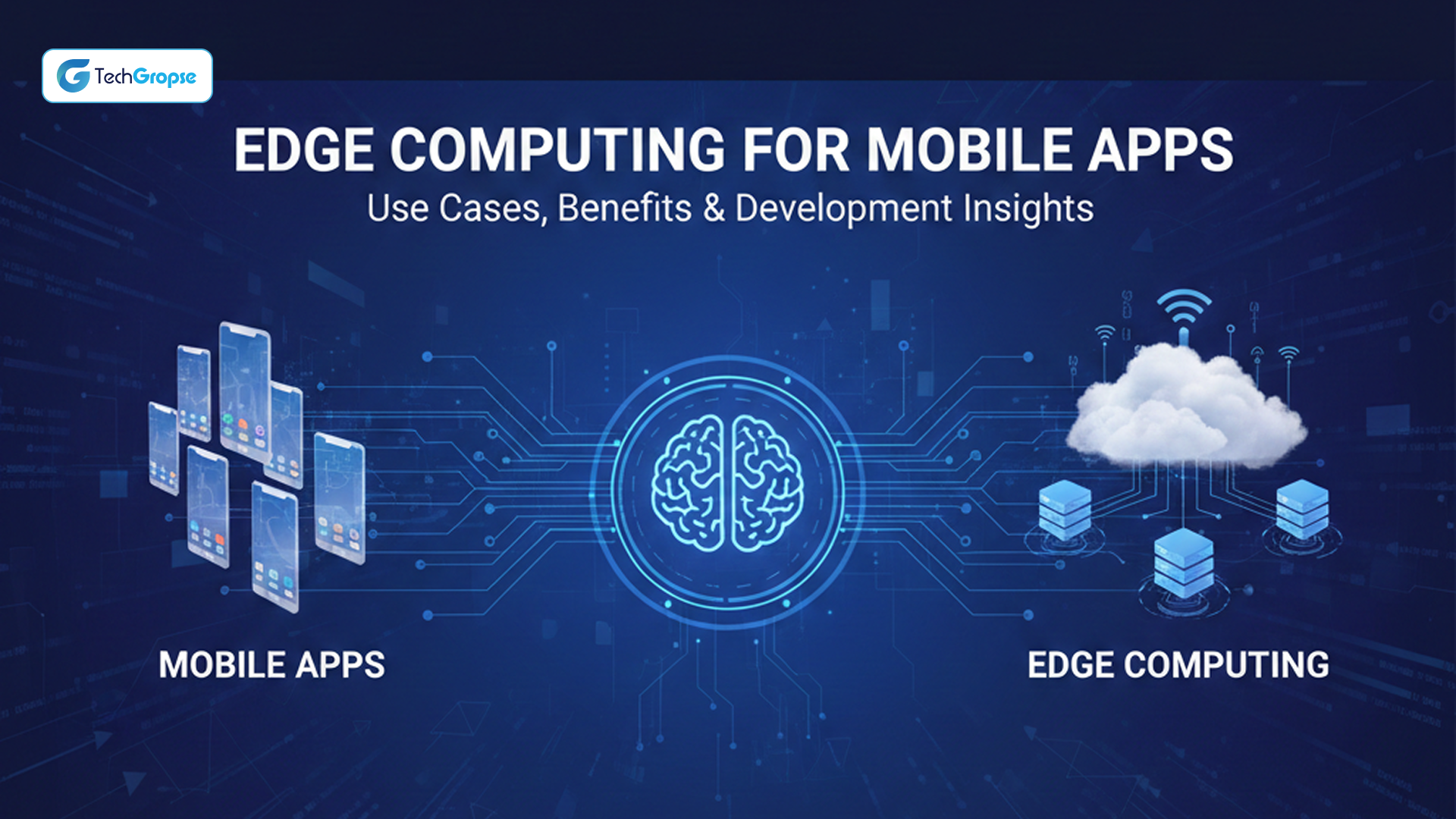
Edge Computing has become the reason modern mobile businesses can churn large datasets and bring computation close to users. Here, the system does not rely on centralized servers but leverages edge nodes, such as local gateways and servers, to make the response non-latent, reliable, and intelligent.
Key Takeaways:
- Why Edge Computing Is Crucial for Mobile Applications?
- How Edge Computing Works in Mobile App Architecture?
- Key Factors Driving Edge Computing Adoption in the Mobile Domain
- Cost of Building an Edge-Focused Mobile Application
Why Edge Computing Is Crucial for Mobile Applications?
Edge Computing keeps the mobile application closer to the device for handling ultra-critical operations, fostering real-time responsiveness and improved performance, even in unstable network environments or low network bandwidth.
Other than these virtues, Edge Computing also elevates data security, internet costs, and high-end AI personalization like AR/VR, Machine Learning, and IoT.Â
How Edge Computing Works in Mobile App Architecture?
Well, now you have the idea that Edge Computing is a mission-critical technology for the success of mobile applications.Â
Now, we must discover how Edge Computing works in mobile infrastructure.Â
Traditional Cloud-Based Mobile Architecture
When we talk about traditional cloud computing, the mobile application sends all data to the centralized server for processing and storage, which causes massive network dependency, a high-latency system, a large network bandwidth requirement, and restricted real-time performance for mission-critical datasets.Â
Edge-Enabled Mobile App Architecture
Edge-focused mobile infrastructure brings the mobile device close to the users, eventually reducing network latency, unresponsiveness, and disruptions, supporting AI functionality, real-time analytics, and data-driven decision-making.Â
| Aspect | Traditional Cloud-Based Mobile Architecture | Edge-Enabled Mobile App Architecture |
|---|---|---|
| Data Processing Location | Centralized cloud servers handle all processing and storage | Data is processed closer to users via edge servers or devices |
| Latency | Higher latency due to long-distance data transmission | Ultra-low latency with nearby data processing |
| Network Dependency | Highly dependent on stable internet connectivity | Works efficiently even with limited or intermittent networks |
| Bandwidth Usage | High bandwidth consumption due to constant data transfer | Reduced bandwidth usage by local data handling |
| Real-Time Performance | Limited real-time responsiveness for interactive apps | Optimized for real-time analytics and instant responses |
| Offline Capability | Minimal or no offline functionality | Supports partial or full offline operations |
| AI & Analytics | AI processing mainly occurs in the cloud | Enables on-device or edge-level AI inference |
| User Experience | Slower response times impact user satisfaction | Faster, smoother, and more reliable user experience |
Key Factors Driving Edge Computing Adoption in the Mobile Domain
Now, let’s explore the key factors that allow the adoption of Edge Computing in the mobile ecosystem.Â
Growth of IoT and Smart Devices
The accelerated growth of IoT sensors and smart devices has resulted in the generation of high-volume data. This phenomenon has paved the path for edge computing adoption in the mobile domain.Â
Demand for Real-Time Data Processing
Businesses looking forward to real-time data processing are more inclined to insights from local servers. This gave rise to the utility of Edge Computing. With Edge Computing in mobile applications, you get AI recommendations, data analytics, and quick decision-making.Â
Impact of 5G on Edge Computing
The 5G network has enhanced the performance of edge computing. So now there’s no risk of low latency, application support, high device density, and real-time responsiveness.Â
Cost of Building an Edge-Focused Mobile Application
Now, let’s evaluate the cost of building an edge-enabled mobile application.Â
| Application Type | Key Features | Development Scope | Estimated Cost | Time-to-Market |
|---|---|---|---|---|
| Simple Edge App | Basic offline accessibility Local data processing | Minimal edge & basic cloud synchronisation | $20,000 - $70,000 | 2-4 months |
| Advanced Edge App | AI interface High-end server integration Real-time processing | Hybrid + Cloud focused security & analytics | $40,000 - $200,000 | 3–6 months |
| Complex Edge App | Multi-edge nodes AR, VR, AI, ML integration IoT & 5G support | Fully compliant and scalable enterprise-level infrastructure | $100,000 - $500,000 | 6–12 months |
Conclusion
TechGropse is a leading mobile app development company with 10+ years of experience in multiple industries. With a vast talent pool, we have crafted innumerable applications for multiple businesses across 25+ locations.Â
Our Edge Computing use cases across industries are:Â
- Healthcare and Fitness
- Manufacturing and Industrial IoT
- Travel, Hospitality, and Smart Buildings
- eCommerce and Live Commerce
- Logistics and Fleet Management
Having worked in 3000+ industries, TechGropse is a one-stop solution for integrating your mobile business application with Edge Computing technology and advanced Agentic AI frameworks.
Partner with a Global Leader in Edge Solutions
Successfully deploying edge-enabled applications requires a partner who understands both global technology trends and local market demands. As a premier mobile app development company in Chicago, we help Western enterprises navigate the complexities of 5G and IoT integration. Simultaneously, our role as a top-tier mobile app development company allows us to spearhead digital transformation for the rapidly evolving Middle Eastern tech landscape.
FAQs
The computing approach where the data processing does not rely on a centralized cloud server, but counts on nearby data sources, is called edge computing. In the case of mobile applications, the computation happens near the smartphone, edge servers, and IoT devices for improved responsiveness & better results.
In cloud computing, the compulsion to use centralized servers brings high latency, high network requirements, and high bandwidth utility. Meanwhile, Edge Computing uses data from edge servers to make the response comparatively faster.
AR/VR, gaming applications, AI-powered applications, live streaming apps, healthcare, fitness, IoT, and location-based applications benefit the most from Edge Computing technology.
In Edge Computing, when the data is processed close to the mobile users, the latency rate of response is automatically reduced to a minimum.
Yes. Edge computing can be highly secure for sensitive mobile app data because data is processed closer to the device, reducing exposure to cloud transfers. With encryption, access control, and secure edge nodes, privacy and security are strengthened.
Yes. Edge Computing works both offline and with limited connectivity. When data processing is actively done so close to the server, the feature supports low-bandwidth connectivity.
High development cost, infrastructure complexity, edge-node management, and data synchronisation are some of the challenges of implementing Edge Computing in mobile applications.
Depending upon the features, infrastructural setup, and AI/ML needs, the cost to develop an edge-enabled mobile application would vary from $15,000 – $500,000.

Hello All, Aman Mishra has years of experience in the IT industry. His passion for helping people in all aspects of mobile app development. Therefore, He write several blogs that help the readers to get the appropriate information about mobile app development trends, technology, and many other aspects.In addition to providing mobile app development services in USA, he also provides maintenance & support services for businesses of all sizes. He tried to solve all their readers' queries and ensure that the given information would be helpful for them.

 info@techgropse.com