












































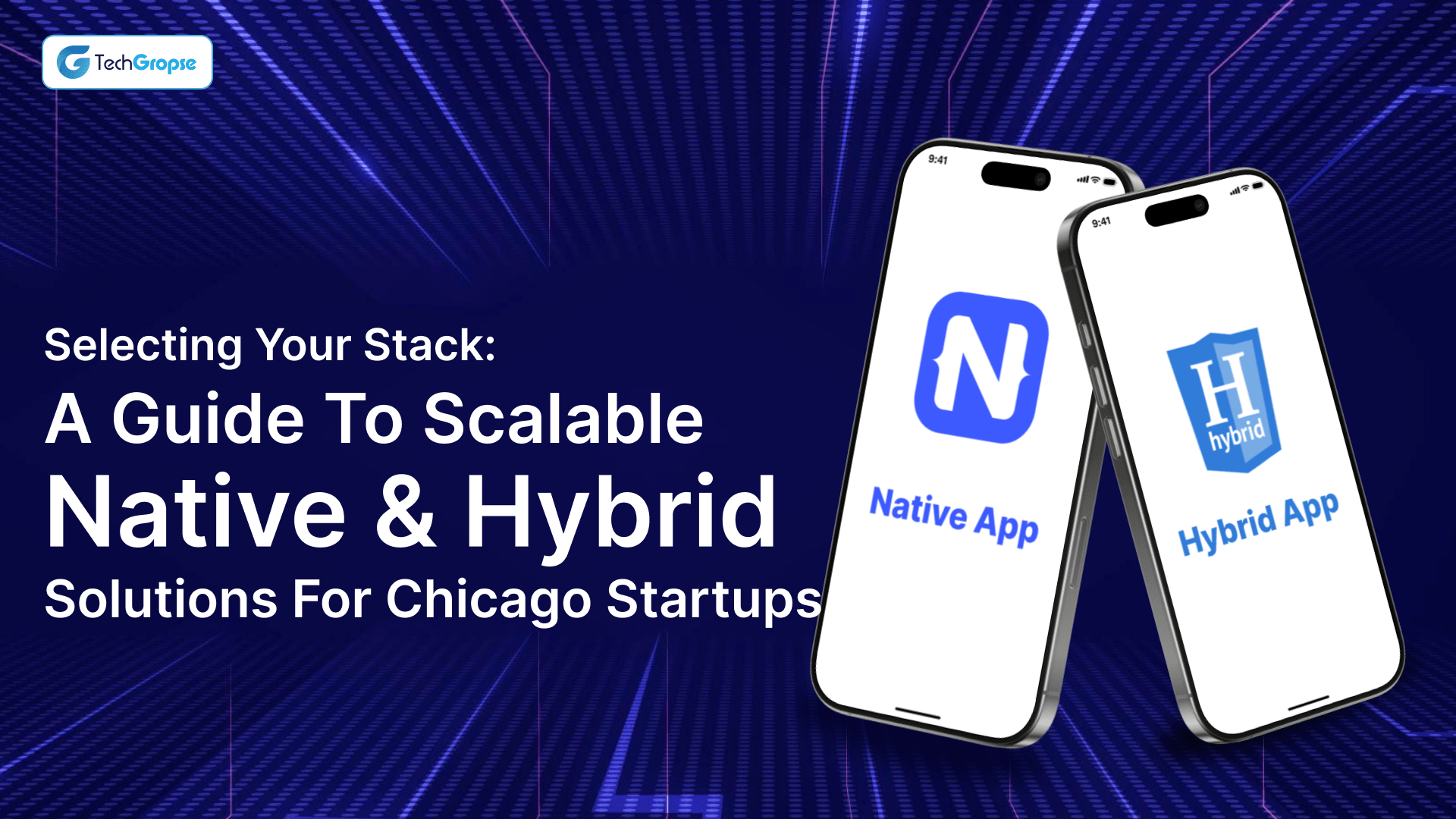
Native and Hybrid solutions are the frontline forces of any business industry. Right away, from a small manufacturing unit to the largest Information Technology firm, everyone is massively relying on Native and Hybrid applications.Â
Selecting the right stack for successful Native & Hybrid app development is not an easy task. To navigate these complexities, partnering with an experienced mobile app development company in Chicago is essential for local startups.
Thus, in this blog, we will learn about the best tech stack ways to choose them for Native & Hybrid application development in 2026.Â
Overview of Native and Hybrid App Development in Chicago
Data from ResearchGate says that in academic benchmarks comparing native and hybrid apps (e.g., native vs Ionic in sensor/communication scenarios), native apps generally process data more efficiently, while hybrid remains viable but with slight performance trade-offs — a common finding in empirical research.Â
Another ResearchGate stat reveals that in a sensor-driven Android app comparison, native apps ran ~2× faster build times and significantly faster execution speed for REST API data processing compared to hybrid ones, while hybrid apps required less code and simpler builds — showing clear trade-offs between raw performance and development effort.Â
A published report from the Journal of Emerging Technologies and Innovative Research says that native iOS apps had the fastest load times (~1.1–1.2 s) and lowest CPU/memory usage, versus frameworks like Flutter and React Native, which had higher load times and resource usage — directly quantifying performance differences between native and hybrid/cross-platform approaches.
Another comparative analysis study of ResearchGate found native frameworks deliver the highest performance and native device capability access, while hybrid solutions improve development speed and cost efficiency, but may suffer performance and device access limitations due to WebView use — a consistent conclusion in empirical research comparing approaches.
Key Factors to Consider Before Choosing the Stack for Native & Hybrid App Development
Let’s evaluate the key factors that must be taken into account before choosing the tech stack for Native and Hybrid app development in Chicago.Â
Business Vision
- Draft long-term business and product vision
- Evaluate the pain points and market scope
- Plan the monetization modelÂ
- Make insightful competitive analysis
Target Platform
- Select one among iOS, Android, and Cross Platform
- Make high-end scalability planning
- Draft platform-oriented platform virtue
- Target device preference and demography alignment
Performance Analysis
- Plan load time and solution responsiveness
- Traffic management plan-of-action
- Backend scalability and performance evaluation
- Real-time efficiency and data processing
Time-to-Market
- MVP vs full-scale product launch strategy
- Development methodology throughout the project
- Speed of feature iteration and updates
- Third-party integrations to accelerate delivery
Development Budget
- Plan the overall budget limit
- Tech stack and licensing criteria
- Plan offshore/hybrid/in-house/near-shore development
- Set post-delivery and support budget
UI/UX
- User flow and navigation alignment
- Platform compatibility and device preference
- Design scalability and visual branding
- Feedback and testing insights
Compliance Requirements
- GDPR, HIPAA, and CCPA privacy standards
- Align with industry-specific regulations
- Protected authentication and authorization
- Compliance updates and audits
Talent Availability
- Access to local and global skilled developers
- Evaluate the experience in tech-stack required
- Compare local and offshore ROI percentage
- Agility and team flexibility methods
Future GrowthÂ
- Future-ready solution with AI integration
- Business apps with analytics readiness
- Market growth and a demography-focused approach
- Long-term sustainability planning
Maintainence & Support
- Bug and error fixing
- Speed and performance testing
- Security patches and monitoring
- Feature update and version upgrade
Tech Stack Curated for Chicago Startups in 2026
Know the best tech stack for building Native and Hybrid solutions in chicago startup ecosystem.Â
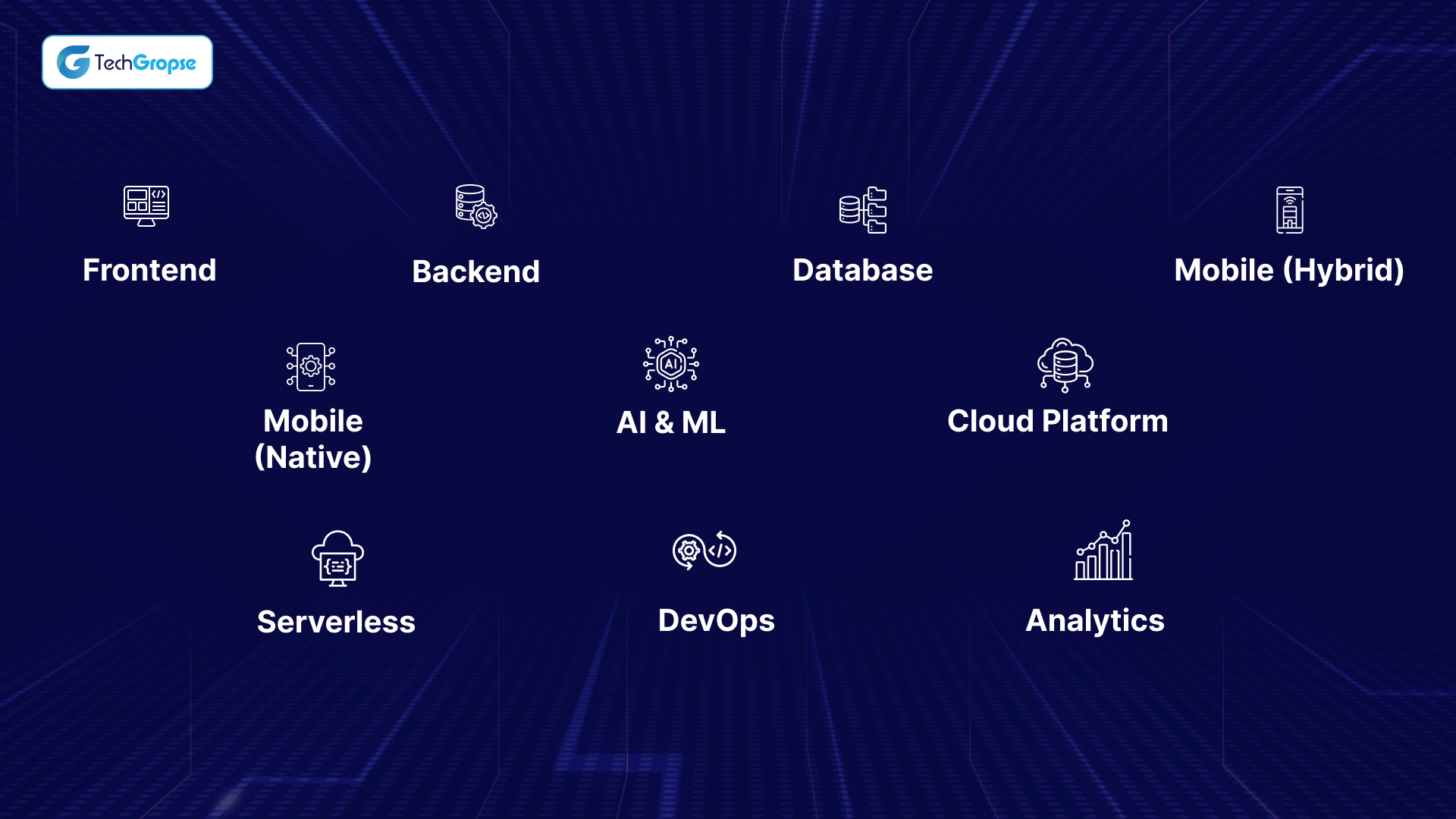
| Catagory | Stack | Suitable For | Key Benefits |
|---|---|---|---|
| Frontend (Web) | Next.js + TypeScript + Tailwind CSS | SaaS, marketplaces | SEO-friendly, fast, scalable |
| Backend | Node.js / FastAPI | APIs, MVPs | Rapid development, easy scaling |
| Database | PostgreSQL / MongoDB | Data-driven apps | Reliable, scalable, cloud-ready |
| Mobile (Hybrid) | React Native / Flutter | Startup MVPs | Single codebase, faster launch |
| Mobile (Native) | Swift (iOS) / Kotlin (Android) | High-performance apps | Best UX, native performance |
| AI & ML | Python + LangChain | AI-powered apps | Strong AI ecosystem |
| Cloud Platform | AWS / Google Cloud | Scaling startups | Global reach, reliability |
| Serverless | AWS Lambda / Cloud Run | Cost-efficient scaling | Low ops, auto-scaling |
| DevOps | Docker + Kubernetes | Enterprise-ready apps | High availability, scalability |
| Analytics | Firebase / Mixpanel | Product growth | User insights, tracking |
Conclsuion
TechGropse is a broadly chosen mobile application development company in Chicago with a decade of experience in crafting industry-focused solutions. Having worked on more than 3000 projects, we have around 92% client retention rate. Thus, our vast software experience in Chicago would certainly help you choose the right stack for startups.Â
What do we offer?Â
- Evaluate the idea, roadmap, and possible growth of the startup before recommending the tech stack.Â
- Scalability requirement analysis that helps you choose the feasible tech stack.Â
- Bifurcated tech stack listing for Native, Hybrid, and Cross-Platform requirements.Â
- Tech recommendations aligned to the planned time-to-market of the solution.Â
- Budget-friendly tech stack recommendations as per the project limit.Â
- Tech-stack that supports future-ready architecture.Â
- Technologies that align with cloud, APIs, and databases optimization for high performance & scalability.Â
- Ongoing consultation and optimization as your startup grows and scales
FAQs
The best app development stack for Chicago startups includes Swift, Kotlin, Java, AWS, React Native, Node.js, PostgreSQL, GCP, and Microsoft Azure.
For high performance, robust security, and strong scalability, you can choose Native app development. For MVP-focused development, quick time-to-market, single codebase usage, and low development cost, you can choose hybrid app development.
With a modern framework, mitigated development cost, and a broad customer base, Hybrid apps are the best choice for startups.
Industries like manufacturing, healthcare, pharmaceuticals, on-demand, eCommerce, and retail benefit the most from Native apps.
Basic native apps would cost $30,000 – $60,000. A Native app with medium complexity would cost $60,000 – $150,000. An enterprise-level Native app development would cost $150,000 – $250,000+.
Yes. With faster response timing, advanced features, and high user experience, native app development is best for startups.
e-commerce and retail applications, healthcare and telemedicine, fitness & lifestyle, and EdTech applications are best for Chicago startups in 2026.
Some of the measures are: Define a clear project goal, check technical experience, go through the portfolio, and past market experience, look for post-launch support and services.
MVP scope, scalability requirements, time-to-market, targeted platforms, security & compliance, integration capabilities, long-term maintenance, and local talent availability are key factors to consider before selecting a tech stack for Chicago startups.
Amazon Web Services (AWS), Microsoft Azure, Google Cloud Platform (GCP), and DigitalOcean are among the key cloud platforms for scaling the Chicago startup ecosystem.

Hello All, Aman Mishra has years of experience in the IT industry. His passion for helping people in all aspects of mobile app development. Therefore, He write several blogs that help the readers to get the appropriate information about mobile app development trends, technology, and many other aspects.In addition to providing mobile app development services in USA, he also provides maintenance & support services for businesses of all sizes. He tried to solve all their readers' queries and ensure that the given information would be helpful for them.

 info@techgropse.com