



























































Not only the IT, eCommerce, and healthcare industries, but education in the United Arab Emirates is also taking a huge leap in AI and software adoption. The Student Management System is one such solution that is highly trending in the market. With a keen approach to a digital-first learning approach, the Student Management System in the UAE is no longer a secondary option. Indeed, it’s a mandatory solution for schools, universities, and learning institutions to redefine the entire education landscape with tech-first innovations.
The ever-expanding gap between digital-focused learning and manual student management caters to the growth of such an extraordinary solution. As MOE, CAA, KHDA, & ADEK have started establishing strict reporting norms, educational units are under massive pressure to sustain compliant and functional operations. Thus, the Student Management System in the UAE is offering a pivotal opportunity to manage attendance, maintain assessments, and enrollment programmes.
So, whether you are converging your focus on creating a SaaS platform or looking forward to building a cloud-focused Student Management System, this blog is going to be the one-stop solution for you. Here, we will break down the features, functionalities, cost, and norms to build a Student Management System.
Let’s explore to know better.
Key Takeaways
- Market Size of Student Management System in the UAE
- What Exactly Student Management System Does?
- Manual Management Vs Student Management System: Save Time, Budget, & Resources
- Competitive Benefits of the Student Management System in the UAE
- Workflow Algorithm of a Student Management System
- How to Build a Student Management System in the UAE?
- Essential Features of a Student Management System
- Know the Cost to Build a Student Management System in the UAE
- Best Monetization Model of Your Student Management System in 2026
- Top 10 Student Management System Development Companies in the UAE
- How Are We Different From Other Developers Offering a Student Management System in the UAE?
- FAQs (Frequently Asked Questions)
Market Size of Student Management System in the UAE
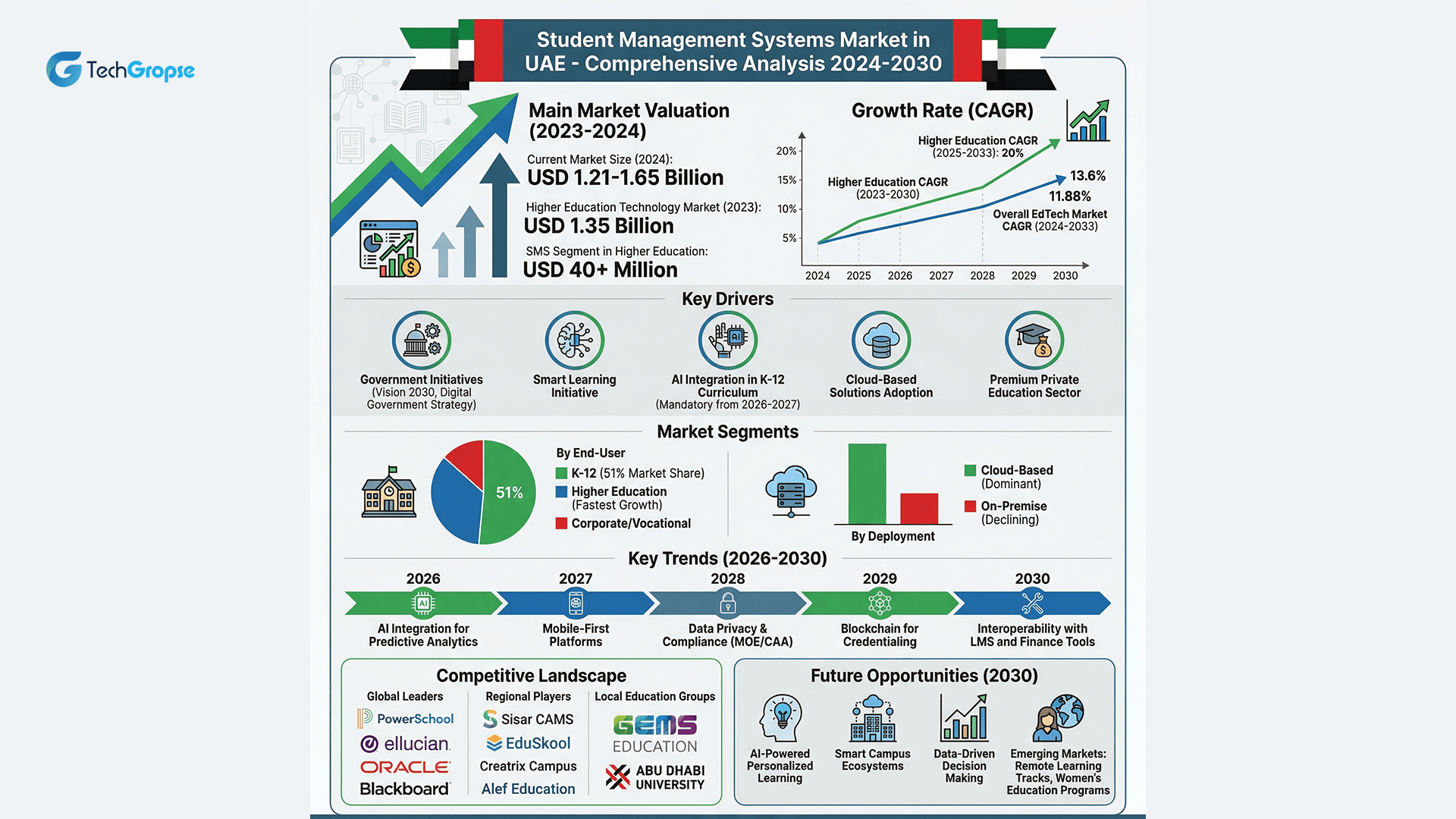
A report from FORTUNE BUSINESS INSIGHTS says that the global EdTech market is projected to grow from $214.58 billion in 2026 to $588.72 billion by 2034, at a CAGR of 13.45%.
Data from GlobeNewswire confirms that the global EdTech market was valued at $334.29 billion in 2023 and is expected to reach $738.60 billion by 2029.
Industry Research data claims that more than 300 million learners globally were actively using EdTech platforms, driven by demand for digital and remote learning.
The same Study confirms that around 65% of educational institutions allocate over 15% of their budget to digital learning tools and platforms like LMS and Student management systems.
Let’s explore some famous market studies of Grand View Research.
Learning Management System (LMS) – Closest High-Value Segment
- Market size (2025): USD 181.2 million
- Projected size (2033): USD 933.5 million
- CAGR (2026–2033): 22.8%
Education ERP Market (Includes Student Information Systems)
- Market size (2024): USD 0.3 million
- Projected size (2030): USD 1.3 million
- CAGR (2025–2030): 26.6%
Overall UAE Education Technology Market (Broader Context)
- Market size (2024): USD 2.26 billion
- Projected size (2030): USD 5.31 billion
What Exactly Student Management System Does?
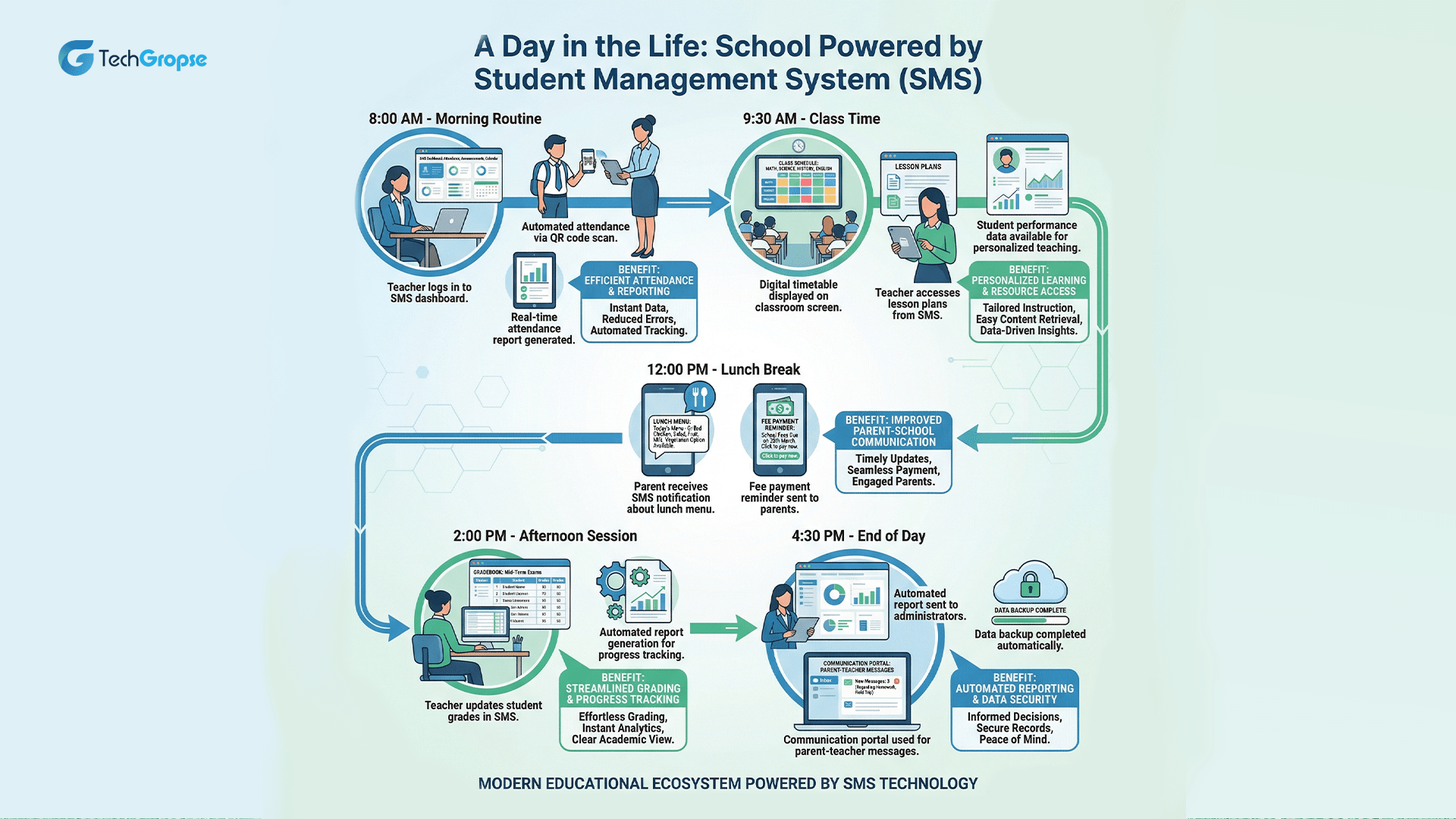
In a nutshell, a Student Management System is a software solution that eases an educational institute of all manual hassles. From programme enrollment to daily attendance, compliance regulation to monthly reporting, everything is substantially managed with a digital-first approach by a Student Management System.
From the UAE’s point of view, strict regulatory bodies like ADEK, CAA, KHDA, and MOE are putting constant pressure on transparent, accurate, and audit-ready operations. This is where a Student Management System jumps into the picture. The solutions enable managing tough manual day-to-day tasks under a one-roof solution, further storing every data within its cloud repository.
Manual Management Vs Student Management System: Save Time, Budget, & Resources
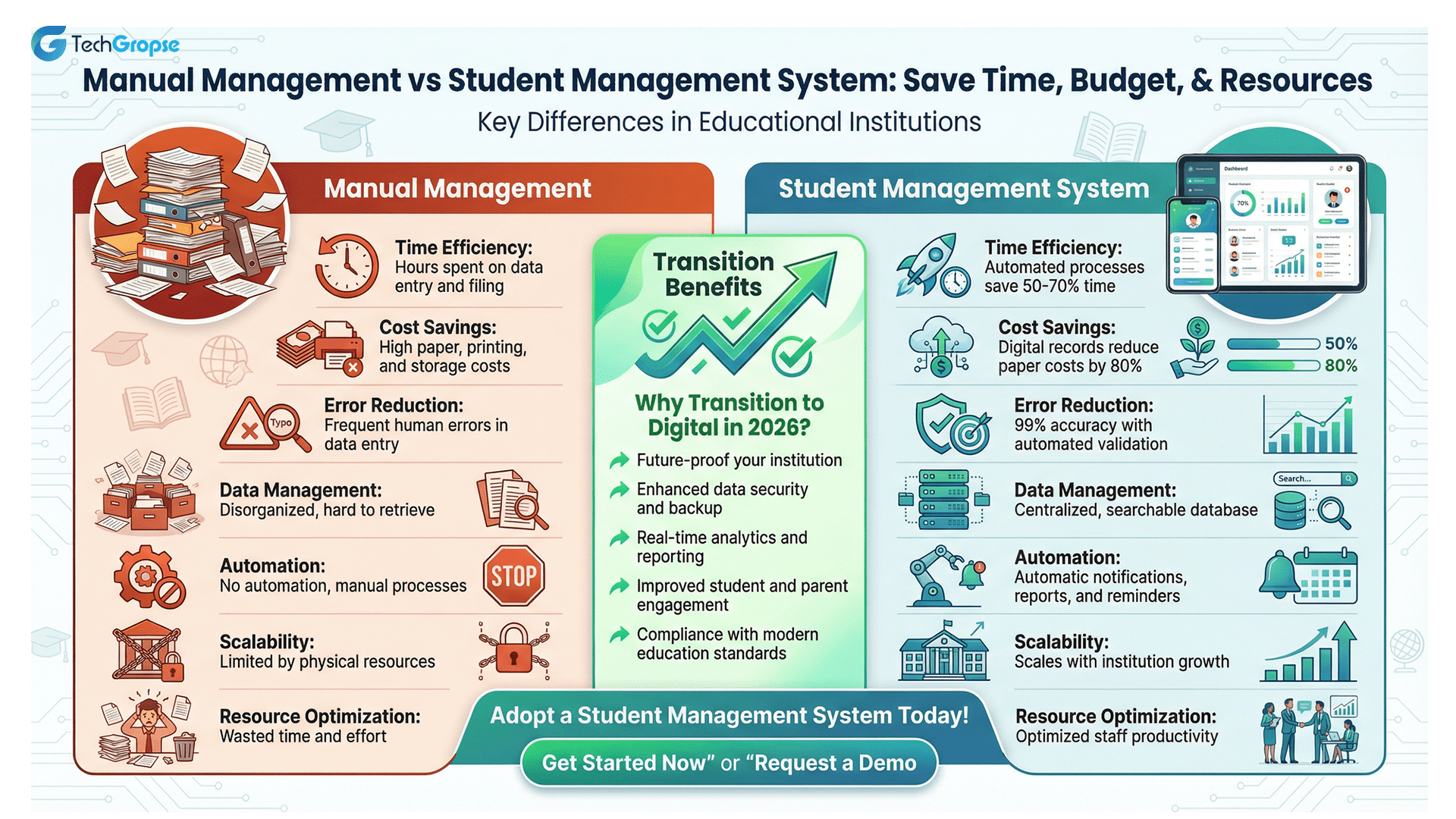
After knowing the cons of manual student management, let’s explore what difference a Student Management System puts on the table.
| Aspect | Manual Management | Student Management System |
|---|---|---|
| Data Handling | Paper-based or spreadsheets; prone to loss and duplication | Centralized digital database with real-time updates |
| Time Efficiency | Time-consuming processes like attendance, grading, and reporting | Automated workflows save 20–30% administrative time |
| Accuracy | High risk of human errors and miscalculations | High accuracy with automated validations and real-time updates |
| Accessibility | Limited access; requires physical presence | Cloud-based access anytime, anywhere |
| Cost Structure | Low upfront cost but high recurring operational expenses | Initial investment, but a predictable subscription or license cost |
| Operational Costs | High costs due to manpower, paperwork, and inefficiencies | 15–20% cost savings through automation and efficiency |
| Paper & Resource Cost | Heavy spending on printing and storage | Up to 10% savings by reducing paper usage |
| Staff Requirement | Requires larger administrative teams | Reduced dependency on manual staff through automation |
| Scalability | Difficult to scale with growing students | Easily scalable without a significant cost increase |
| Data Security | Risk of physical damage or loss | Secure with backups, encryption, and access control |
| Reporting & Analytics | Manual reports: slow and limited insights | Real-time analytics for faster decision-making |
| Communication | Manual notices, calls, and emails | Automated notifications, portals, and messaging |
| Compliance | Difficult to track and manage records | Automated compliance and audit-ready documentation |
| Productivity | Low productivity due to repetitive tasks | 20–30% efficiency improvement in operations |
| ROI (Return on Investment) | Minimal ROI; mostly cost-consuming system | ROI can exceed 150% annually with automation benefits |
| Payback Period | No clear payback; continuous expense | Typically 6–12 months payback period |
| Long-Term Value | Increasing cost over time | Long-term savings, better resource utilization, and growth scalability |
Competitive Benefits of the Student Management System in the UAE
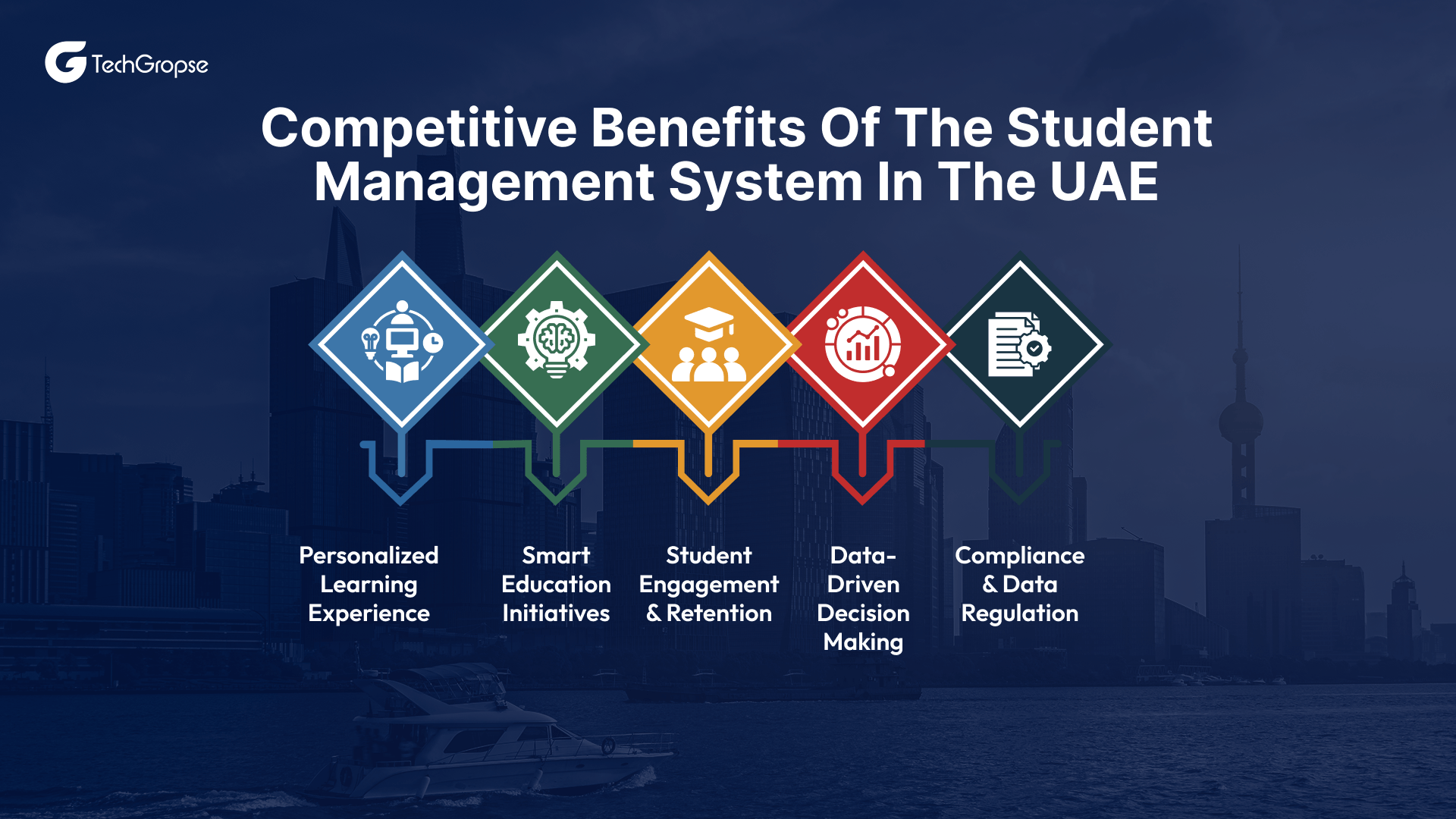
Now, let’s discover some competitive benefits of the Student Management System in 2026.
Personalized Learning Experience
A school management software in the UAE enables the educational institute to foster a hyperpersonalized learning experience. This elevates the academic reputation, student performance, and operational outcome in terms of overall progress.
- Tracks behaviour and performance
- Adaptive learning path with personalized content
- Continuous feedback and assessment
- Improves academic success and student satisfaction
Smart Education Initiatives
Encouraging the digital transformation pathway, the Student Management System of the UAE conducts smart education initiatives with AI automation, cloud-based learning portals, digital workflows, and a future-ready education ecosystem.
- Encourage the UAE’s smart education standpoint
- Cloud-based and remote learning infrastructure
- Tech-innovation in teaching and administration
- AI automation in academic operation management
Student Engagement & Retention
These systems improve communication and interaction through portals, notifications, and performance tracking, ensuring students stay informed, engaged, and motivated throughout their academic journey.
- Provides real-time updates on attendance and grades
- Enables seamless communication with students and parents
- Offers student portals for easy access to information
- Improves engagement through alerts and reminders
Data-Driven Decision Making
A Student Management System offers real-time predictive analysis to build comprehensive reports, showcase correct datasets, and sustain data-focused academic planning.
- Real-time reporting and dashboards
- Seamless communication and knowledge impart
- Alerts, notifications, and reminders to improve engagement
- Easy permission accessibility to learning portals
Compliance & Data Regulation
The Ministry of Education of the UAE is very strict about compliance management and adherence to the disciplinary regulations and guidelines. An integrated student management system allows you to manage operations, generate revenue, and adhere to the drafted compliance requirements.
- Seamless storage of audit-ready datasets
- Ensures compliance with the UAE education authorities
- Improves security measures and data privacy
- Mitigates penalties, fines, and non-compliant risks
Workflow Algorithm of a Student Management System
Input → Authentication → Processing → Operations → Decision → Output → Monitoring → Optimization
[START]
↓
- EDGE & ACCESS LAYER
├── CDN Routing (Optimizes content delivery based on user location)
├── Load Balancer (Distributes traffic across multiple servers)
├── API Gateway (Manages and routes incoming API requests)
├── Rate Limiting (Controls request frequency to prevent overload)
└── Traffic Filtering (Blocks malicious or unwanted traffic)
↓
- IDENTITY MANAGEMENT
├── Multi-Factor Authentication (Adds extra security verification steps)
├── Single Sign-On (Allows access across systems with one login)
├── Token Generation (Creates secure session tokens for users)
├── Role Resolution (Assigns user roles dynamically)
└── Access Validation (Verifies permissions before granting access)
↓
→ IF Authentication Failed → Access Denied → END
↓
- DATA INGESTION
├── User Inputs (Captures data entered by users)
├── API Data Streams (Collects data from external systems)
├── Batch Uploads (Processes bulk data files)
├── External Integrations (Connects third-party platforms)
└── Real-Time Pipelines (Handles live streaming data)
↓
- DATA PROCESSING
├── Data Cleansing (Removes errors and inconsistencies)
├── Normalization (Standardizes data formats)
├── Validation Rules (Ensures data accuracy and completeness)
├── Duplicate Removal (Eliminates repeated records)
└── Data Structuring (Organizes data for processing)
↓
- EVENT PROCESSING
├── Event Triggers (Initiates workflows based on actions)
├── Workflow Initiation (Starts predefined processes)
├── Task Queueing (Queues tasks for execution)
├── Priority Handling (Assigns priority levels to tasks)
└── Event Routing (Directs tasks to appropriate services)
↓
- MICROSERVICES ORCHESTRATION
├── Service Discovery (Identifies available services dynamically)
├── Container Management (Manages application containers)
├── Load Distribution (Balances workload across services)
├── Retry Mechanisms (Retries failed operations automatically)
└── Failure Handling (Manages system failures gracefully)
↓
- BUSINESS LOGIC EXECUTION
├── Financial Operations (Handles billing and transactions)
├── Resource Allocation (Distributes resources efficiently)
├── Task Management (Manages operational workflows)
├── Customer Management (Handles customer-related processes)
└── Transaction Processing (Executes business transactions)
↓
- AI AND ANALYTICS ENGINE
├── Predictive Analysis (Forecasts trends and outcomes)
├── Behavior Tracking (Analyzes user activities)
├── Recommendation Models (Suggests actions or content)
├── Risk Detection (Identifies potential risks or anomalies)
└── Pattern Recognition (Finds hidden patterns in data)
↓
- DECISION ENGINE
├── Rule Evaluation (Applies business logic conditions)
├── Confidence Scoring (Measures reliability of predictions)
├── Risk Assessment (Evaluates risk levels)
↓
├── IF Low Risk → Auto Execution (Automates decision without intervention)
├── IF Medium Risk → Approval Queue (Requires human validation)
└── IF High Risk → Escalation Flow (Triggers higher-level approvals)
↓
- INTEGRATION LAYER
├── API Management (Controls API interactions)
├── Payment Integration (Handles online transactions)
├── CRM/ERP Sync (Synchronizes enterprise systems)
├── Data Transformation (Converts data between formats)
└── Webhooks (Triggers real-time external updates)
↓
- COMMUNICATION ENGINE
├── Email Notifications (Sends automated emails)
├── SMS Alerts (Delivers text-based notifications)
├── Push Notifications (Notifies users via apps)
├── In-App Messaging (Enables internal communication)
└── Chatbot Interaction (Provides AI-based support)
↓
- OUTPUT LAYER
├── Dashboard Display (Visualizes key metrics)
├── Report Generation (Creates detailed reports)
├── Data Visualization (Represents data graphically)
├── Export Options (Allows data downloads)
└── Insights Delivery (Provides actionable insights)
↓
- MONITORING SYSTEM
├── Performance Tracking (Measures system efficiency)
├── Error Logging (Records system errors)
├── Usage Analytics (Tracks user behavior)
├── System Health Check (Monitors system status)
└── Alert Mechanisms (Sends alerts for issues)
↓
- SECURITY AND COMPLIANCE
├── Data Encryption (Protects sensitive data)
├── Audit Logs (Maintains activity records)
├── Access Monitoring (Tracks user access)
├── Compliance Checks (Ensures regulatory adherence)
└── Threat Detection (Identifies security threats)
↓
- OPTIMIZATION LOOP
├── Feedback Collection (Gathers user/system feedback)
├── Performance Tuning (Improves system speed)
├── Feature Updates (Adds new functionalities)
├── Resource Optimization (Optimizes resource usage)
└── Scaling Strategy (Plans system expansion)
↓
- SELF-LEARNING SYSTEM
├── Model Retraining (Updates AI models regularly)
├── Behavior Adaptation (Adjusts system behavior dynamically)
├── Pattern Learning (Learns from historical data)
├── Workflow Optimization (Improves process efficiency)
└── Continuous Improvement (Ensures ongoing enhancement)
↓
[END → CONTINUOUS LOOP]
How to Build a Student Management System in the UAE?
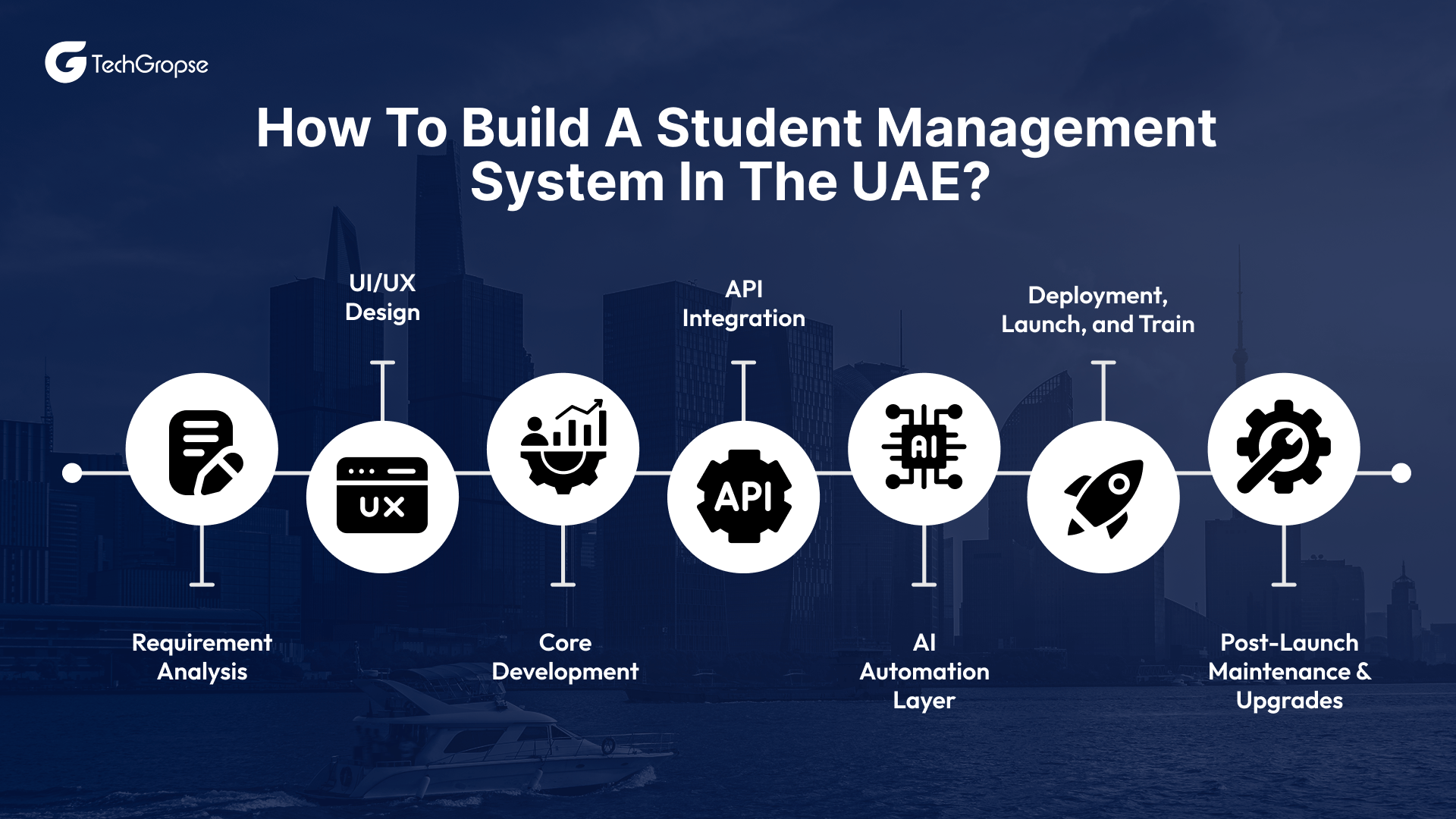
Let’s explore the 7 comprehensive steps of building a Student Management System in the UAE in 2026.
Requirement Analysis
- Business Objective: Goal Setting | ROI Focus | Strategy Alignment | Efficiency Improvement | Growth Planning
- Audience Analysis: User Identification | Needs Analysis | Behavior Study | Role Definition | UX Improvement
- Market Research: Competitor Analysis | Trend Analysis | Demand Evaluation | Pricing Strategy | Gap Identification
- Technical Requirements: Tech Stack | System Architecture | API Integration | Scalability Planning | Security Measures
- Compliance Needs: Regulation Check | Data Privacy | Audit Trails | Access Control | Legal Compliance
UI/UX Design
- Wireframes and Prototypes: Layout Sketching | Interactive Mockups | User Flow Mapping | Design Validation | Prototype Testing
- User-Centric Design: User Research | Persona Creation | Needs Mapping | Feedback Integration | Experience Focus
- Mobile Responsiveness: Responsive Layouts | Device Compatibility | Touch Optimization | Screen Adaptation | Performance Optimization
- Controlled Accessibility: Role-Based Access | Permission Control | Secure Login | Data Restrictions | User Authentication
- UX Optimization: Usability Testing | Performance Enhancement | Navigation Simplification | Interface Consistency | Engagement Improvement
Core Development
- Frontend Interface: UI Design | Responsive Layout | Interactive Elements | Cross-Browser Support | User Experience
- Backend Architecture: Server Logic | Database Design | API Development | System Integration | Data Processing
- Core Modules: Student Management | Course Management | Attendance Tracking | Fee Management | Reporting System
- Role-Based Accessibility: User Roles | Access Control | Permission Levels | Authentication System | Data Security
- Performance & Scalability: Load Handling | System Optimization | Cloud Scaling | Speed Enhancement | Resource Management
API Integration
- Payment Gateways: Online Payments | Transaction Processing | Payment Security | Multi-Currency Support | Billing Integration
- Third-Party Systems: External Integrations | ERP Connectivity | LMS Integration | CRM Sync | Data Exchange
- Storage Integration: Cloud Storage | Data Backup | File Management | Secure Storage | Scalability Support
- Communication API: SMS Integration | Email Services | Push Notifications | Real-Time Alerts | Messaging Systems
- API Security: Data Encryption | Secure Endpoints | Authentication Tokens | Access Control | Threat Protection
AI Automation Layer
- Personalized Learning: Adaptive Content | Learning Paths | User Preferences | Performance Tracking | Custom Feedback
- Predictive Analytics: Data Analysis | Trend Prediction | Performance Forecasting | Risk Detection | Decision Support
- Chatbot Development: AI Chatbot | Query Handling | Instant Support | NLP Integration | User Assistance
- Assessment Automation: Auto Grading | Test Creation | Result Processing | Feedback Generation | Exam Scheduling
- Smart Recommendation Engine: Content Suggestions | Course Recommendations | Behavior Analysis | AI Algorithms | Engagement Boost
Deployment, Launch, and Train
- Cloud Infrastructure: Cloud Hosting | Server Setup | Auto Scaling | Data Storage | Backup Systems
- Platform Testing: QA Testing | Bug Fixing | Performance Testing | Security Testing | User Acceptance
- Final Launch: Deployment Process | Go-Live Strategy | System Monitoring | Issue Resolution | Performance Check
- Staff Training: User Training | System Guidance | Role-Based Training | Hands-On Sessions | Support Materials
- Onboarding Material: User Manuals | Video Tutorials | Help Guides | FAQs Section | Documentation Support
Post-Launch Maintenance & Upgrades
- Monitor System Performance: Performance Tracking | System Monitoring | Usage Analytics | Load Analysis | Uptime Management
- Fix Bugs & Issues: Bug Tracking | Issue Resolution | Error Fixing | Debugging Process | System Stability
- Update Features Regularly: Feature Updates | Version Upgrades | UI Improvements | Function Enhancements | User Feedback
- Maintain Security Compliance: Security Audits | Data Protection | Compliance Checks | Risk Management | Access Control
- Scale & Upgrade Technology: System Scaling | Tech Upgrades | Cloud Expansion | Performance Boost | Infrastructure Growth
Essential Features of a Student Management System
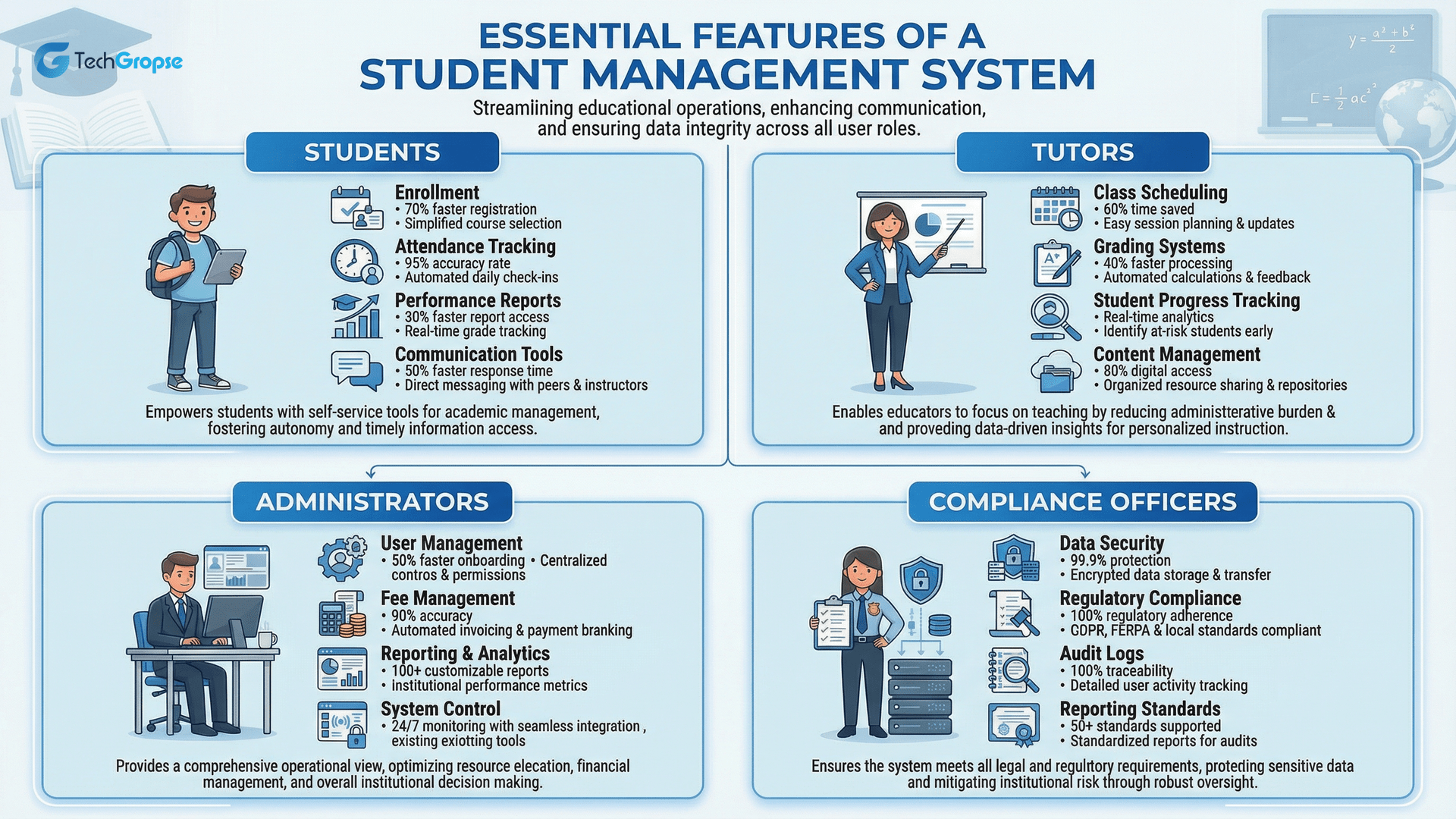
Well, knowing the competitive benefits and development methodologies is not sufficient. We need to discover the essential features of a Student Management System at all levels, i.e., Students, Tutors, Parents, and Compliance Officers. So, let’s find out the best student management system features for the UAE schools.
For Students
- Personalized Learning Dashboard: Display tailored notifications, progress reports, schedules, and recommendations.
- Course & Content Access: Get seamless access to study materials, lectures, and educational resources.
- Assignment & Exam Management: View schedules, track deadlines, and manage assignments.
- Progress Tracking & Analytics: Monitor performance through analytics and reports.
- Notifications & Reminders: Manage announcements, classes, reminders, and deadlines.
For Tutors
- Course Creation & Management: Create, manage, update, upgrade, and restructure the courses.
- Attendance & Scheduling Tools: Manage sessions & classroom schedules and track attendance digitally.
- Assignment & Assessment Tools: Create assessments, tests, and student performance reports.
- Student Performance Insights: Identify the insights on individual strengths and weaknesses to elevate the student performance.
- Communication & Collaboration: Interact and engage with students via different mediums and messaging tools.
For Administrators
- User & Role Management: Manage staff, stakeholders, and students at different levels.
- System Dashboard & Reporting: Get detailed reporting and real-time dashboards.
- Fee & Payment Management: Manage financial parts like invoices, payment tracking, and fee collection.
- Integration Management: Connect with LMS, ERP, and third-party tools.
- Security & Data Management: High-end security and institutional database management.
For Parents
- Student Progress Monitoring: Monitor performance on a weekly, monthly, and annual basis.
- Attendance Tracking: Track daily attendance with monthly present and absent percentages.
- Communication with Tutors: Stay in touch with teachers and lecturers for any concerns and updates.
- Fee Payment & Billing: Easy access to fee details and online payment options
- Notifications & Alerts: Receive notifications and messages on upcoming sessions and activities.
For Compliance Officers
- Data Privacy & Security Monitoring: Protect the sensitive data of the students and institutions.
- Audit Trails & Reporting: Maintain database and logs for holistic trial and audit-readiness.
- Regulatory Compliance Management: Adhere to the law guidelines of the Ministry of Education in the UAE.
- Risk Assessment Tools: Identify risk activities and malicious attacks for the prevention of non-compliant actions.
- Access Control & Permissions: Manage role-based access to critical system data.
Know the Cost to Build a Student Management System in the UAE
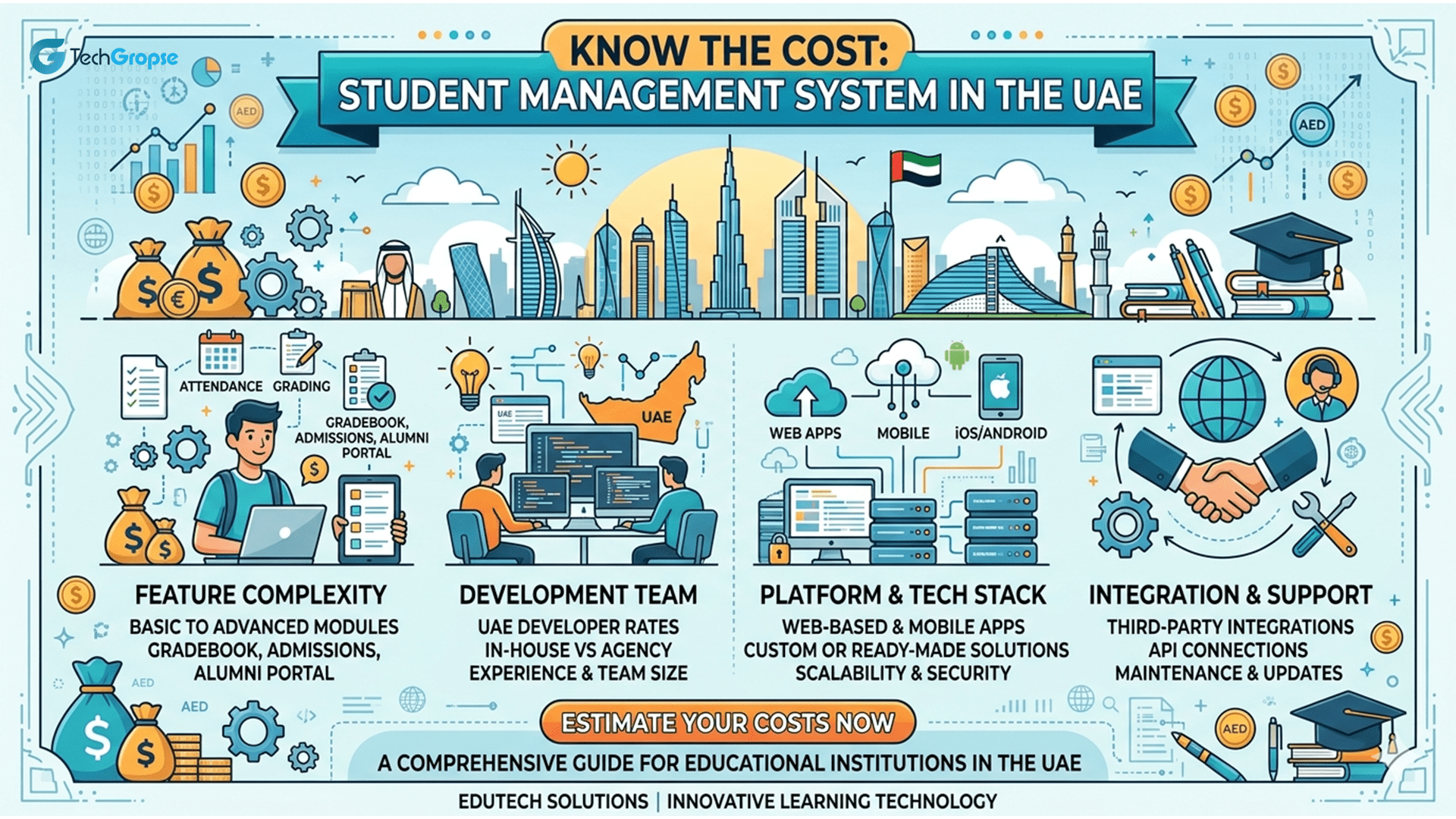
Every educational unit learning institution wants to get clarity on the price before investing in the Student Management System. Understandably, the price range would be subjective. It all depends on the application complexity, feature integration, and infrastructure maturity.
To measure the cost of building a Student Management System in the UAE, we have bifurcated the application into 4 categories: Basic, Advanced, Complex, and Enterprise-Grade.
| Category | Description | Key Features Included | Estimated Cost (USD) | Timeline |
|---|---|---|---|---|
| Basic Application | Ideal for small institutes or MVP launch | Student registration, course management, basic dashboard, notifications, simple reports | $40,000 – $60,000 | 3 – 6 Months |
| Advanced Application | Suitable for mid-sized schools & coaching centers | Role-based access, attendance tracking, fee management, API integrations, analytics dashboard | $60,000 – $120,000 | 6 – 9 Months |
| Complex Application | Best for universities or multi-campus institutions | AI features, real-time tracking, mobile apps, advanced analytics, integrations (ERP/CRM), automation | $120,000 – $300,000+ | 9 – 12 Months |
| Enterprise-Grade Application | Large-scale institutions or government-level systems | AI automation, cloud-native architecture, high security, multi-tenant system, big data analytics, compliance layers | $300,000 – $500,000+ | 12 – 24 Months |
Also, know the factors impacting the Student management system development cost:
- Feature Complexity & Scope: Complex features come up with high scalability requirements, multi-control accessibility, and tailored workflow that significantly elevates the consumption of budget and resources.
- Technology Stack & Platform Choice: The choice of programming languages, cloud platforms, and frameworks also determines the overall cost of the Student Management System in the UAE.
- UI/UX Design Complexity: Building seamless responsive layouts, interactive designs, accessibility features, and intuitive navigation may heavily impact the student management system budget.
- AI & Automation Integration: The automation vertical often encapsulates advanced AI features, AI chatbots, and hyperpersonalized layouts that require multiple resource units colossal budget.
- Integration & Third-Party Dependencies: Integrating APIs, payment gateways, ERP, CRM, and legacy systems adds complexity, development time, and ongoing maintenance costs.
- Development Team & Location: Hiring offshore skilled developers, managing a large development team, and adding local resources would significantly increase the budget of the Student Management System in the UAE.
- Maintenance, Security & Compliance: This is an inevitable expense where a decent slice of your budget goes to security measures, bug fixing, speed optimization, and data protection sustainability.
How to optimize the cost management?
Well, every institution may not have the potential to get an expensive Student Management System. So, you also need to have a proper strategy in your bucket to optimize the student management system development cost. Let’s explore.
Build MVP (Minimum Viable Product)
- Core Features First: Integrate only essential features like dashboards, reporting, and core management.
- Avoid Overload: Don’t integrate features that are not targeting primary users.
- Get Early Validation: keep contextual awareness before investing in any function or features.
- Reduce Time-to-Market: Less time invested in development costs means less finance invented in application development.
- Scale Gradually: Progress with adding the features in the chronology of importance.
Choose Right Tech-Stack
- Open-Source Technologies: React, Node.js, and Python to reduce licensing and development costs.
- Choose Scalable Architecture: Opt for the infrastructure that can expand when the business grows.
- Dilute Hyper-Engineering: Select and implement a technological approach within certain limitations.
- Use Cross-Platform Development: Native solutions are expensive. Go for Cross-Platform development instead.
- Plan for Long-Term Maintenance: Adopt technologies, frameworks, and infrastructure that are easy to maintain in the long run.
Hybrid Development Teams
- Adopt Offshore Development: Outsource your student management system project to an IT-growth country like India.
- Choose the Hybrid Team Model: Hire both local and offshore experts to streamline the final development cost.
- Hire Experienced Developers: Keep the number of developers low and their experience high. The budget will be significantly reduced.
- Right Engagement Model: Fixed price, hourly rate, dedicated team, choose the one that eases the development budget.
- Optimize Team Size: As discussed, we have to keep the good developers, but fewer developers.
Reuse Existing Solutions & APIs
- Use Pre-Built Modules: Use ready-made components for dashboards, authentication, and reporting.
- Integrate Third-Party APIs: Payment gateways, analytics, and social sharing integration can streamline the cost.
- No Reinnovation: If it ain’t broke, don’t fix it. Thus, no further innovation is required if the users are satisfied with the existing MVP solution.
- Utilize SaaS Tools: Streamline hosting, storage, and analytics with SaaS products.
- Ensure Easy Integration: Choose tools that integrate seamlessly to reduce complexity and maintenance efforts.
Plan AI Integration Strategically
- Start with Basic Automation: Keep simple AI features at the initial MVP level.
- Use Pre-Trained Models: Leverage the existing AI-trained model for your student management system.
- Scale AI Gradually: Make a gradual add-on. Don’t directly jump into the advanced features.
- Optimize Data Usage: Use relevant and clean data to reduce training time and cost.
- Monitor AI Performance: Perform regular monitoring to analyse the return that your AI solution is cultivating for the business.

Best Monetization Model of Your Student Management System in 2026
Developing an application is completely futile if you are not able to monetize it. Any Student Management System in the UAE holds the same notion. So, today we will explore the best 5 monetization strategies for a Student Management System.
Subscription-Based Model (SaaS)
A subscription-based model makes your school ERP software in Abu Dhabi a high-demand SaaS product in the market. Here, the customers will make recurring payments on a monthly, quarterly, half-yearly, or annual basis to continue with the services.
- Monthly, quarterly, annual billing
- Feature-based accessibility
- Recurring payments
- Per student pricing
Freemium Model
This model offers the basic features without any charges. Meanwhile, the students will have to pay for the premium functions. The Freemium model converts existing free users into high-paying customers by showcasing the valuable features like analytical dashboards, AI recommendations, and other improved capabilities.
- Free basic features
- Paid premium features
- Limited usage access
- Best conversion strategy
White-Label Solutions
White-labeling allows businesses to sell their student management system to other institutions or partners who rebrand it as their own. This strategy opens B2B revenue streams, supports bulk licensing deals, and enables expansion into new markets without direct customer acquisition efforts.
- Licensing Revenue
- Reseller Partnerships
- Bulk Deployments
- B2B Expansion
Transaction-Based Revenue
These are the fundamental financial transactions where all users pay to use the service. Here, you can integrate multiple payment gateways to enable service utility and commission fees to generate revenue from daily platform usage.
- Payment Gateway Fees
- Commission Charges
- Billing Transactions
- Usage-Based Earnings
Implementation & Customization Services
There are many Student Management Systems that charge while onboarding. Many educational institutions look for tailored and customized opportunities to seamlessly functionalize certain features and functions. Now, this is another mode of revenue for a company developing a Student Management System.
- Customization charges
- Setup charges
- Data migration fee
- Training programme services
Top 10 Student Management System Development Companies in the UAE
Now, let’s explore the top 10 companies that can help you develop the best student management system for all-level education institutes in the UAE.
1. TechGropse
Location
- Dubai, United Arab Emirates
Founded In
- 2015
Number of Employees
- 50 – 249
Hourly rate
- $25 – $49 / hr
Industries
- eCommerce
- Information technology
- Business services
- Education
- Financial services
- Government
- Medical
- Automotive
- Manufacturing
- Real estate
Services
2. Blink22
Location
- Dubai, UAE
Founded In
- 2015
Number of Employees
- 50 – 249
Hourly rate
- $50 – $99 / hr
Industries
- Financial services
- Supply Chain, Logistics, and Transport
- eCommerce
- Education
- Retail
Services
- Mobile App Development
- AI Development
- Generative AI
- Web Development
- Low/No Code Development
- UX/UI Design
3. Lumitech
Location
- Dubai, UAE
Founded In
- 2022
Number of Employees
- 50 – 249
Hourly rate
- $25 – $49 / hr
Industries
- Supply Chain, Logistics, and Transport
- Information technology
- Medical
- Education
- Food & Beverage
- Manufacturing
- Real estate
Services
- Custom Software Development
- Web Development
- Mobile App Development
- AI Development
- IT Strategy Consulting
- UX/UI Design
4. Shakuro
Location
- Dubai, United Arab Emirates
Founded In
- 2006
Number of Employees
- 50 – 249
Hourly rate
- $25 – $49 / hr
Industries
- Education
- Business services
- Medical
- eCommerce
- Financial services
Services
- Web Development
- Custom Software Development
- Low/No Code Development
- Mobile App Development
- UX/UI Design
- Web Design
5. Ewaantech
Location
- Dubai, United Arab Emirates
Founded In
- 2018
Number of Employees
- 10 – 49
Hourly rate
- $25 – $49 / hr
Industries
- Information technology
- Hospitality & leisure
- Medical
- Supply Chain, Logistics, and Transport
- eCommerce
Services
- Mobile App Development
- Custom Software Development
- Web Development
- AI Development
- API Development
- Application Testing
- E-Commerce Development
- UX/UI Design
6. Eurisko
Location
- United Arab Emirates
Founded In
- 2009
Number of Employees
- 50 – 249
Hourly rate
- $50 – $99 / hr
Industries
- Financial services
- Business services
- Consumer products & services
- Gaming
- Information technology
- Media
- Retail
- Arts, entertainment & music
- Education
- Government
- Medical
- Other industries
Services
- AR/VR Development
- Generative AI
- Custom Software Development
- Low/No Code Development
- Mobile App Development
- UX/UI Design
- Web Development
7. Euvic
Location
- Floor, United Arab Emirates
Founded In
- 2005
Number of Employees
- 1,000 – 9,999
Hourly rate
- $50 – $99 / hr
Industries
- Supply Chain, Logistics, and Transport
- Media
- eCommerce
- Government
- Information technology
Services
- Custom Software Development
- IT Managed Services
- IT Strategy Consulting
- Mobile App Development
8. Ambient Infotech
Location
- United Arab Emirates
Founded In
- 2015
Number of Employees
- 50 – 249
Hourly rate
- < $25 / hr
Industries
- eCommerce
- Information technology
Services
- E-Commerce Development
- API Development
- Web Development
- Custom Software Development
- Microservices Architecture Services
- Mobile App Development
9. Apliko Technologies
Location
- New Delhi, India (Presence in Dubai)
Founded In
- 2023
Number of Employees
- 10 – 49
Hourly rate
- $25 – $49 / hr
Industries
- Education
- eCommerce
- Financial services
- Contracting
- Food & Beverage
- Consumer products & services
- Utilities
Services
- Mobile App Development
- Web Development
- AI Development
10. NXT Labs
Location
- Dubai, United Arab Emirates
Founded In
- 2015
Number of Employees
- 50 – 249
Hourly rate
- < $25 / hr
Industries
- Business services
- Contracting
- Financial services
- Gaming
- Government
- Information technology
- Real estate
- Supply Chain, Logistics, and Transport
- Telecommunications
- eCommerce
Services
- AI Agents
- AI Development
- BI & Big Data Consulting & SI
- Custom Software Development
- Generative AI
- IT Staff Augmentation
- Mobile App Development

How Are We Different From Other Developers Offering a Student Management System in the UAE?
With 10+ years of experience and 1000+ projects delivered, TechGropse is a preferred software identity in the UAE.
We are ready to offer you affordable school management software in Dubai that would work as a:
- KHDA-compliant school management software
- UAE Ministry of Education school system
- ADEK-approved school software Abu Dhabi
- Arabic-English bilingual school ERP UAE
- UAE data protection school software
Our 150+ software professionals have worked across 25+ locations for 500+ industry leaders, earning 100+ awards in the mobile app development services, with 92% retention rate. You must see what we offer differently as a Student Management System developer in the UAE.
| Criteria | TechGropse | Other IT Companies |
|---|---|---|
| Development Approach | Agile, flexible, and client-centric with faster iterations | Mostly structured, enterprise-driven, and slower processes |
| Cost Efficiency | Cost-effective with hybrid/offshore models | Higher development costs due to local pricing |
| Target Clients | Startups, SMEs, and enterprises | Primarily, large enterprises and government projects |
| Customization Level | Highly customized solutions tailored to business needs | Standardized enterprise solutions with limited flexibility |
| Technology Adoption | Early adoption of AI, automation, and emerging tech | Focus on proven enterprise technologies |
| Time to Market | Faster delivery with MVP-first approach | Longer timelines due to complex workflows |
| Communication & Transparency | Direct communication, regular updates, agile sprints | Formal communication with multiple layers |
| Scalability Approach | Build small → scale fast → optimize continuously | Build large systems upfront |
| Pricing Model | Flexible (hourly, dedicated team, fixed cost) | Mostly fixed enterprise pricing |
| Innovation Focus | Product-driven innovation and experimentation | Process-driven and compliance-heavy innovation |
| Support & Maintenance | Continuous support with proactive improvements | Reactive support with higher maintenance costs |
| Client Involvement | High involvement with collaborative decision-making | Limited involvement after the requirement phase |
So, it’s high time to buy a school management system in the UAE from TechGropse.
https://www.apsense.com/user/techgropsetg
FAQs (Frequently Asked Questions)
A Student management system is a digital platform that helps manage learning, student data, courses, and academic processes efficiently.
The cost typically ranges from $40,000 to $500,000+, depending on features, complexity, and AI integration.
Development usually takes 3 to 12 months, depending on the app’s complexity and required functionalities.
Key features include dashboards, course management, attendance tracking, analytics, communication tools, and role-based access.
Yes, AI can enable personalized learning, predictive analytics, automated grading, and AI chatbots for a better user experience.
Yes, even small institutions can start with a basic system and scale features as their needs grow.
Common technologies include Python, JavaScript frameworks, cloud platforms, and AI/ML tools like TensorFlow.
Modern systems include encryption, secure authentication, and compliance with data protection laws to ensure high security.
Yes, it can integrate with ERP, CRM, payment gateways, and other third-party tools via APIs.
Maintenance typically costs 15–20% of the initial development cost annually, covering updates, security, and performance improvements.

Hello All, Aman Mishra has years of experience in the IT industry. His passion for helping people in all aspects of mobile app development. Therefore, He write several blogs that help the readers to get the appropriate information about mobile app development trends, technology, and many other aspects.In addition to providing mobile app development services in USA, he also provides maintenance & support services for businesses of all sizes. He tried to solve all their readers' queries and ensure that the given information would be helpful for them.


 info@techgropse.com