



























































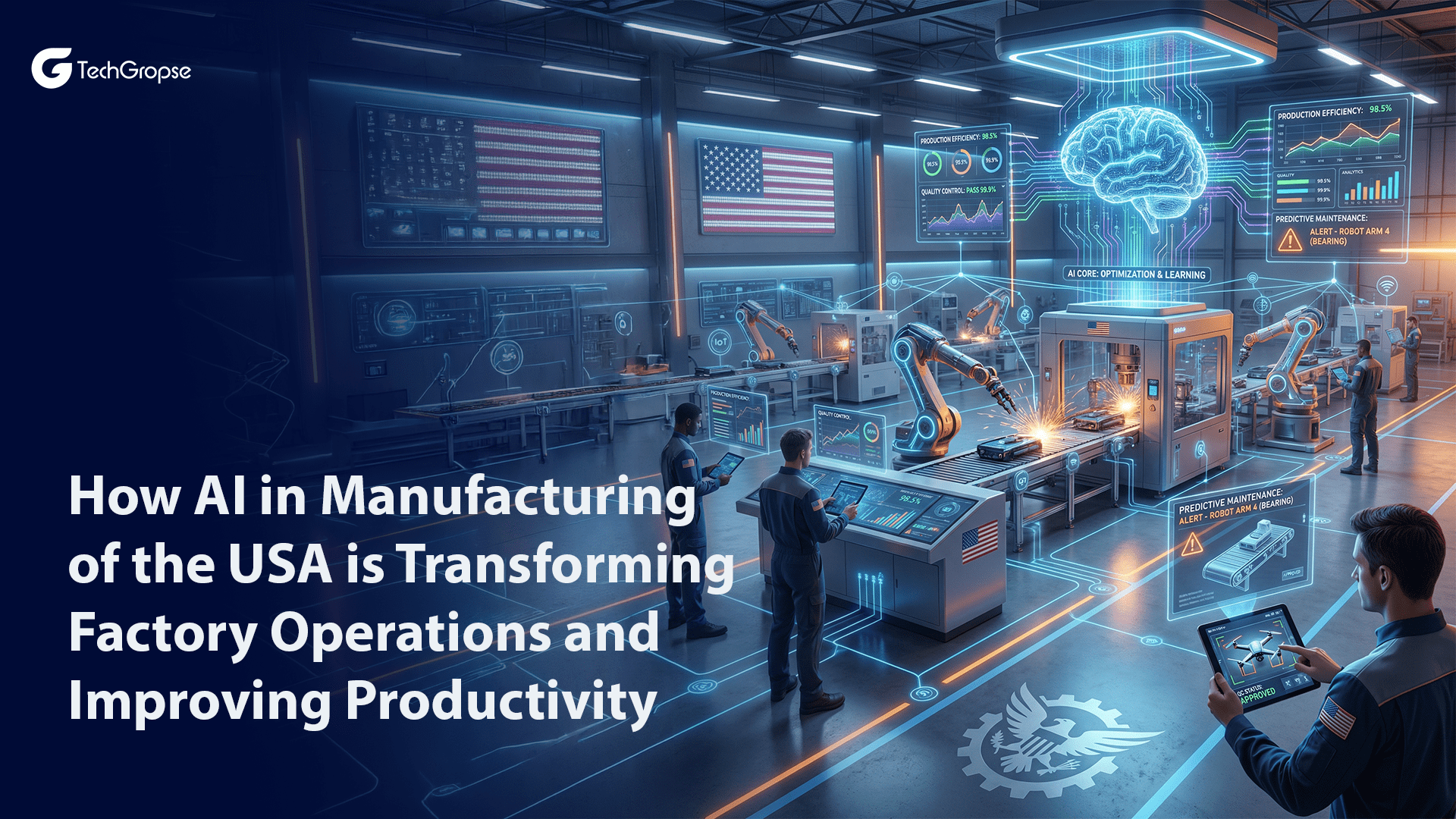
Today, Artificial Intelligence is the baseline for any business. Industries like e-commerce, FMCG, logistics, gaming, digital media, and the public sector are adopting AI for their seamless and predictive operations. Manufacturing is one such vertical that adheres to the same notion. Thus, AI manufacturing application development is something that the global tech investors are frenetically chasing after.Â
But to go through such a voracious transformation is not an easy task. You have to first understand the fundamentals and then the dynamics of such tech adoption. Consequently, we have curated this blog for you. So, if you are a tech enthusiast and willing to know the pole-to-pole approach of developing an AI manufacturing application, let’s explore the topic with the best of possibilities.Â
Key Takeaways:
- Market Size of Artificial Intelligence in the USA
- Why Do Businesses Need AI in Manufacturing in the USA?Â
- Competitive Advantages of AI in Manufacturing in the USA
- Future Trends of AI in Manufacturing in the USA
- Top 5 Manufacturing Industries that Require Artificial Intelligence in 2026
- Cost of AI Implementation in Manufacturing Businesses of USA
- Top 10 Manufacturing App Development Companies in the USA
- Hire the Right Software Company for AI in Manufacturing of the USA: 10 Questions to Make the Right Choice!
- FAQs (Frequently Asked Questions)
Market Size of Artificial Intelligence in the USA
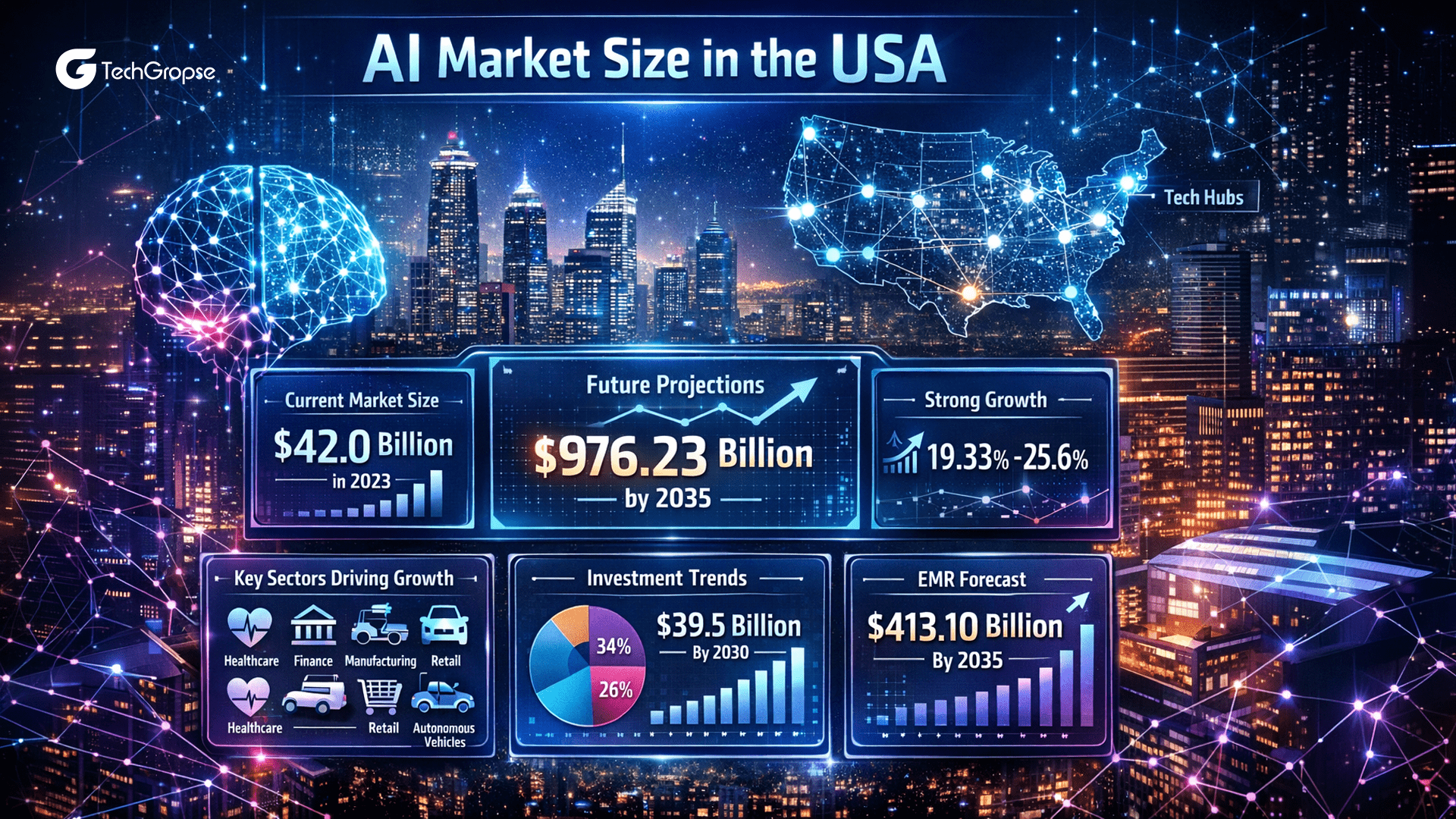
Know how AI is transforming manufacturing in the USA.Â
According to Precedence Research, the U.S. AI market was valued at $173.56 billion in 2025 and is projected to reach $976.23 billion by 2035, growing at a CAGR of 19.33%.
A Grand View Research report says that the market stood at $42.0 billion in 2023 and is expected to reach $219.09 billion by 2030, growing at a CAGR of 25.6%.
An EMR report claims that the U.S. AI market reached approximately $42.62 billion in 2025 and is forecasted to grow to $413.10 billion by 2035.
A Demandsage research report says that the U.S. AI market is estimated at around $73.98 billion in 2025, with a projected CAGR of 26.95% through 2031.
As per Strategic Market Research, AI in the manufacturing market was valued at $5.5 billion in 2024 and is projected to reach $39.5 billion by 2030, growing at a CAGR of 34.7%.
Why Do Businesses Need AI in Manufacturing in the USA?Â
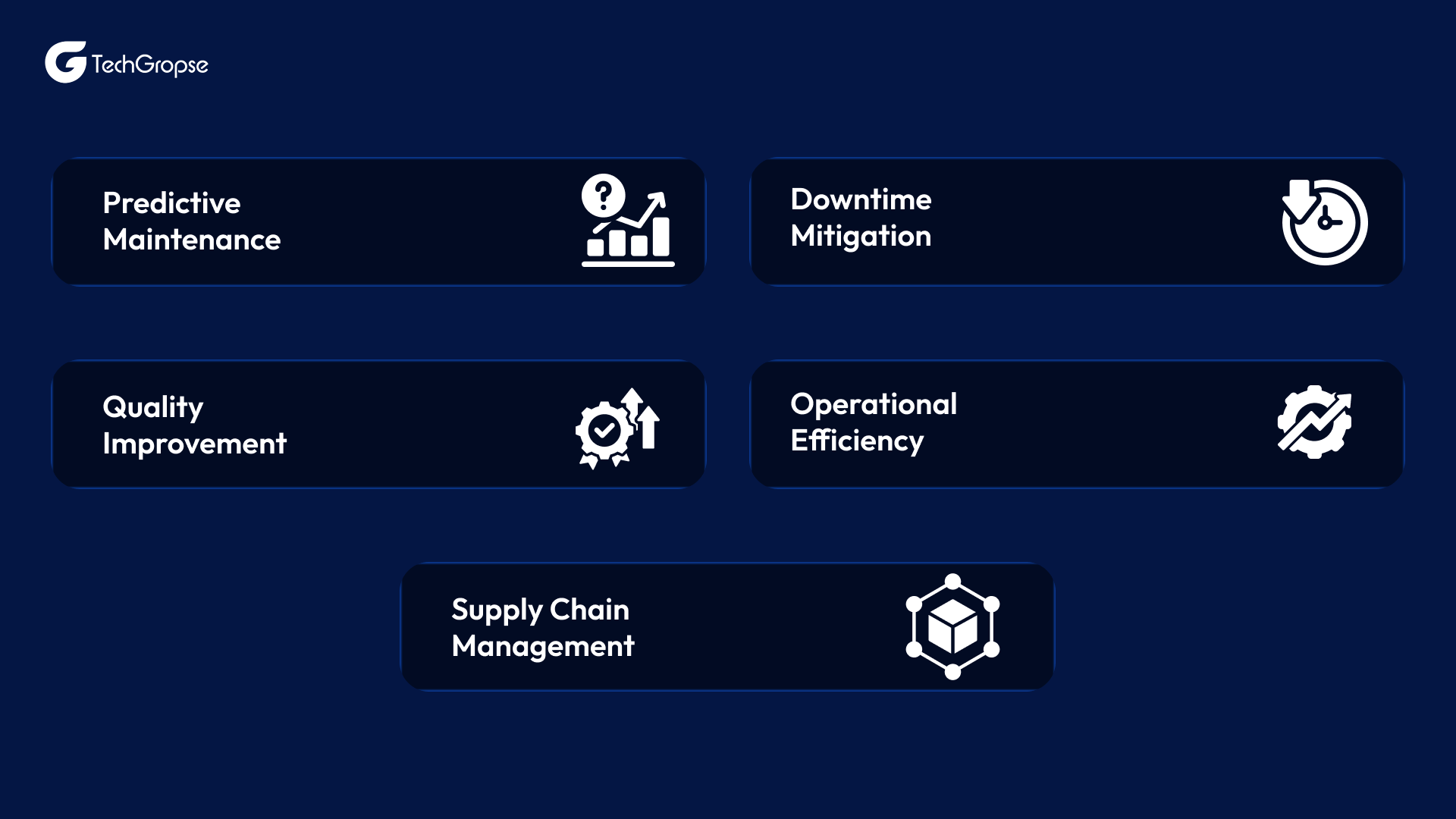
There are many industry verticals that need Artificial Intelligence today. In this blog, we are going to explore why manufacturing businesses and production hubs require Artificial intelligence in 2026.Â
Predictive Maintenance
Artificial intelligence not only automates the entire production process but also offers predictive maintenance beneficial for the entire operation. This mitigates the unexpected breakdown, repairing costs, and extends the machinery’s life span, leading to continuous production in business.Â
Downtime Mitigation
Since AI has the capabilities to predict system failure at a very early stage, the occurrence of unplanned downtime is significantly reduced. This improves production and business continuity of your manufacturing brand across all industry verticals.Â
Quality Improvement
AI-powered inspection systems use computer vision and data analysis to detect defects instantly. This ensures consistent product quality, reduces human error, minimizes waste, and enhances overall customer satisfaction and brand reputation.
Operational Efficiency
With seamless optimization of the operational process, you can improve workflow management at a large scale. With Artificial Intelligence, better resource allocation, cost reduction, and faster output are just at your fingertips.Â
Supply Chain Management
And finally, Artificial intelligence elevates the logistics and supply chain optimization, fosters automated inventory management, and capitalizes on shortage and overstocking prediction. This will further ensure cost-effective and continuous distribution of market products.Â
Competitive Benefits of AI in Manufacturing in the USA
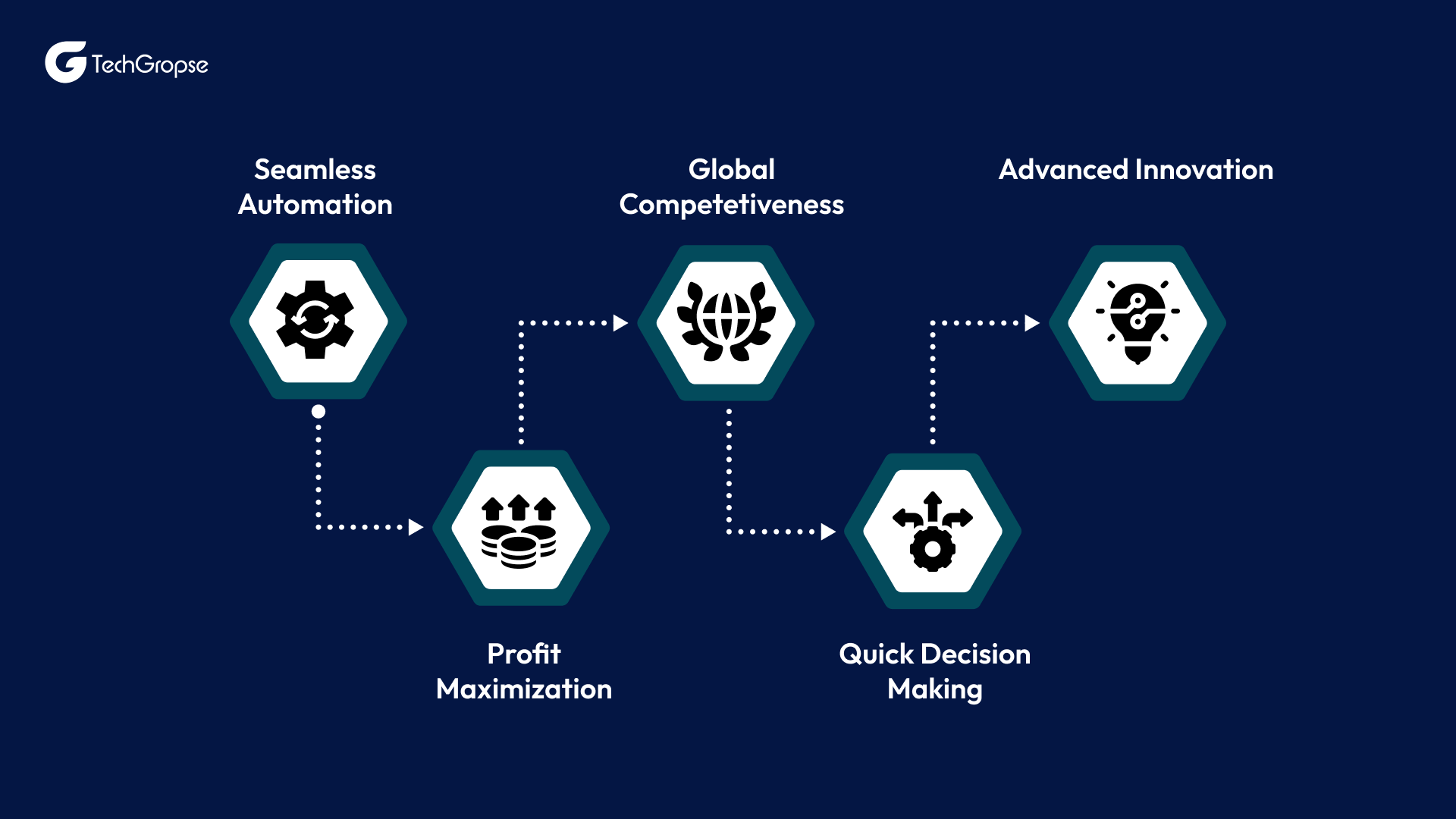
Before you adopt an AI application for your manufacturing business, there is a significant requirement to evaluate the competitive benefits. Let’s explore them.Â
Seamless Automation
AI automation is the trending approach to operating today’s manufacturing units. Artificial Intelligence reduces human errors and significantly improves the delivery speed. Smart machines driven by an AI algorithm ensure the right resource allocation, uninterrupted delivery, and a reduction in operational cost.Â
Global Competitiveness
Human manufacturing can restrict itself to a regional scale. Meanwhile, AI in the manufacturing of the USA offers global competitiveness. With predictive maintenance, advanced AI analytics, and optimization of supply chain management, businesses can cater to the international demand as well.Â
Advanced Innovation
Innovation with human or manual effort will witness colossal limitations. However, AI manufacturing solutions in the USA would go through rapid prototyping and smart production management with cutting-edge technologies and automated tools. This will help them stay ahead in the competition across the ever-evolving digital landscape.Â
Profit Maximization
Going beyond the lethargic human effort, AI factory automation in the United States effortlessly fosters much better performance. Consequently, you will see an elevation in profit scale. Optimized inventory management, demand forecasting, and cultivation of productive pricing strategies would help you reduce the operational cost and yield higher returns from digital investments.Â
Quick Decision Making
AI enables real-time data analysis, allowing manufacturers to make faster and more accurate decisions. By leveraging predictive insights and machine learning models, businesses can quickly adapt to market changes, optimize operations, and reduce risks, ensuring improved responsiveness and strategic agility.
Future Trends of AI in Manufacturing in the USA
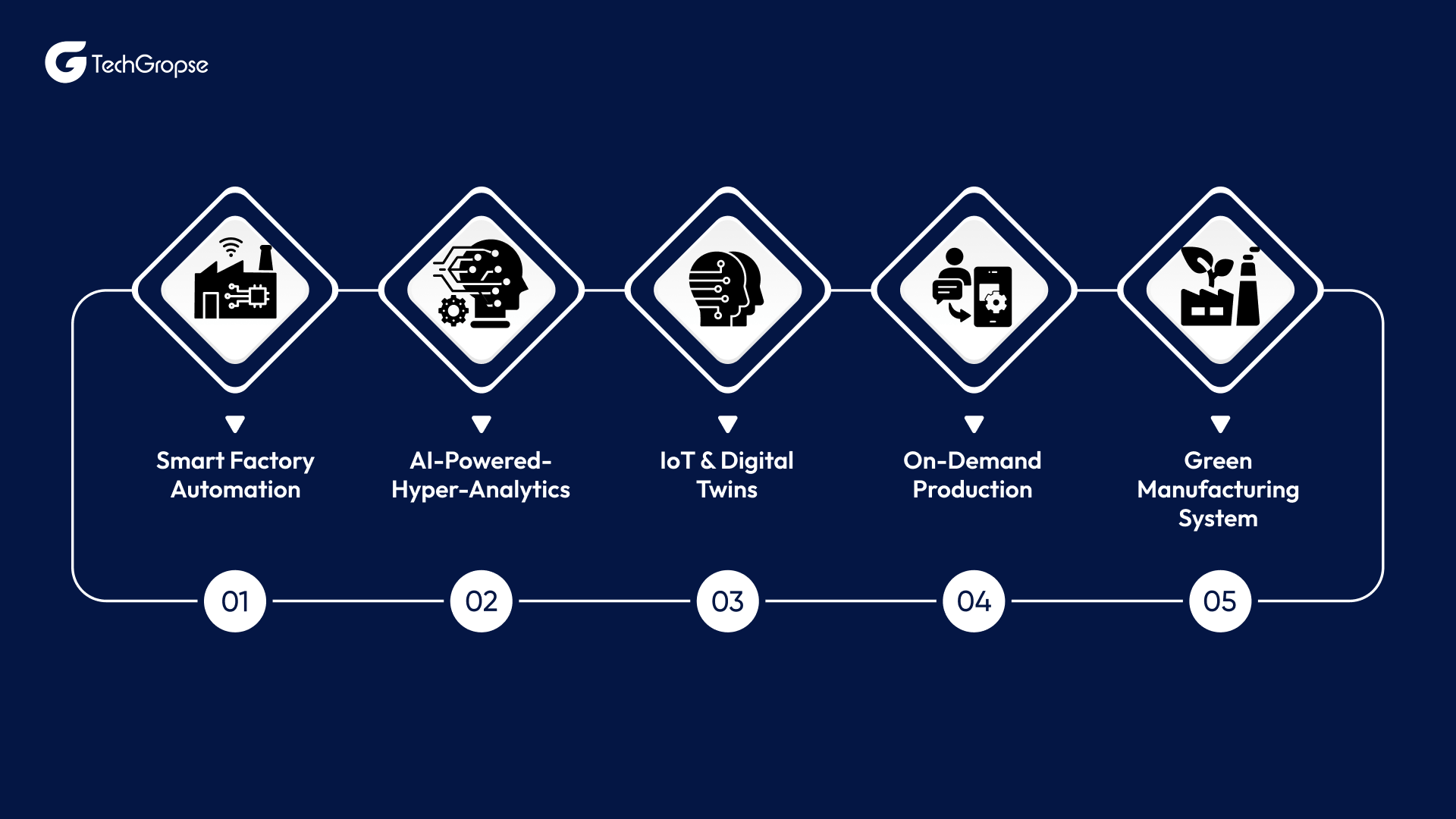
AI won’t stop with simple personalization and smart recommendations. There is limitless potential in artificial intelligence that is still left to be unraveled. So, in this blog, we will explore future trends that will simplify and elevate manufacturing businesses.Â
Smart Factory Automation
With AI-powered manufacturing platforms in the USA, you leverage an automated robotics matrix, a self-optimized production ecosystem, and concrete AI-driven production optimization in the USA. This will not only reduce human intervention but also bring real-time monitoring, a quick production cycle, and reduced operational downtime. Thus, AI in smart factory operations in the USA brings great ease.Â
- Automated production lines
- Real-time system monitoring
- Zero human dependencies
- High predictive maintenance
- Better production speed
AI-Powered Hyper-Analytics
You can hire AI developers for manufacturing to adopt AI-powered hyper-analytics. AI app development for manufacturing uses machine learning algorithms and big data insights to identify loopholes, forecast upcoming demand, improve business productivity, and offer strategic and real-time decision-making.Â
- Advanced data-driven insights
- High-end demand forecasting
- Initiate process optimization
- Real-time performance tracking
- Identification of risky malicious attacks
Digital Twins & IoT
Digital twins and IoT create virtual replicas of physical assets, enabling manufacturers to simulate, monitor, and optimize operations. AI-driven insights from connected devices improve maintenance, enhance system performance, and reduce downtime, while enabling smarter and more efficient production processes.
- Real-time asset monitoring
- Virtual simulation models
- Improved predictive maintenance
- Enhanced operational visibility
- Reduced downtime risks
On-Demand Production
Custom AI manufacturing software in the USA fosters on-demand production with repository data and customer demand. It mitigates the possibility of overproduction, high inventory cost, glitches in manufacturing, and loopholes in the production lines. With on-demand production, you quickly adapt to the transforming marketplace with a tailored approach and budget-friendly resource allocation.
- Demand-driven production
- Seamless inventory management
- Faster production cycle
- Agile operational system
- Improved supply chain flexibility
Green Manufacturing System
Green manufacturing may not be a recent trend, but it will have a huge environmental impact on the future. AI integration services in the manufacturing of the USA strive to focus on low-energy utility, reduced wastage, and low-profile emissions. These efficient, cost-reduction, and eco-friendly production will facilitate a massive long-term business growth.Â
- Energy consumption optimization
- Waste management strategies
- Mitigates carbon emission
- Sustainable resource allocation
- Adherence to environmental standards
Top 5 Manufacturing Industries that Require Artificial Intelligence in 2026
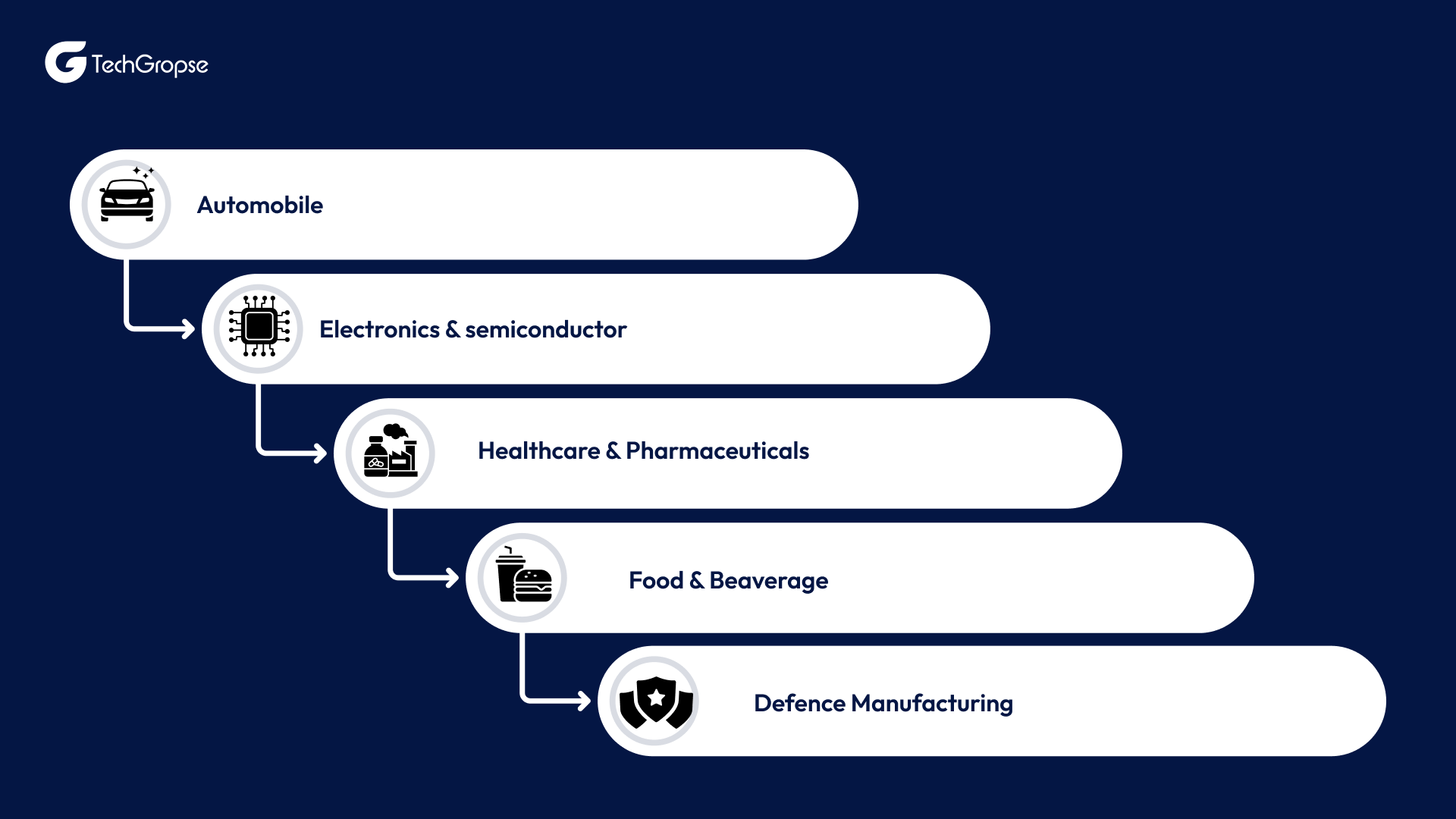
Now, let’s explore the top 5 industries that are seamlessly using Artificial Intelligence to streamline manufacturing and production processes.Â
Automobile
To streamline complex production and automated delivery, the automotive industry requires high-end AI integration. Automobile manufacturing is such a domain that is making a massive shift from petrol and diesel engines to electric vehicles. Here, AI would help in managing battery production, predictive maintenance, assembly optimization, and downtime management.Â
- Predictive maintenance to streamline the budget
- Robotic process automation for faster output
- Quality inspection with a computer vision system
- Real-time supply chain and inventory management
Electronics & semiconductor
The industry that operates at such a microscopic level is certain to be advanced by the intervention of Artificial Intelligence. From chip design to chip manufacturing optimization, AI plays a great role in this business. With the growing global demand for semiconductors, AI ensures higher yield rates, improved accuracy, and efficient production cycles.
- Identify microscopic defects during manufacturing
- Fabrication process and chip design with an advanced algorithm
- Production management and yield rates with AI
- Automated testing and validation of multiple components
Healthcare & Pharmaceuticals
To leverage this YMYL (Your Money or Your Life) industry, Artificial Intelligence has played a phenomenal role in uplifting its manufacturing operations. It includes compliance assurance, drug development, and improved quality, supported by evaluation of historical datasets, chemical identification, and production automation. In the 2026 health and drug manufacturing landscape, Artificial Intelligence, along with Big Data, will bring a massive turnaround in production, driving growth.Â
- Chemical formulation process & drug discovery
- Strict compliance and regulation assurance
- Quality control with AI-focused inspection
- High production efficiency with predictive analysis
Food & Beverage
In this industry, maintaining quality, hygiene, and efficiency at scale is crucial. AI is widely used for quality inspection (like detecting defects in food products), demand forecasting, and supply chain optimization. It also helps reduce waste, improve inventory management, and ensure compliance with food safety regulations.Â
- Safety assurance and AI-based product quality management
- Automated waste reduction with the least manual effort
- Real-time monitoring of hygiene and compliance standards
- Supply chain, logistics, and inventory management
Defence Manufacturing
When the world is predicting the possibility of World War 3, intelligent nations are incorporating Artificial intelligence for defense manufacturing. Aerospace construction, high-value components, advanced stimulations, and predictive maintenance are all accomplished through Artificial intelligence. Further, it helps in design optimization, mitigation of production errors, and construction of high-standard aircraft.Â
- Predictive maintenance of highly sensitive equipments
- Quality testing and stimulations before final production
- Enablement of the safety and risk management system
- Precision manufacturing across the entire defense system
| Industry | Why is AI needed? | Key AI Use Cases | Estimated AI Implementation Cost (USD) | Estimated Cost (INR) |
|---|---|---|---|---|
| Automobile | Complex assembly lines, EV demand, precision manufacturing | Predictive maintenance, robotic automation, and quality inspection | $100,000 – $500,000+ | ₹80L – ₹4Cr+ |
| Electronics & Semiconductor | High precision, micro-level defect sensitivity | AI-based defect detection, chip optimization, automated testing | $150,000 – $1M+ | ₹1.2Cr – ₹8Cr+ |
| Healthcare & Pharmaceuticals | Strict regulations, complex production processes | Drug discovery, quality control, process automation | $200,000 – $1.5M+ | ₹1.6Cr – ₹12Cr+ |
| Food & Beverage | High-volume production, safety compliance | Quality inspection, demand forecasting, supply chain optimization | $50,000 – $300,000+ | ₹40L – ₹2.4Cr+ |
| Defence Manufacturing | High-value components, zero-error tolerance | Predictive maintenance, simulation, and generative design | $300,000 – $2M+ | ₹2.4Cr – ₹16Cr+ |
Cost of AI Implementation in Manufacturing Businesses of USA
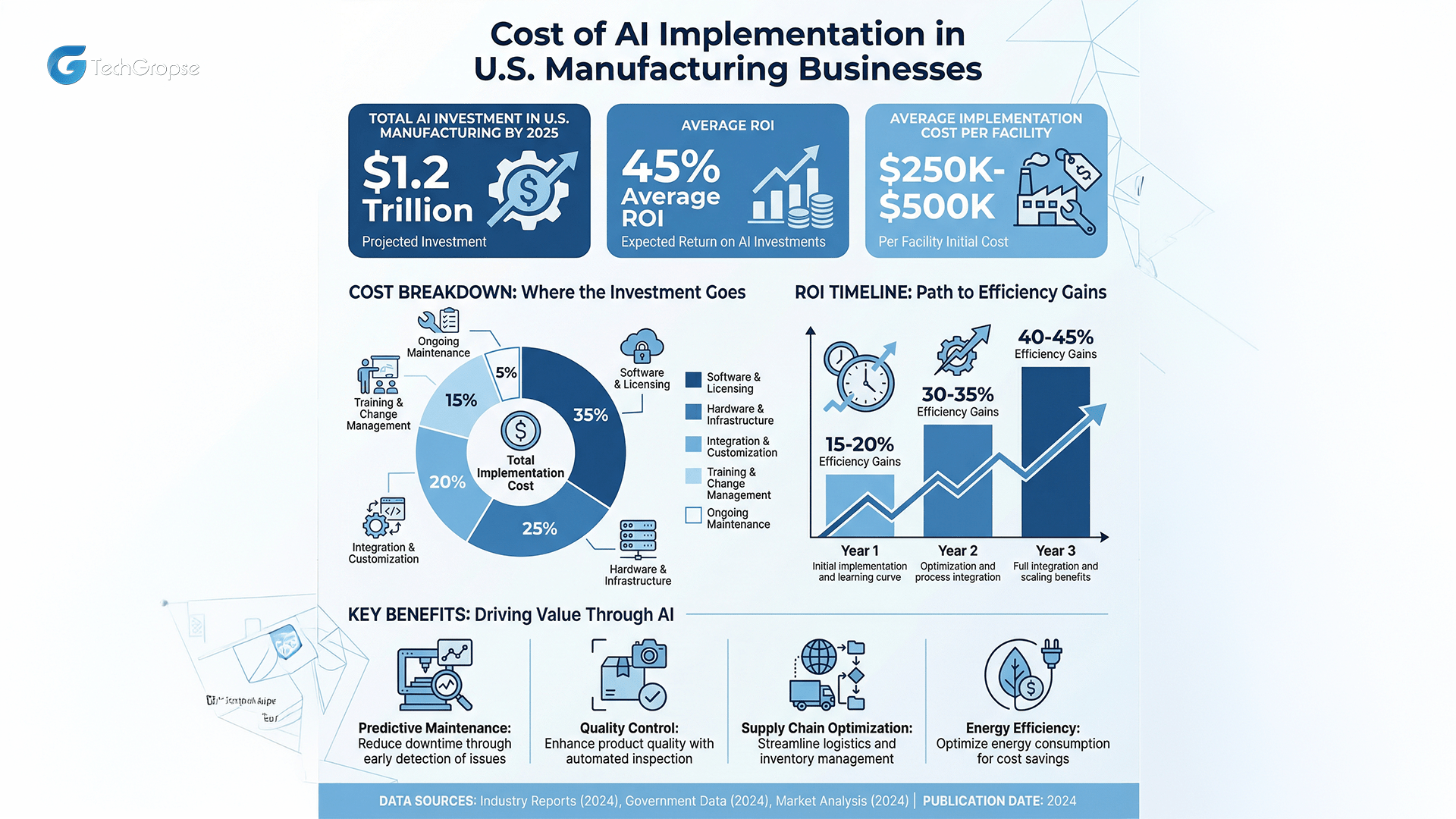
Let’s explore the cost of integrating Artificial Intelligence into the manufacturing business in 2026.Â
| Cost Component | Description | Estimated Cost (USD) | Estimated Cost (INR) |
|---|---|---|---|
| AI Strategy & Consultation | Business analysis, use-case identification, roadmap planning | $5,000 – $25,000 | ₹4L – ₹20L |
| Data Collection & Preparation | Data gathering, cleaning, labeling, and structuring | $10,000 – $50,000 | ₹8L – ₹40L |
| AI Model Development | Designing, training, and testing machine learning models | $20,000 – $100,000+ | ₹16L – ₹80L+ |
| Hardware & Infrastructure | Cloud services or on-premise GPUs, servers, and IoT devices | $15,000 – $200,000+ | ₹12L – ₹1.6Cr+ |
| Software & Tools | AI platforms, licenses, APIs (e.g., TensorFlow, Azure AI) | $5,000 – $50,000/year | ₹4L – ₹40L/year |
| Integration with Existing Systems | ERP, MES, CRM, and legacy system integration | $10,000 – $60,000 | ₹8L – ₹48L |
| Testing & Quality Assurance | Model validation, real-time testing, performance optimization | $5,000 – $30,000 | ₹4L – ₹24L |
| Deployment Costs | Production rollout, monitoring setup, DevOps | $5,000 – $25,000 | ₹4L – ₹20L |
| Employee Training | Training staff to use AI tools and workflows | $3,000 – $15,000 | ₹2.5L – ₹12L |
| Maintenance & Support | Ongoing updates, monitoring, and retraining models | $10,000 – $100,000/year | ₹8L – ₹80L/year |
Top 10 Manufacturing App Development Companies in the USA
Let’s explore the top 10 AI manufacturing companies in the United States.Â
TechGropse
Location
- Atlanta, USAÂ
Founded In
- 2015
Number of Employees
- 50-249
Hourly rates
- $25 – $49 / hr
Industries
- eCommerce
- Information technology
- Business services
- Education
- Financial services
- Government
- Medical
- Automotive
- Manufacturing
- Real estate
Services Offered
- Mobile App Development
- AI Development
- E-Commerce Development
- Custom Software Development
Wve Labs
Location
- Costa Mesa, CA
Founded In
- 2015
Number of Employees
- 50 – 249
Hourly rates
- $50 – $99 / hr
Industries
- Medical
- Real estate
- Arts, entertainment & music
- Consumer products & services
- Energy & natural resources
- Government
- Hospitality & leisure
- Retail
- eCommerce
- Manufacturing
Services Offered
- Mobile App Development
- AI Development
- Web Development
- UX/UI Design
Lickability
Location
- New York, NY
Founded In
- 2009
Number of Employees
- 2 – 9
Hourly rates
- $150 – $199 / hr
Industries
- Media
- Consumer products & services
- Gaming
- Information technology
- Medical
- Manufacturing
- eCommerce
Services Offered
- Mobile App Development
- AI Development
- AR/VR Development
- UX/UI Design
AppMakers USA
Location
- Los Angeles, CA
Founded In
- 2014
Number of Employees
- 10 – 49
Hourly rates
- $100 – $149 / hr
Industries
- Education
- Financial services
- Gaming
- Hospitality & leisure
- Media
- Medical
- Real estate
- Retail
- Supply Chain, Logistics, and Transport
- Manufacturing
- eCommerce
Services Offered
- Mobile App Development
- AI Development
- UX/UI Design
- Web Development
Mercury Development
Location
- Aventura, FL
Founded In
- 1999
Number of Employees
- 50 – 249
Hourly rates
- $50 – $99 / hr
Industries
- Information technology
- Media
- Retail
- eCommerce
- Automotive
- Financial services
- Manufacturing
Services Offered
- Custom Software Development
- Mobile App Development
- IoT Development
- UX/UI Design
- Wearable App Development
ISBX Corp
Location
- Los Angeles, CA
Founded In
- 2009
Number of Employees
- 50 – 249
Hourly rates
- $150 – $199 / hr
Industries
- Medical
- Consumer products & services
- Retail
- Media
- eCommerce
- Automotive
- Education
- Manufacturing
- Other industries
Services Offered
- AI Development
- API Development
- Application Management & Support
- Custom Software Development
- E-Commerce Development
- Enterprise App Modernization
- Mobile App Development
- UX/UI Design
- Web Development
Dedicated Developers
Location
- Atlanta, GA
Founded In
- 2007
Number of Employees
- 10 – 49
Hourly rates
- $50 – $99 / hr
Industries
- Medical
- Hospitality & leisure
- eCommerce
- Manufacturing
- Education
Services Offered
- Mobile App Development
- Web Development
Fueled
Location
- New York, NY
Founded In
- 2007
Number of Employees
- 250 – 999
Hourly rates
- $150 – $199 / hr
Industries
- Consumer products & services
- Advertising & marketing
- Arts, entertainment & music
- Media
- Retail
- Automotive
- Education
- Manufacturing
- Hospitality & leisure
Services Offered
- Mobile App Development
- UX/UI Design
- Web Development
- Web Design
Five Pack
Location
- Frisco, TX
Founded In
- 2008
Number of Employees
- 50 – 249
Hourly rates
- $150 – $199 / hr
Industries
- Manufacturing
- Medical
- Non-profit
- Retail
- Supply Chain, Logistics, and Transport
- eCommerce
Services Offered
- Mobile App Development
- Custom Software Development
- IT Staff Augmentation
- Web Development
- UX/UI Design
Cultivate Brands
Location
- Chicago, IL
Founded In
- 2005
Number of Employees
- 10 – 49
Hourly rates
- $150 – $199 / hr
Industries
- Other industries
- Business services
- Consumer products & services
- Energy & natural resources
- Financial services
- Hospitality & leisure
- Information technology
- Manufacturing
- Medical
- Non-profit
- Retail
- Supply Chain, Logistics, and Transport
- Utilities
Services Offered
- Branding
- Mobile App Development
- Web Design
Hire the Right AI Manufacturing App Development Company: 10 Questions to Make the Right Choice!
Well, now you have the complete information on AI app development for manufacturing business, latest trends, competitive benefits, best AI app development brands, budget requirement, profit scope, and market opportunity for Artificial Intelligence in manufacturing business.Â
However, you must know these 10 questions that must be put forward to a mobile app development company before hiring it.Â
Question: How much experience do you have as an AI manufacturing app development company in the USA
Intent: Ensure that the company has enough experience, expertise, and knowledge for developing manufacturing applications with Artificial intelligence.Â
Question: Are you comfortable sharing your past project experience with the manufacturing industry?
Intent: Understand how expert the brand is in integrating IoT dashboards, ERP, and production tracking across the manufacturing solutions.Â
Question: Which technologies, tools, frameworks, and libraries do you use in building AI applications for manufacturing businesses?
Intent: Evaluate their expertise in Flutter, React Native, Cloud Computing, Artificial Intelligence, Machine Learning, and Big Data for developing AI manufacturing solutions.Â
Question: How do you manage the third-party API integrations in the existing system?
Intent: Analyse how they plan to integrate the necessary functions and add-on features in the existing application.Â
Question: How do you ensure the database security and adherence to compliance guidelines while creating AI manufacturing applications?Â
Intent: Know their approach to managing the security protocols and compliance standards in manufacturing AI solutions.Â
Question: Do you negotiate the pricing of the AI manufacturing application development projects?Â
Intent: Along with the clear breakdown of the development price catalogue, understand their flexibility bandwidth in terms of budget and pricing.Â
Question: What is your tentative timeline for developing an AI manufacturing application?
Intent: Get an idea of how long they will take to build your manufacturing solution.Â
Question: Do you offer after-sales support and maintenance services?
Intent: Discover their approach to integrating the latest trends, operational functions, bug-fixing, feature updates, and version upgrades.Â
Question: How do you ensure app scalability and future readiness?
Intent: The app should handle growing data, users, and advanced features like AI or automation.
Question: Who will be the point of contact throughout the entire app development journey?
Intent: Understand their client focus, sincerity, and communication channels for your app development project.Â
FAQs (Frequently Asked Questions)
AI in manufacturing uses smart algorithms to automate processes, improve efficiency, and reduce operational errors significantly.
AI enhances productivity by automating repetitive tasks, optimizing workflows, reducing downtime, and improving operational efficiency overall.
Industries like automotive, aerospace, electronics, and pharmaceuticals widely adopt AI to enhance production capabilities and quality.
AI offers benefits like cost reduction, improved product quality, faster production cycles, and enhanced decision-making capabilities.
AI implementation costs vary depending on complexity, ranging from moderate investments to high enterprise-level deployment expenses.
Predictive maintenance uses AI to analyze data, forecast equipment failures, and prevent costly unplanned downtime effectively.
Yes, small manufacturers can adopt AI through scalable solutions, cloud platforms, and affordable automation tools available.
Companies face challenges like high costs, data security risks, integration issues, and a shortage of skilled professionals.
Businesses typically see ROI within months to years, depending on implementation scale, efficiency improvements, and use cases.
The future includes smart factories, autonomous systems, digital twins, and advanced analytics driving continuous innovation globally.

Hello All, Aman Mishra has years of experience in the IT industry. His passion for helping people in all aspects of mobile app development. Therefore, He write several blogs that help the readers to get the appropriate information about mobile app development trends, technology, and many other aspects.In addition to providing mobile app development services in USA, he also provides maintenance & support services for businesses of all sizes. He tried to solve all their readers' queries and ensure that the given information would be helpful for them.

 info@techgropse.com