



























































Do you know why Medication Management App Development Cost is the most talked-about topic in the market?
It’s been a couple of years that Covoid-19 has unarguably created healthcare awareness across the globe. Parallelly, Artificial intelligence also penetrated the stagnant digital ecosystem and caused havoc. Also, the geopolitical landscape has witnessed multiple friction points, including wars, civil unrest, power-shifts, and economic shutdowns. And finally, natural calamities like earthquakes, floods, volcanic eruptions, landslides, and avalanches are certain to occur.
All these adversities lead to a mandatory social upliftment, i.e., HEALTHCARE. Medicine, pharmaceuticals, and healthcare have become the focal point of a sustainable society. And thus, medication management app development is a must-have digital-first approach to the entire healthcare system.
According to the NCBI report, other than management failure of the hospitals, medication non-adherence is another reason for half of the failed treatments in the United States. Consequently, it has led to 1,25,000 death casualties. A medical management application is an absolute solution to this problem.
But before you take a baby step to build your first solution, it’s mandatory to know the Medication Management App Development Cost in 2026
Key Takeaways
- What is a Medication Management App?
- Market Overview of Medication Management Application
- Competitive Benefits of Medication Management App Development in 2026
- Medication Management App Development Cost Breakdown
- Medication Management App Development Cost Based on Application Types
- Budget Plan for Future Trends in AI Medication Management (2025–2030)
- Lifecycle Architecture of a Medication Management Application
- Top 10 Companies for Medical Management App Development in 2026
- Step-by-Step Process to Develop an AI Medication Management App
- Conclusion: Why Choose TechGropse for Your Medication Management App Development?
- FAQs (Frequently Asked Questions)
What is a Medication Management App?
A medication management app is a digital solution that enables healthcare service providers and medical institutions to track, organize, and optimize the medication process.
Medication Management App Development has a single fundamental goal: RIGHT MEDICINE, RIGHT TIME, RIGHT DOSAGE. With tracking systems, AI insights, and reminders, this application aims to simplify the complex medication process with a digital approach and under one platform.
With the growing number of healthcare issues across the globe, manual management of patients has become practically impossible. Here, medication management app development brings a precise solution to the problem.
Market Overview of Medication Management Application
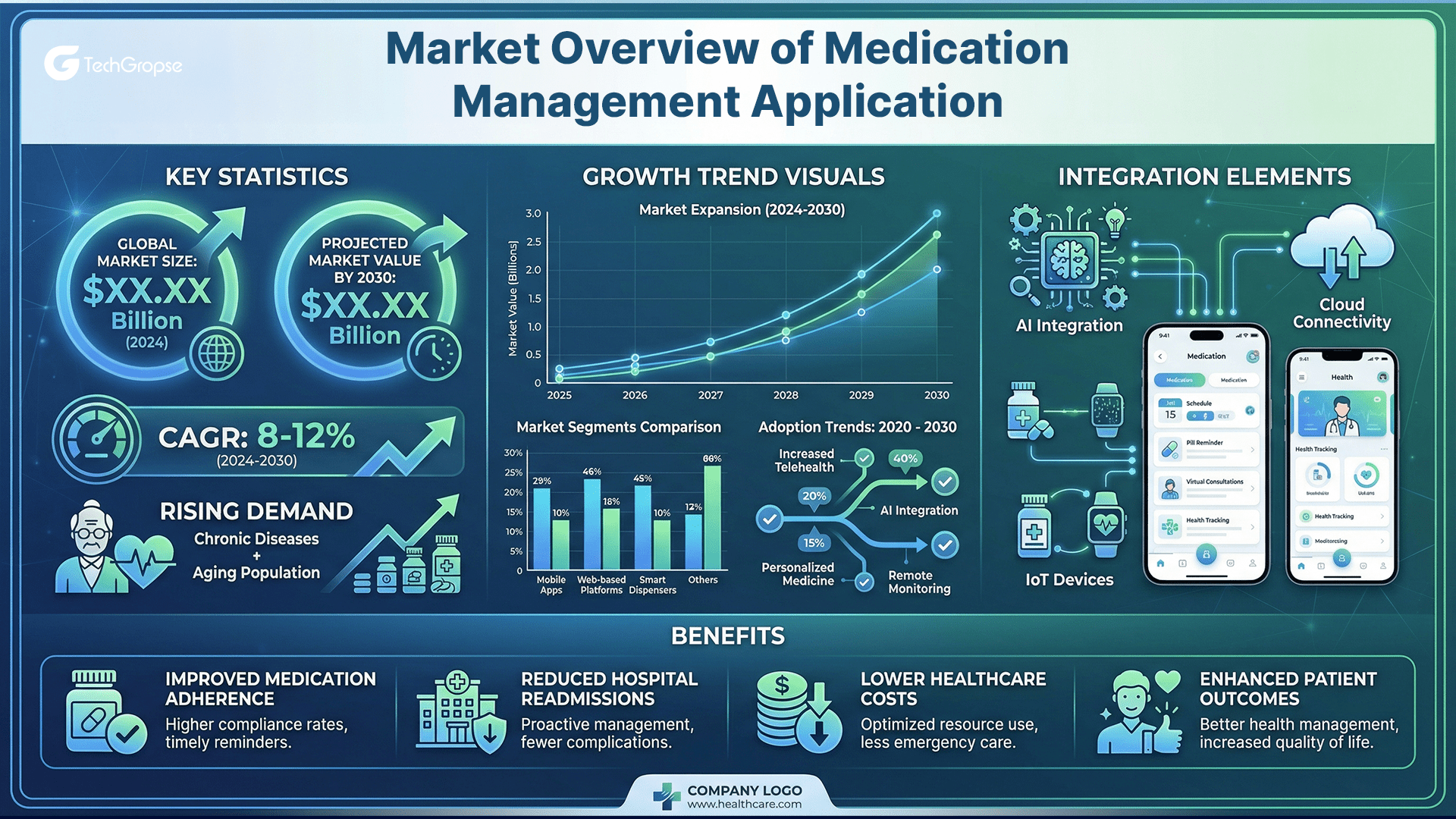
Before getting into the detailed bifurcation of Medication Management App Development Cost, you must have an overview of the growth prospects, revenue projections, societal needs, and healthcare assistance that come along. This will at least give you the confidence to build a medication management app.
Grand View Research claims that the global medication management system market was valued at $7.70 billion in 2024 and is expected to reach $12.79 billion by 2030, growing at a CAGR of 8.8%.
Data from MarketResearch says that the medication management app market is projected to grow from $171.36 million in 2025 to $448.93 million by 2032, at a CAGR of 14.75%.
Another Grand View Research says that around 60% of adults use at least one prescription drug, and 36% take three or more medications regularly
PMC data says that around 50% of patients with chronic diseases do not follow prescribed medications properly, leading to serious health and economic consequences.
A McKinsey study points to areas pharmaceutical companies can address to combat this long-standing industry issue. It says that around 10% of hospitalizations in older patients are preventable with better medication adherence.
Cornell University published a clinical study showing that 92.9% of users were willing to use medication apps daily, and 63% would actively engage with advanced features like pill tracking.
Reports indicate that the medication management app market is growing due to the rising global burden of chronic diseases and aging populations, increasing the need for digital adherence solutions.
Competitive Benefits of Medication Management App Development in 2026
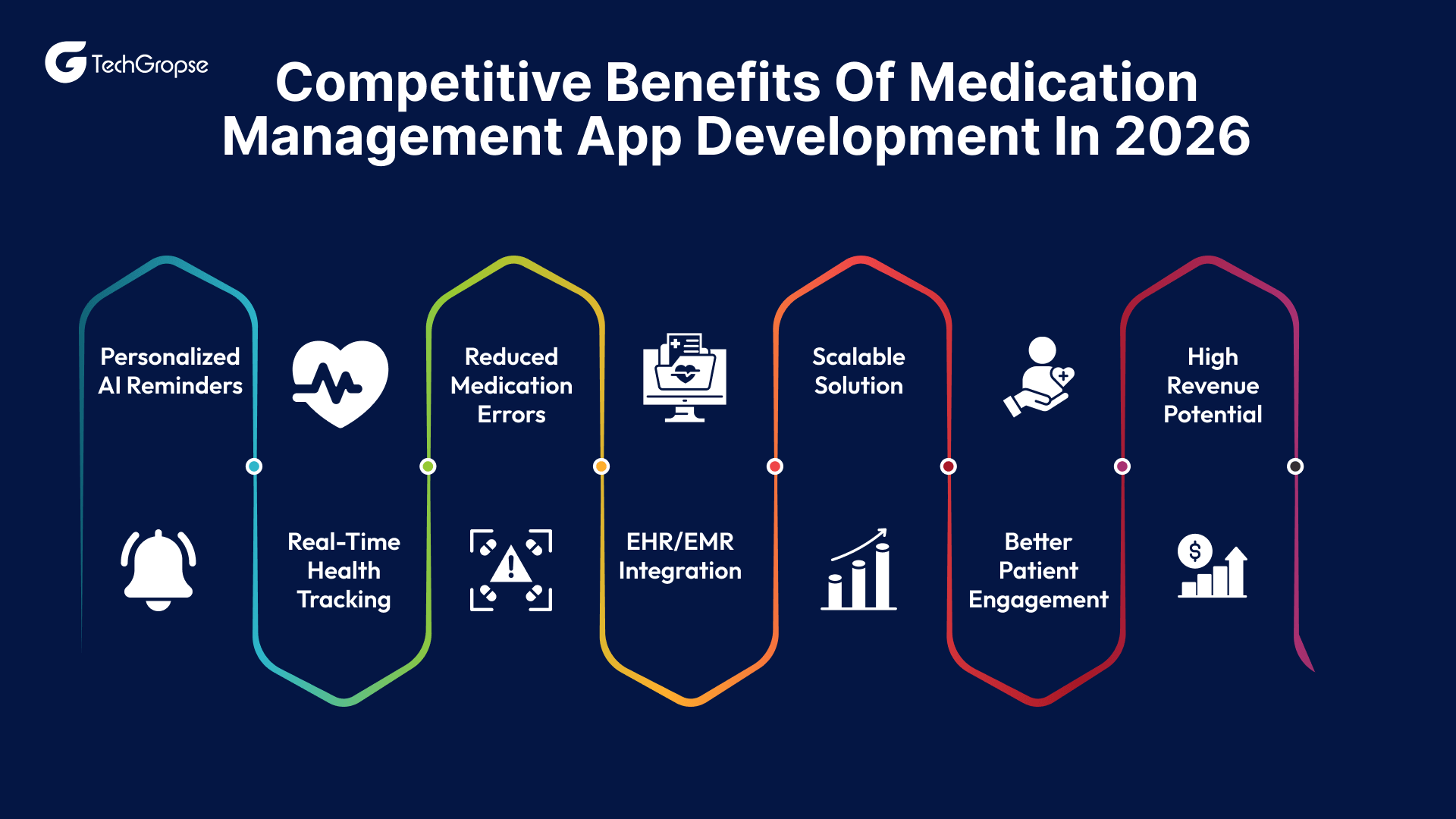
Today, AI intervention can be seen across any sector in the global business. Similarly, AI-powered medication management apps are the new trend in the healthcare business vertical. Let’s explore some of the competitive benefits of such medication management applications.
Personalized AI Reminders
This feature processes the patient’s behaviour, medical history, and lifestyle patterns to foster a personalized AI reminder. The main goal is to offer a personalized and consistent adherence to the medication schedule, thus improving treatment impact, decreasing missed doses, and offering a tailored and holistic experience to the users.
- Behavior-focused reminders
- Adaptive tracking & schedule
- Smart reminders & notifications
- Improved medication adherence
Real-Time Health Tracking
Real-time health tracking is another benefit of AI in healthcare app development that monitors a patient’s condition and medical schedules through connected cloud devices. This will enable healthcare service providers to get access to data, offer quick intervention and treatment adjustments to come up with long-term health outcomes.
- Real-time data tracking
- Wearable and IoT integration
- Predictive health insights
- Early disease identification
- Continuous health monitoring
Reduced Medication Errors
Manual healthcare services may encapsulate multiple glitches and errors. However, medication management app features check the dosage schedules, drug strength, and medication schedules as a vital safety check, ensuring the right medical practices to reduce risk and errors.
- Drug interaction reminders
- Dosage strength checks
- Error mitigation systems
- Safe medication usage
- Automated medicine validation
EHR/EMR Integration
Integration with electronic health records ensures seamless access to accurate patient data across healthcare systems. This improves communication between doctors, pharmacists, and patients, enabling informed decisions and coordinated care. It also reduces duplication of records and enhances overall healthcare efficiency.
- Centralized patient records
- Seamless data sharing
- Improved care coordination
- Real-time updates
- Better clinical decisions
Scalable Solution
How to improve medication adherence with technology? The scalable infrastructure of your medication management application would cater to the high customer volume when the business grows. With additional features, you will be able to sustain the application performance, engage virtue, and create an ideal operational ecosystem for the business.
- Cloud-based solution
- Agile infrastructure
- Multi-user functionality
- Seamless feature expansion
- High performance virtue
Better Patient Engagement
A good medication management app development company would develop interactive features and an engaging interface for your solution, resulting in improved proximity and better outcomes. The analytical dashboard and tools would offer personalized insights to users for maintaining his/her long-term routine.
- Interactive dashboards
- Intuitive design
- Hyperpersonalized insights
- Engagement tools & dashboards
- High user retention rate
High Revenue Potential
Medication management apps offer strong revenue opportunities through subscriptions, SaaS models, and healthcare partnerships. With rising demand for digital health solutions, businesses can generate recurring income while delivering value to users, making it a profitable and scalable investment.
- Subscription plans
- SaaS solutions
- In-app purchases
- Data monetization
- Long-term ROI
Medication Management App Development Cost Breakdown
Do you want to hire medication app developers in 2026? Before then, you must know the major factors that determine the overall development cost. To make the narration comprehensive, we have divided the cost breakdown on the basis of three factors: Complexity, stage, and feature integration.
Let’s explore.
Based on App Complexity
A major part of the medication management app development cost depends on the application complexity. Basic applications with low-profile features would cost you moderately. Meanwhile, complex applications with high-end features, analytical dashboards, scalable infrastructure, and multiple AI integrations would need heavy investment.
Here’s a table to comprehend the cost based on application complexity.
| App Type | Estimated Cost | Timeline | Features Included |
|---|---|---|---|
| Basic (MVP) | $5,000 – $40,000 | 1–2 months | Medication reminders, user login, basic tracking |
| Mid-Level App | $40,000 – $120,000 | 3–6 months | Cloud sync, caregiver access, analytics dashboard |
| Advanced (AI-Powered) | $120,000 – $300,000+ | 6–12 months | AI insights, EHR integration, telehealth, wearables |
Based on the Development Stage
Every development stage has a distinctive budget thrust on your overall medication management app development cost. It depends on how much you are emphasizing the particular stage that includes UI/UX, core development, quality assurance, and post-delivery support and maintenance services.
A table to understand the cost breakdown based on the development stage
| Development Stage | Estimated Cost |
|---|---|
| Research & Planning | $3,000 – $15,000 |
| UI/UX Design | $7,000 – $25,000 |
| Frontend & Backend Development | $30,000 – $120,000+ |
| AI Development & Integration | $20,000 – $50,000+ |
| Testing & QA | $5,000 – $20,000 |
| Deployment & Launch | $3,000 – $10,000 |
Based on Feature Integration
The chosen feature-boutique directly determines the overall cost of custom medication tracking app development. Basic features like reminders, video tutorials, and profile management would cost you very little. High-level advanced features like AI analytics, IoT integration, EHR integration, and advanced dashboards would make you go ahead with a colossal investment.
Table for cost breakdown based on feature integration
| Feature | Estimated Cost |
|---|---|
| Medication Reminders | $2,000 – $8,000 |
| Prescription Upload (OCR + NLP) | $5,000 – $15,000 |
| Drug Interaction Checker | $8,000 – $20,000 |
| AI-Based Recommendations | $15,000 – $40,000 |
| EHR/EMR Integration | $10,000 – $30,000 |
| Real-Time Analytics Dashboard | $10,000 – $25,000 |
Medication Management App Development Cost Based on Application Types
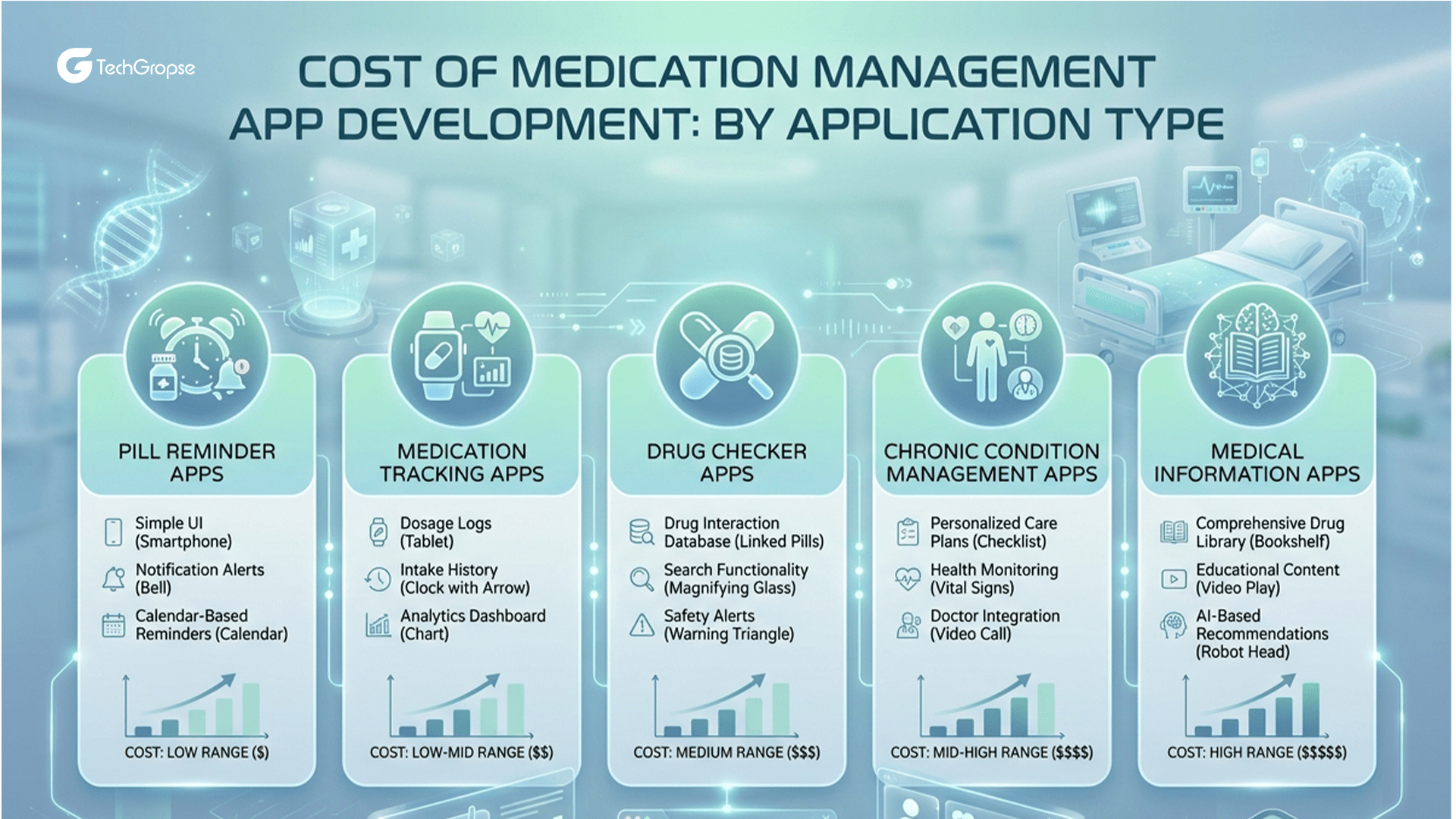
Now, let’s understand the medication management app development cost on the basis of the application category. We have segmented the app types into 5 major categories: Pill Reminder Apps, Medication Tracking Apps, Drug Checker Apps, Chronic Condition Management Apps, and Medical Information Apps.
Pill Reminder Apps
These are basically the alarm clocks of your medication schedule. The features incorporated are notifications, alerts, and reminders for your next dosage. Other than this, you get medication instructions and dosage refill reminders as well. Depending upon the app complexity and feature integration, the cost to develop an AI medication reminder app would fluctuate from $5,000 – $30,000.
Medication Tracking Apps
This application is fundamentally a database repository and recording for the daily dosage history of the patients. Further, the tracking history stored in the infrastructural cloud can be seamlessly shared with the permitted medical institutions or healthcare service providers. The cost to develop a medication tracking application would vary from $30,000 – $80,000.
Drug Checker Apps
A drug checker is like a medical checkpost where every medicine, drug, and medication dosage would be checked before the patient takes it. Here, you check the drug interaction, safety warning, and side effects aligned to a large medical database. The cost to develop a drug check application would oscillate from $50,000 – $120,000.
Chronic Condition Management App
These applications are significantly designed to treat chronic diseases like hypertension, asthma, and diabetes. With facilitations like advanced analytical insights, real-time tracking, and IoT integration, the solution would offer complex monitoring and high-end compliance requirements. The cost to develop such a solution would invariably fluctuate between $80,000 – $200,000+
Medical Information App
A medical information application is like a chatbot assistant of healthcare wikipedia where you get detailed information about the drugs, usage guidelines, and side effects in the form of educational content. Development usually ranges from $20,000 – $70,000, depending on database size, user interface complexity, and content integration features.
| Application Type | Description | Key Features | Development Complexity | Estimated Cost | Timeline |
|---|---|---|---|---|---|
| Pill Reminder Apps | Basic apps that notify users to take medications on time and manage simple schedules. | Reminders, alerts, basic scheduling, notifications | Low | $5,000 – $30,000. | 1 – 2 months |
| Medication Tracking Apps | Apps that track medication intake history and adherence over time with reporting features. | Dose tracking, history logs, adherence reports, dashboards | Medium | $30,000 – $80,000 | 2 – 4 months |
| Drug Checker Apps | Apps focused on checking drug interactions, side effects, and safety information. | Drug database, interaction checker, safety alerts, search system | Medium–High | $50,000 – $120,000 | 3 – 6 months |
| Chronic Condition Management App | Advanced apps designed for long-term disease management with continuous monitoring and insights. | AI insights, health tracking, reminders, wearable integration | High | $80,000 – $200,000+ | 4 – 8 months |
| Medical Information App | Apps providing detailed drug information, usage guidelines, and educational content. | Drug library, search, educational content, and bookmarking | Low–Medium | $20,000 – $70,000 | 2 – 4 months |
Budget Plan for Future Trends in AI Medication Management (2025–2030)
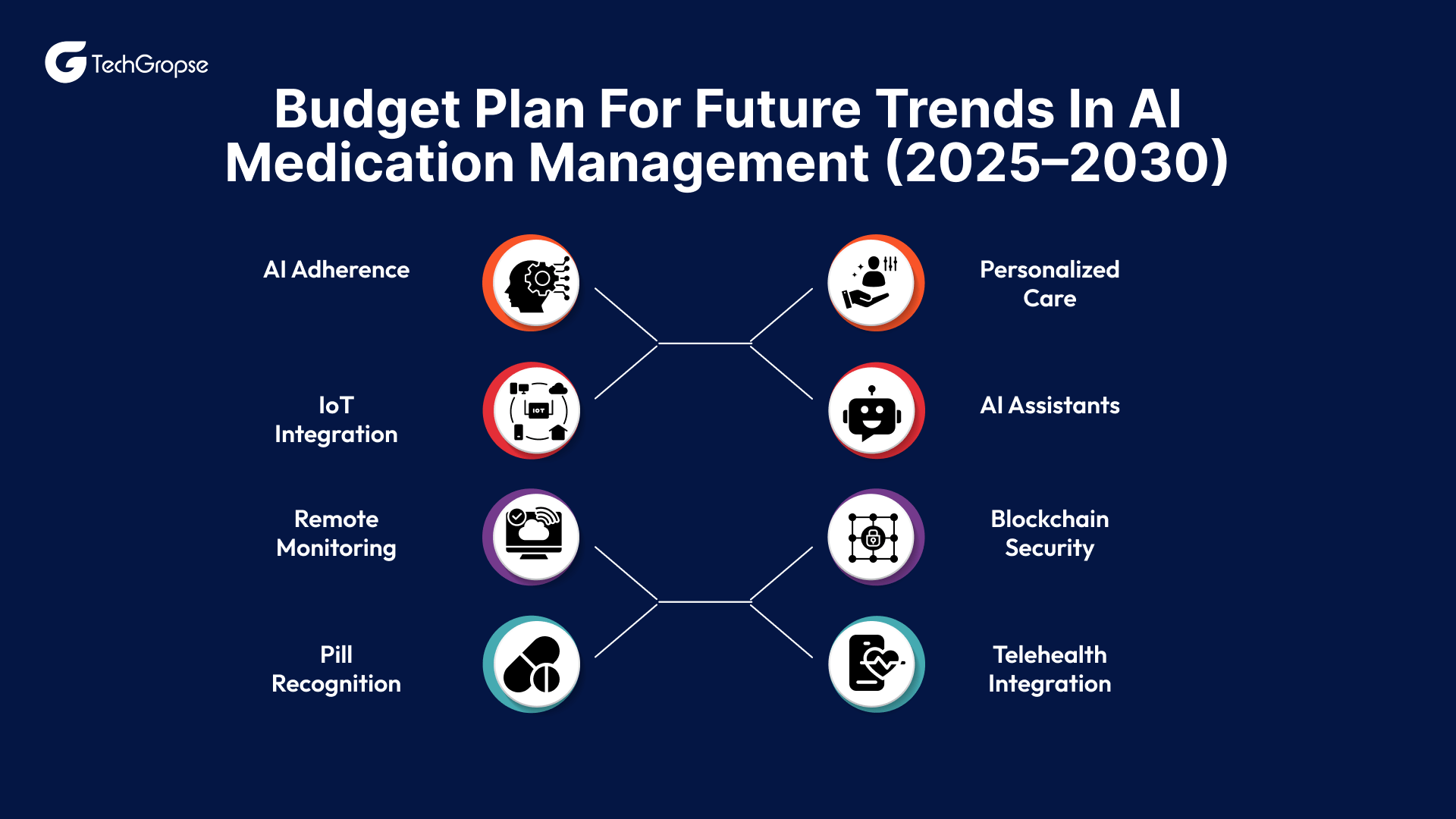
Now, let’s figure out the future trends in AI medication management that will voraciously impact the Medication Management App Development Cost in the future.
AI Adherence
AI adherence is going to be a huge trend in the future. Thus, there has to be a huge investment in machine learning models, analytical frameworks, and AI data processing units. Your budget must encapsulate continuous training models, data-based cloud infrastructure, and information pipelines. The long-term AI budget optimization, feature updates, and version upgrades would add accuracy to the process.
- Predictive analytical models
- Data processing units
- High-end system training
- Behaviour and preference tracking
Personalized Care
As the AI models keep on learning about the healthcare ecosystem, personalized care management would be the common trend in business. So, your major investment would go for patient profiling, advanced analytics, and a smart recommendation engine. To leverage personalized care for patients, you have to put a recurring budget for AI refinement, offering an adaptive healthcare experience.
- Patient profiling management
- Smart Recommendation Engines
- Data integration tools
- Adaptive algorithms
IoT Integration
Do you know how AI is transforming medication management? Real-time medication management with smart watches and other wearable devices would be the trending game of healthcare business. Think that you are not with your mobile device, and the smart watch and WHOOP strap on your wrist would give you continuous medication reminders and updates. Additional costs arise from maintaining device ecosystems, ensuring seamless connectivity, and managing large volumes of real-time health data.
- IoT device integration
- Backend API connectivity
- Real-time data synchronisation
- Data storage management
AI Assistants
Voice and chat-based AI assistants would be a mandatory trend in medication management app development. Here you train your datasets, make interactive and conversational design, and execute NLP model development. This investment for assistant integration will improve the support accuracy and elevate the customer engagement rate.
- NLP model development
- Voice recognition systems
- Chatbot frameworks
- Conversational design
Remote Monitoring
Cloud-based remote monitoring would enable consistent health tracking for the patients. Here you invest in scalable architecture, real-time analytics, and pole-to-pole IoT integration. Such budget allocation would improve system reliability, uninterrupted health tracking, and prevent critical health conditions from being unchecked.
- Real-time analytics
- Wearable & IoT integration
- Notification & alert system
- Scalable cloud infrastructure
Blockchain Security
Blockchain security ensures the secure and transparent handling of medical data. Budget planning includes decentralized architecture, encryption protocols, and compliance systems. Ongoing costs involve maintaining network performance, ensuring scalability, and updating security layers to protect sensitive healthcare information.
- Decentralized architecture
- Encryption protocols
- Secure data storage
- Compliance systems
Pill Recognition
This is a hyper-advanced AI trend where the solution uses AI-focused computer vision identification techniques to recognize the pill and give end-to-end information on it. In this trend, the investment would go for app optimization (as per the recent market devices), image processing models, and dataset training. The more you expand the drug datasets, the wider the identification bandwidth.
- Image processing system
- Computer vision model
- Dataset training algorithm
- Solution accuracy progress
Telehealth Integration
Telehealth integration would promote virtual healthcare services. Here, the brands would invest in a high-level video conferencing system, backend API integration, platform scalability, and secured communication channels. Ongoing costs include maintaining system performance, ensuring compliance, and scaling infrastructure to handle increasing user demand.
- Third-party API integration
- Secured video infrastructure
- Protected communication channels
- High-end compliance management
| Aspect | Features | Benefits | Budget (Cost) | Budget Allocation |
|---|---|---|---|---|
| Focus Area | Functionalities & tech capabilities | Outcomes & value | $10,000 – $50,000 | 10% – 20% |
| Perspective | Product-centric | User-centric | $20,000 – $100,000 | 15% – 25% |
| Includes | AI reminders, integrations, and dashboards | Adherence, engagement, efficiency | $50,000 – $200,000+ | 30% – 40% |
| Goal | Build the app | Deliver value | $50,000 – $300,000+ | 20% – 30% |
| Audience | Developers, stakeholders | Patients, providers | $10,000 – $80,000 | 10% – 15% |
Lifecycle Architecture of a Medication Management Application
Sense → Ingest → Contextualize → Orchestrate → Execute → Learn → Predict → Adapt → Govern → Scale
[START → DYNAMIC INTELLIGENT SYSTEM]
- SENSE LAYER (Multi-Source Signal Acquisition)
├── Patient Inputs (manual entries, voice, app interactions)
├── Clinical Data Streams (EHR, prescriptions, lab reports)
├── IoT Signals (wearables: HR, BP, glucose monitors)
├── Environmental Context (location, time, activity)
└── Behavioral Signals (usage patterns, adherence habits)
↓
- DATA INGESTION GRID (Unified Data Fabric)
├── Real-Time Streaming Pipelines (Kafka-like ingestion)
├── Batch Processing (historical medical records)
├── API Federation (pharmacy, insurance, providers)
├── Data Validation Gateways (schema & compliance checks)
└── Data Lake Storage (structured + unstructured data)
↓
- CONTEXTUAL INTELLIGENCE LAYER
├── Patient Digital Twin (virtual health profile modeling)
├── Temporal Context Mapping (time-based medication logic)
├── Lifestyle Correlation Engine (routine vs adherence)
├── Drug Knowledge Graph (relationships & interactions)
└── Risk Contextualization (multi-factor risk scoring)
↓
- ORCHESTRATION ENGINE (Distributed Decision Routing)
├── Workflow Engine (dynamic medication workflows)
├── Event Bus (event-driven architecture)
├── Microservices Coordination (loosely coupled services)
├── Load-Aware Routing (priority-based execution)
└── Failover Strategies (resilience & redundancy)
↓
- EXECUTION LAYER (Action Delivery System)
├── Smart Reminder Engine (adaptive notifications)
├── Multi-Channel Delivery (push, SMS, voice, wearable alerts)
├── Medication Logging (active + passive confirmation)
├── Refill Automation (auto pharmacy triggers)
└── Caregiver Sync (real-time updates & alerts)
↓
- ANALYTICS & LEARNING CORE
├── Adherence Modeling (predictive compliance scoring)
├── Anomaly Detection (outlier behavior identification)
├── Causal Inference Models (impact of missed doses)
├── Feedback Loop Processing (user + system feedback)
└── Continuous Model Training (self-improving AI)
↓
- PREDICTIVE & PRESCRIPTIVE AI LAYER
├── Risk Forecasting (hospitalization probability)
├── Dose Optimization Models (AI-driven adjustments)
├── Preventive Recommendations (proactive care)
├── Next-Best-Action Engine (what to do next)
└── Scenario Simulation (what-if analysis)
↓
- ADAPTIVE RESPONSE SYSTEM
├── Dynamic Schedule Adjustment (real-time updates)
├── Personalized Engagement Strategies (nudges, gamification)
├── Escalation Protocols (doctor/caregiver alerts)
├── Emergency Response Trigger (critical intervention)
└── Context-Aware Automation (auto decision execution)
↓
- GOVERNANCE & TRUST FRAMEWORK
├── Policy Engine (clinical + regulatory rules)
├── Explainable AI (transparent decision logic)
├── Consent & Privacy Management (user data control)
├── Auditability (full traceability of actions)
└── Compliance Layer (HIPAA, GDPR enforcement)
↓
- EXPERIENCE & INTERFACE LAYER
├── Patient Dashboards (real-time insights)
├── Doctor Portals (clinical decision views)
├── Caregiver Interfaces (monitoring tools)
├── Voice & Conversational UI (AI assistants)
└── Accessibility Layer (elderly-friendly UX)
↓
- ECOSYSTEM INTEGRATION GRID
├── Telehealth Systems (remote consultations)
├── Pharmacy Networks (drug supply chain)
├── Insurance Systems (claims & coverage)
├── Health Devices (IoT ecosystem)
└── Third-Party APIs (fitness, nutrition, labs)
↓
- SCALABILITY & PERFORMANCE LAYER
├── Auto-Scaling Infrastructure (cloud elasticity)
├── Edge Computing (low-latency processing)
├── Distributed Databases (global availability)
├── Performance Optimization (latency reduction)
└── High Availability Systems (uptime assurance)
↓
- EVOLUTION & SELF-OPTIMIZATION LOOP
├── Model Retraining Pipelines (AI evolution)
├── Feature Experimentation (A/B testing)
├── User Feedback Assimilation (continuous input)
├── System Optimization (resource efficiency)
└── Innovation Layer (new AI capabilities)
[END → CONTINUOUSLY EVOLVING INTELLIGENT ECOSYSTEM]
Top 10 Companies for Medical Management App Development in 2026
Today, every Tom, Deccan, and Harry is claiming to be the best mobile app developer in the market. Thus, we have curated a list that comprises the names of the 10 best mobile app development companies for medication management software development services.
Let’s explore.
-
TechGropse
Location
- Dubai, United Arab Emirates
Founded In
- 2015
No. of Employees
- 50-249
Hourly Rates
- $25 – $49 / hr
Industries
- eCommerce
- Information technology
- Business services
- Education
- Financial services
- Government
- Medical
- Automotive
- Manufacturing
- Real estate
Services
- Mobile App Development
- AI Development
- E-Commerce Development
- Custom Software Development
-
Mercury Development
Location
- Aventura, FL
Founded In
- 1999
No. of Employees
- 50 – 249
Hourly Rates
- $50 – $99 / hr
Industries
- Hospitality & leisure
- Medical
- Business services
- Consumer products & services
- Information technology
- Media
- Retail
- eCommerce
- Automotive
- Financial services
Services
- Custom Software Development
- Mobile App Development
- IoT Development
- UX/UI Design
- Wearable App Development
-
Innowise
Location
- Warszawa, Poland
Founded In
- 2007
No. of Employees
- 1,000 – 9,999
Hourly Rates
- $50 – $99 / hr
Industries
- Financial services
- Medical
- Information technology
- Manufacturing
Services
- Custom Software Development
- AI Development
- BI & Big Data Consulting & SI
- Blockchain
- Cloud Consulting & SI
- Cybersecurity
- IT Staff Augmentation
-
Empat
Location
- San Francisco, CA
Founded In
- 2013
No. of Employees
- 250 – 999
Hourly Rates
- $25 – $49 / hr
Industries
- Financial services
- Medical
- eCommerce
- Education
- Legal Cannabis
- Real estate
Services
- Mobile App Development
- Custom Software Development
- Web Development
-
AppMakers USA
Location
- Los Angeles, CA
Founded In
- 2014
No. of Employees
- 10 – 49
Hourly Rates
- $100 – $149 / hr
Industries
- Education
- Financial services
- Gaming
- Hospitality & leisure
- Media
- Medical
- Real estate
- Retail
- Supply Chain, Logistics, and Transport
- eCommerce
Services
- Mobile App Development
- AI Development
- UX/UI Design
- Web Development
-
Emizen Tech
Location
- Jaipur, India
Founded In
- 2013
No. of Employees
- 50 – 249
Hourly Rates
- < $25 / hr
Industries
- eCommerce
- Automotive
- Medical
- Hospitality & leisure
- Information technology
- Real estate
Services
- Mobile App Development
- Web Development
- AI Development
- Custom Software Development
- E-Commerce Development
-
Konstant Infosolutions
Location
- New York , NY
Founded In
- 2003
No. of Employees
- 250 – 999
Hourly Rates
- $25 – $49 / hr
Industries
- eCommerce
- Medical
- Arts, entertainment & music
- Consumer products & services
- Education
- GPS, Navigation & GIS
- Supply Chain, Logistics, and Transport
- Financial services
- Real estate
Services
- Mobile App Development
- AI Development
- UX/UI Design
- Web Development
-
Tapptitude
Location
- Cluj-Napoca, Romania
Founded In
- 2013
No. of Employees
- 50 – 249
Hourly Rates
- $25 – $49 / hr
Industries
- Consumer products & services
- Medical
- Automotive
- Financial services
- Arts, entertainment & music
- Hospitality & leisure
- Real estate
Services
- Mobile App Development
- Web Development
- AI Development
- Low/No Code Development
- UX/UI Design
-
Wolfpack Digital
Location
- Dublin, Ireland
Founded In
- 2015
No. of Employees
- 50 – 249
Hourly Rates
- $50 – $99 / hr
Industries
- Financial services
- Medical
- Advertising & marketing
- Automotive
- Business services
- Consumer products & services
- Hospitality & leisure
- Information technology
- Retail
Services
- Mobile App Development
- Web Development
- AI Development
-
Simpalm
Location
- Rockville, MD
Founded In
- 2009
No. of Employees
- 10 – 49
Hourly Rates
- Undisclosed
Industries
- Education
- Financial services
- Medical
- Non-profit
- Media
- Government
- Hospitality & leisure
Services
- Mobile App Development
- Web Development
- Web Design
- Application Management & Support
- UX/UI Design
| Company | Core Expertise | USP | Estimated Cost |
|---|---|---|---|
| TechGropse | Mobile apps, AI solutions, healthcare apps | Strong AI integration with cost-effective, scalable healthcare solutions | $20,000 – $120,000 |
| Mercury Development | Mobile app development, enterprise solutions | High-end enterprise-grade apps with premium quality delivery | $80,000 – $300,000+ |
| Innowise | Custom software, healthcare IT, AI | Extensive experience in healthcare compliance and scalable systems | $50,000 – $200,000 |
| Empat | Product development, startups, UI/UX | Extensive experience in healthcare compliance and scalable systems | $40,000 – $150,000 |
| AppMakers USA | Mobile & web apps, healthcare apps | Client-centric development with strong support and maintenance | $60,000 – $250,000 |
| Emizen Tech | E-commerce, healthcare, mobile apps | Cost-effective solutions with diverse industry expertise | $25,000 – $100,000 |
| Konstant Infosolutions | Mobile app development, enterprise apps | Wide global client base with flexible engagement models | $30,000 – $120,000 |
| Tapptitude | Product development, mobile apps | Product-first approach with strong UX and scalability focus | $50,000 – $180,000 |
| WOLFPACK DIGITAL | Mobile apps, digital products | Premium design and development with global brand experience | $70,000 – $250,000 |
| Simpalm | Web & mobile apps, healthcare solutions | Affordable development with strong local US market understanding | $40,000 – $150,000 |
Step-by-Step Process to Develop an AI Medication Management App
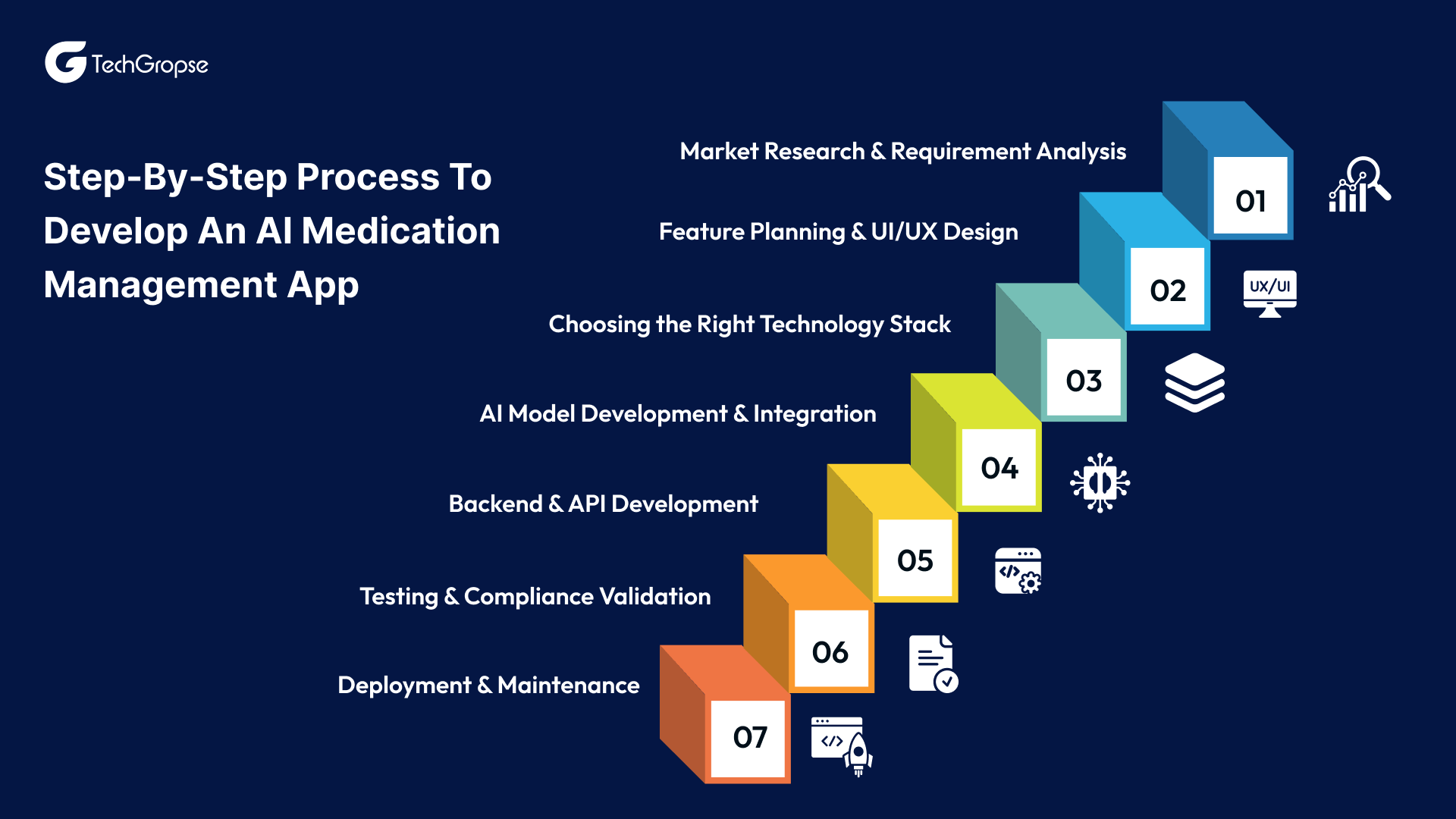
When you are set to develop a medication management application, multiple IT managed service providers will present various price catalogues. Thus, it’s important to know the essential steps that fall in the process. These steps have been mentioned with a tentative cost. The calculation would help you evaluate the overall development budget feasibility.
Market Research & Requirement Analysis
In this stage, we fundamentally define the business goals and objectives aligned to market and financial conditions. When it comes to medical management application development, we have to take care of the functional requirements, technical needs, healthcare regulations, stakeholder feedback, and idea validation.
- Target audience
- Competitor analysis
- Business goals
- Requirement gathering
- Compliance research
- Monetization strategy
- Stakeholder validation
Feature Planning & UI/UX Design
Feature planning, UI/UX design, core layout management, wireframes, and prototypes are the essential areas of this stage. For a seamless experience for patients, healthcare institutions, and caregivers, you focus on a simple yet attractive design, intuitive navigation, and transparent accessibility.
- Feature listing
- User flows
- Wireframing
- Accessibility design
- Navigation optimization
- Usability testing
- UI finalization
Choosing the Right Technology Stack
This is one of the most significant stages of medication management app development, where you choose the right technologies, including frontend and backend frameworks, cloud platform, database management, and AI tools. Here, you need to ensure that your final solution will be scalable, efficient, and integrated with the required APIs, IoT devices, and EHR
- Frontend selection
- Backend framework
- AI tools
- Database selection
- Cloud platform
- Scalability planning
- API evaluation
AI Model Development & Integration
This stage involves building the healthcare repository, accumulation of healthcare datasets, training large AI models, and developing Machine Learning algorithms for drug interaction, medicine scheduling, and recommendations. The models are tested for accuracy and integrated into the app to enable intelligent features and personalized patient care.
- Data collection
- Model training
- Interaction detection
- Recommendation engine
- NLP integration
- Accuracy testing
- Model deployment
Backend & API Development
Backend development focuses on building secure server-side architecture, creating APIs, and integrating third-party services.
- Server architecture
- API development
- Third-party integration
- Authentication setup
- Database management
- Data security
- Performance optimization
Testing & Compliance Validation
This stage is required in any mobile app development journey to ensure that your application is ready to launch in the market. In medication management app development, you take care of the functional performance, security testing, GDPR compliance, and HIPAA validation. Your team must ensure pole-to-pole data privacy, security management, and legitimate adherence.
- Functional testing
- Performance testing
- AI validation
- Compliance checks
- Security testing
- Bug fixing
- User testing
Deployment & Maintenance
Deployment and maintenance include fixing bugs, scalability elevation, speed improvement, and releasing the final application to iOS and Android platforms. The continuous support and maintenance would cocoon the long-term health and sustainability of the application.
- App deployment
- Cloud setup
- Performance monitoring
- Feature updates
- Bug fixes
- Scalability upgrades
- Ongoing support
| Development Stage | Description | Estimated Cost | Cost Contribution |
|---|---|---|---|
| Market Research & Requirement Analysis | Identifying target users, competitors, and defining app requirements and scope | $5,000 – $15,000 | 5% – 10% |
| Feature Planning & UI/UX Design | Designing user flows, wireframes, and intuitive interfaces for patients and providers | $8,000 – $25,000 | 10% – 15% |
| Choosing the Right Technology Stack | Selecting frameworks, tools, cloud services, and architecture for scalability | $5,000 – $15,000 | 5% – 10% |
| AI Model Development & Integration | Building AI models for adherence prediction, recommendations, and analytics | $20,000 – $60,000 | 20% – 30% |
| Backend & API Development | Developing server-side logic, databases, and third-party integrations (EHR, APIs) | $30,000 – $100,000 | 25% – 35% |
| Testing & Compliance Validation | Ensuring app quality, performance, and compliance with healthcare regulations | $10,000 – $30,000 | 10% – 15% |
| Deployment & Maintenance | Launching the app, monitoring performance, and ongoing updates and support | $10,000 – $40,000/year | 10% – 20% |
Conclusion: Why Choose TechGropse for Your Medication Management App Development?
With 10+ years of experience and 1000+ projects delivered, TechGropse is a leading mobile app development company with 92% retention rate. Our 150+ software professionals have worked in 25+ locations for 500+ industry giants to receive 100+ awards in the mobile app development arena.
Having a holistic experience in innumerable industries, including manufacturing, pharmaceuticals, healthcare, eCommerce, FMCG, education, digital media, defense, aerospace, and other public & private sectors, we are the best Medication Management App Development Company across any marketplace.
Even when it comes to a reasonable pitch of Medication Management App Development Cost, we have been highly acknowledged by global clients for developing easy and budget-friendly applications.
FAQs (Frequently Asked Questions)
A medication management app helps users track prescriptions, set reminders, monitor adherence, and manage medication schedules efficiently using digital tools, automation, and real-time tracking features for better health outcomes.
AI enhances apps by providing smart reminders, predicting missed doses, analyzing patient behavior, and offering personalized medication schedules for better adherence, improved decision-making, and more accurate healthcare insights.
Core features include smart reminders, drug interaction alerts, AI-based recommendations, prescription scanning, adherence tracking, and integration with healthcare systems, along with real-time analytics and personalized health insights.
Development costs typically range from $50,000 to $150,000+, depending on features, AI complexity, platform selection, and development team location, along with integration requirements, scalability needs, and ongoing maintenance costs.
It usually takes 3 to 9 months, depending on app complexity, AI integration level, compliance requirements, and customization needs, along with testing phases, feature additions, and third-party system integrations.
Technologies include AI/ML frameworks (TensorFlow, Python), cloud platforms (AWS, Azure), and mobile frameworks like Flutter or React Native, along with APIs, databases, and security tools for scalable development.
Yes, when built with proper encryption, secure APIs, and compliance standards like HIPAA or GDPR, ensuring patient data privacy, secure storage, controlled access, and protection against cyber threats and breaches.
Patients, caregivers, healthcare providers, hospitals, and pharmaceutical companies all benefit through improved adherence, monitoring, operational efficiency, better communication, reduced errors, and enhanced overall healthcare management systems.
Common models include subscriptions, freemium plans, SaaS solutions for hospitals, in-app purchases, and data-driven healthcare analytics services, along with partnerships, licensing, and enterprise-level solution offerings for scalability.
Artificial Intelligence can significantly reduce errors by detecting drug interactions, providing accurate dosage suggestions, and sending timely reminders to patients and caregivers, improving safety, reducing risks, and enhancing overall treatment effectiveness.

Hello All, Aman Mishra has years of experience in the IT industry. His passion for helping people in all aspects of mobile app development. Therefore, He write several blogs that help the readers to get the appropriate information about mobile app development trends, technology, and many other aspects.In addition to providing mobile app development services in USA, he also provides maintenance & support services for businesses of all sizes. He tried to solve all their readers' queries and ensure that the given information would be helpful for them.


 info@techgropse.com