


























































Quick Summary:
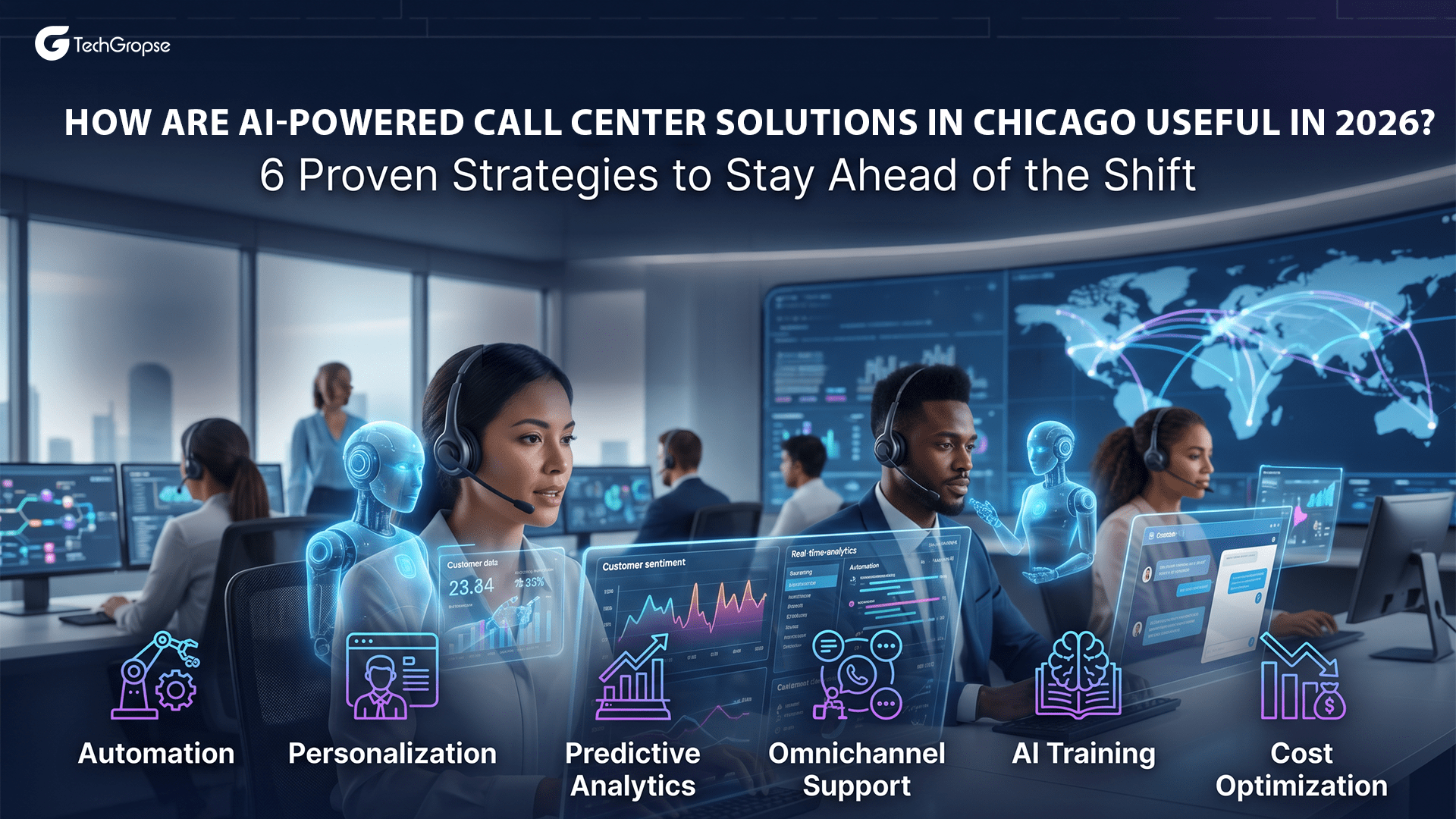
- How modern call center solutions Chicago are changing the field. These locations are redefined using intelligent technology.
- The current scenario of AI usage in call centers, especially in the Chicago region. From IVR to AI, the call centers of the region have changed drastically.
- The benefits of using Voice agents for call centers in Chicago. These benefits cover the top 5 must-know points.
- Top 6 ways AI is redefining how call centers in Chicago operate to meet the modern business needs.
- How a business can select the best AI agent tool to boost its operations and revenue during a quarter or financial year.
AI is rapidly changing the Chicago-based call centers. They are no longer just cost centers for handling inbound calls. They are now strategic hubs powered by intelligent technology. AI voice bots and automated systems to handle customer inquiries faster and more efficiently than ever before.
As per Fortune Business Insights, the worldwide call center AI market will explode to reach 13.52 billion by 2034. In fact, many call centers globally are using AI to enhance their operations by building highly personalized customer relationships. However, a few of the decision-makers are still confused and want to know how AI is changing call centers.
Many business decision makers consider AI as a future trend, but it is happening right now, especially in call centers. This blog will tell you how AI is changing the call centers, how to choose the best AI call center software, steps to take for staying ahead, and who can help.
AI for Call Center Solutions Chicago: The Current State
Earlier, the Chicago-based call centers were using IVR (many call centers didn’t only use IVR, they overused it). IVR menus were rigid. Scripts were static. Agents were overwhelmed. Customer satisfaction was low, and operational costs were high.
That era is over. AI-powered call center solutions Chicago have replaced the old playbook entirely, and the contact centers still clinging to legacy infrastructure are falling further behind every quarter.
Due to this, call center automation has become important for Chicago-based call centers. This automation, done using AI, helps to reduce operational costs and improve customer satisfaction.
For Chicago businesses, home to some of the largest financial, healthcare, and logistics operations in the USA, using AI in call centers is not a distant trend. It is an immediate competitive reality. Companies that invest now will compound their advantage. Companies that delay will spend twice as much to catch up.
Technologies like Natural Language Processing (NLP), Generative AI, and Large Language Models (LLMs) gave contact center systems the ability to perform complex conversations without human escalation. Together, these three technologies eliminated the core limitation that had held call center AI back for a decade: the inability to handle nuance.
According to Calabrio, 98% of contact centers now use some form of AI. This report says that “AI is critical, but sustainable impact comes from combining technology with meaningful investment in people.”
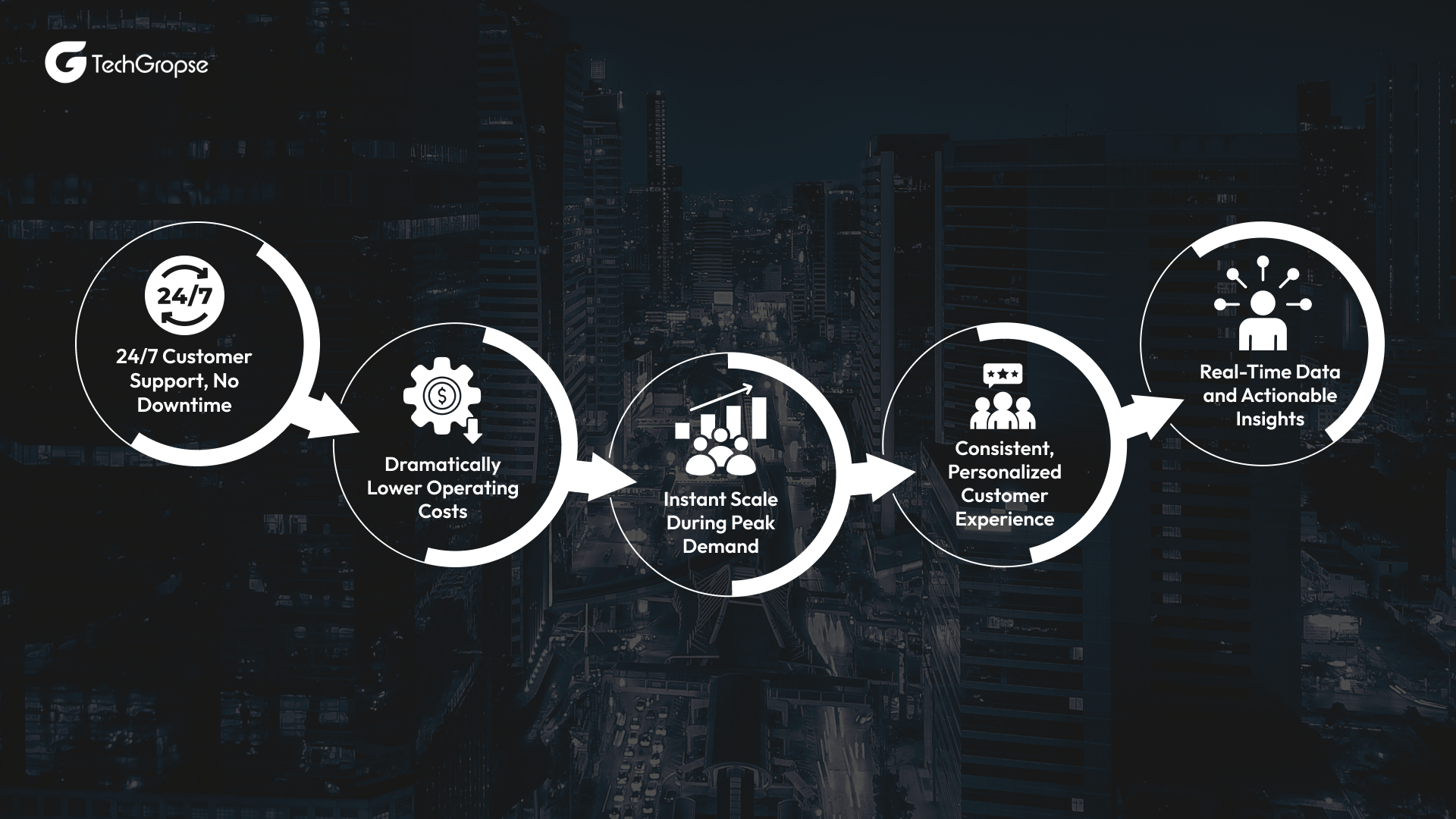
Top 5 Benefits of Voice Agents for Call Centers in Chicago
6 Ways AI Is Changing Call Centers Right Now
Call center solutions Chicago are useful for businesses in Chicago as they can get cutting-edge in operations. The following points showcase how AI is changing call centers in Chicago:
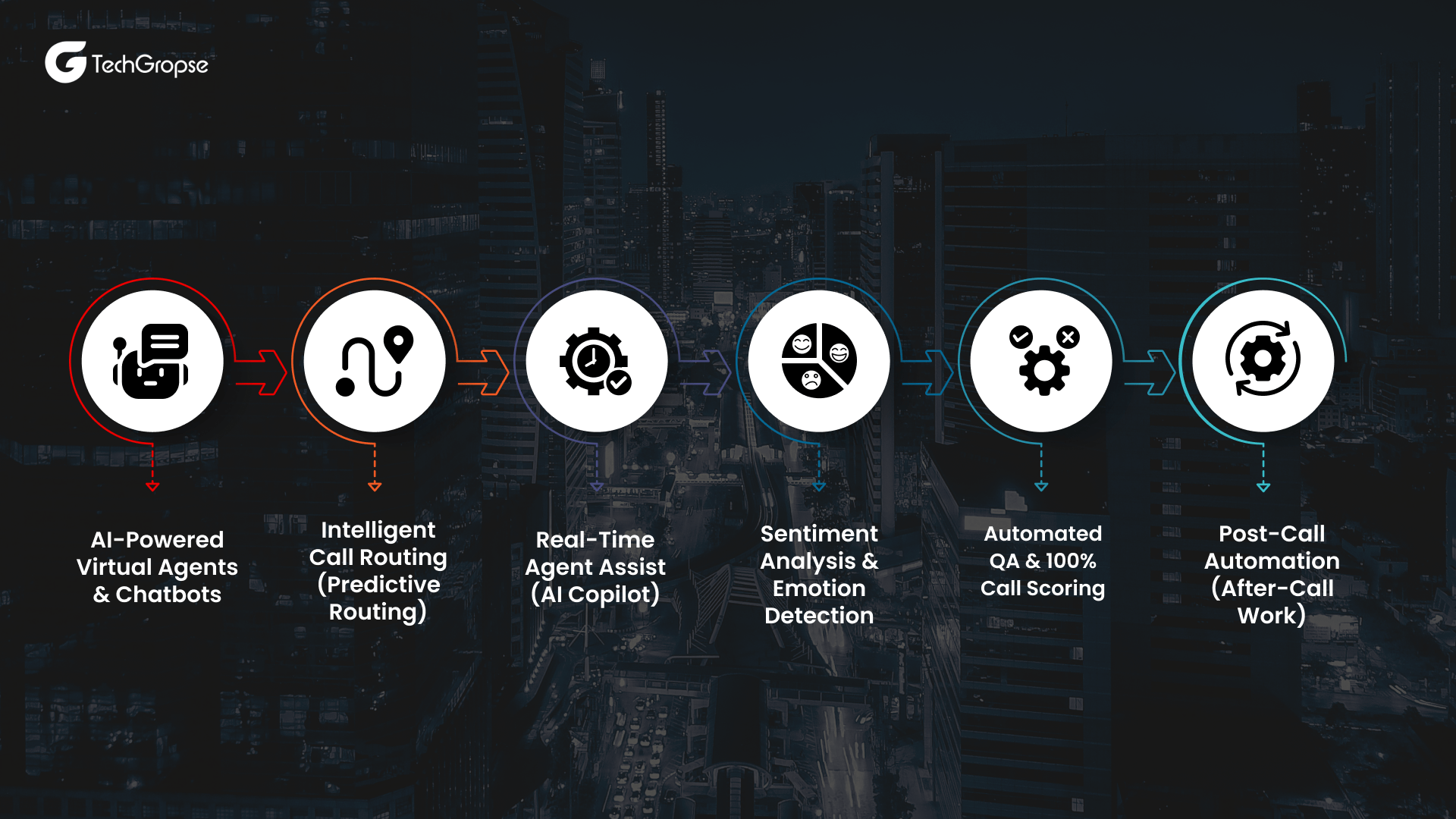
AI-Powered Virtual Agents & Chatbots
The call centers in Chicago do not have to have human agents to answer all incoming calls. Virtual agents powered by AI are capable of answering frequently asked questions, taking orders, and making appointments 24/7. They provide prompt and correct responses with no holdups and no staffing expenses.
Routine queries make up the majority of call center volume, and AI virtual agents handle these interactions end-to-end without escalation. Studies show inbound volume drops by 30–50% when virtual agents are properly deployed.
The ROI of virtual agents compounds quickly for Chicago enterprises. Every routine call deflected saves agent time, reduces operational cost, and frees human staff for complex interactions. Businesses that deploy them report measurable CSAT improvements within the first quarter.
Use Case: Customers want to be able to get answers instantly at 2 AM, as much as at 2 PM. Artificial intelligence chatbots and voice agents do not sleep, do not call sick leave, and do not hold callers. That would be 24/7 resolution without a single extra head.
Intelligent Call Routing (Predictive Routing)
Traditional call routing matched callers to agents based on basic skill tags. AI-powered predictive routing goes far deeper by analyzing intent, sentiment, history, and behavior patterns. The result is the right caller reaching the right agent on the first attempt.
AI in call centers in Chicago frustrates none. Intelligent routing eliminates unnecessary transfers by predicting the caller’s needs before the conversation begins. CSAT scores rise significantly when customers feel immediately understood and correctly directed.
Predictive routing uses real-time data, not static rules. AI reads customer history, purchase behavior, and live sentiment to make routing decisions in milliseconds. This level of precision was simply impossible with legacy IVR systems.
Use Case: For Chicago’s high-volume contact centers, intelligent routing is a force multiplier. It reduces average handle time, improves first-call resolution, and maximizes agent utilization. Smarter routing means fewer wasted interactions and higher revenue per call.
Real-Time Agent Assist (AI Copilot)
It is impossible to have human agents who memorize all the policies, product updates, and compliance requirements at the same time. AI copilots hear live calls and bring the correct answers to the surface in real-time. In each and every interaction, agents act like professionals.
McKinsey estimates that AI-assisted agents are capable of resolving 14% more issues per hour. Such profits multiply among hundreds of agents making thousands of calls a day. To Chicago businesses, that can be translated to millions of dollars of productivity saved in a year.
AI copilots are not just answer retrievers; they dictate agent behavior. They indicate compliance risks, propose next-best actions, and give empathy cues when conversations are tense. This makes all agents high performers, irrespective of level of experience.
Use Case: Contact center management is one of the most costly tasks, with new agent onboarding. Live AI support significantly reduces the time to learn among new employees. Within a few weeks, a new agent with the help of AI can be as effective as a six-month veteran.
Sentiment Analysis & Emotion Detection
An agitated customer will hardly declare his or her aggravation in straightforward terms. Sentiment analysis is an NLP-based tone, pace, and word choice detector that identifies emotional signals in real time. At-risk calls are noticed immediately they start escalating by supervisors.
It is only by the agents being aware of how one of the customers is feeling that empathy at scale becomes possible. Sentiment analysis presents the agent with real-time emotional intelligence on his/her screen. It enables the adjustment of tones, defusing, and authentic human interaction in the present.
Sentiment data not only guards the individual calls but also indicates systemic patterns. The repetitive emotional triggers during customer conversations reveal the product failures, gaps in policies, and training requirements. Chicago companies utilize the data to solve root causes, not merely symptoms.
Use Case: Live supervisor dashboards powered by sentiment AI change how contact centers are managed. Floor managers no longer rely on random call monitoring or lagging reports. They see the emotional health of every active conversation in real time and intervene where it matters most.
Automated QA & 100% Call Scoring
Traditional quality assurance reviewed 2–5% of calls, leaving 95% of interactions completely blind to oversight. AI-powered QA scores every single call automatically, without additional headcount. No compliance risk, coaching moment, or script deviation goes undetected.
Manual QA is slow, inconsistent, and limited by human bandwidth. AI applies the same scoring criteria uniformly across thousands of daily interactions. This eliminates evaluator bias and creates a reliable, auditable quality record for every conversation.
For Chicago businesses in regulated industries, healthcare, finance, and insurance, 100% call scoring is not a luxury. It is a compliance necessity. AI-powered QA creates automatic evidence trails that protect businesses during audits and legal disputes.
Use Case: Automated QA also transforms coaching from reactive to proactive. Managers no longer wait for complaints to identify underperforming agents. AI flags coaching moments the same day they occur, compressing the feedback loop from weeks to hours.
Post-Call Work (Post-Call Automation)
Agents manually wrap up, write notes, update CRMs, tag categories, and schedule follow-ups (10-15 minutes) after each call. The AI eradicates this completely by automating the actions after calls when a conversation is over. The agents go to the next caller.
Manual after-call work is not only slow, but it is also prone to errors. Memory-based agents do not capture all the details, label the categories of calls improperly, and leave uneven CRM records. The summaries that are produced by AI are precise, standardized, and can be accessed by each downstream team in real-time.
The ability to recapture 10-15 minutes of after-call time per agent per call leads to massive capacity. The equivalent productive hours of several full-time employees are reclaimed each week by a team of 50 agents making 40 calls per day. The recovered capacity does not add any extra cost to implement.
Use Case: The customer experience on future interactions gets better with post-call automation. With the tagging and logging of all the calls, the subsequent agent is fully informed and does not need to inquire of the customer to repeat themselves. Continuity is one of the most influential drivers of customer loyalty.
We can help businesses get customer AI-powered solutions to accelerate their call center operations.
How to choose the best AI call center software?
Call center managers and business owners in Chicago are aware of what AI’s incorporation has changed. However, they are confused and want to know “how to choose an AI call center software.
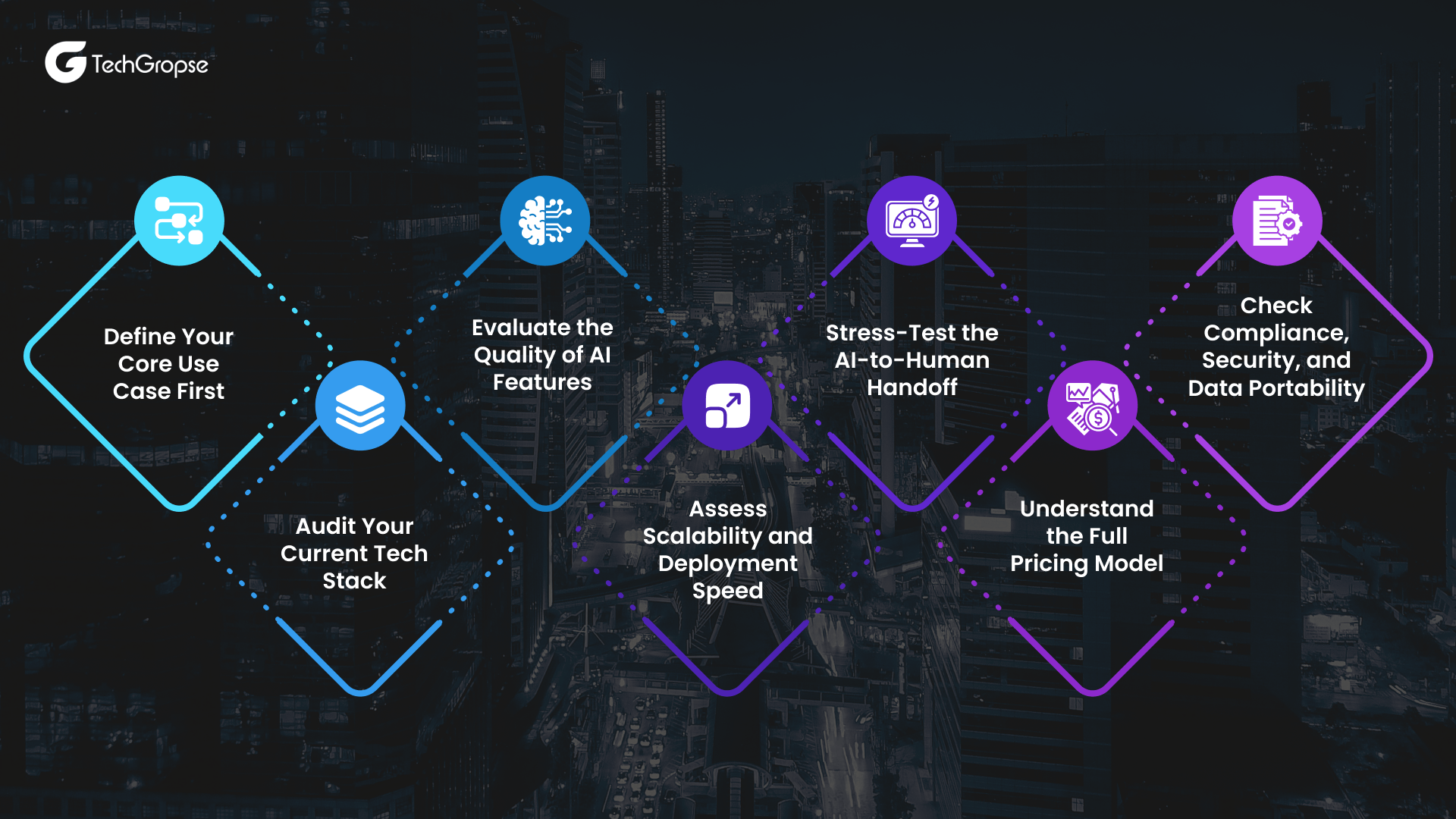
Define Core Use Case First
Understand whether you should have inbound support, outbound sales, or both. The role of AI voice agents and AI agent-assist tools is quite different. Selecting the incorrect type wastes money and slows down your team.
Review Your Tech Stack
Name all CRM, helpdesk, and communication tools your team already utilizes. Your new AI software needs to be an inseparable part, not only to connect through API. Lack of integration results in data silos and renders the use of AI futile.
Evaluate the Quality of AI Features
See past the marketing, put the real AI capabilities to the test. Confirm real-time agent assist, sentiment analysis, and call summaries. Be wary of AI functionality that is only accessible on enterprise levels and not on basic packages. The Digital Merchant
Evaluate Scalability and Deployment Time
Cloud-native systems such as Aircall or Dialpad will become operational in a few hours. The Digital Merchant Enterprise systems, such as Five9, may take weeks and need professional services. Select according to your timeframe, group size, and speed of results required.
AI-to-Human Handoff-Stress-Test
Whenever AI cannot solve a call, it has to switch to a human agent without problems. Request the vendors to clarify what context is being passed to the agent and what the customer should restate.
Know the Full Pricing Model
Pricing can also grow unpredictably when used in combination with AI add-ons, as well as usage-based pricing. Create an approximate number of seats and volume of calls, and compare vendors. The most economical plan is seldom what you actually cost to run.
Check Compliance, Data Portability, and Security
Make sure the software is in line with the regulations, such as GDPR or HIPAA, and seek encryption and voice biometrics. Ensure that your call recording and CRM information can be exported in case you change vendors. Some platforms are harsh to migrate to due to proprietary integrations; never sign without enquiring about portability.
Do you know: Many mobile app development companies in Chicago provide AI-powered features with a voice AI agent to enhance operations.
Conclusion
The 6 steps in this guide provide you with a clear, actionable direction, whether you are running a global contact center or a small business team in Chicago. Measure one high-impact change and start with that. Superiority outstrips excellence all the time.
The future of customer service is smart, quick, and human where it counts most. AI does the volume, your agents the value. It is a balance that will make the difference between a good and a great call center in 2026 and beyond. This will answer the question: “How AI-powered call center solutions Chicago are changing the field in 2026”.
To learn how to apply AI to your call center, either worldwide or here in Chicago, book a consultation with Techgropse to get expert advice specific to your business.

Frequently Asked Questions
AI handles call routing, chatbot support, sentiment analysis, agent coaching, automated QA, and post-call summaries. It reduces manual work while improving customer experience at scale.
No. AI handles repetitive, high-volume tasks, but human agents remain essential for complex, emotional, and high-stakes conversations that require empathy, judgment, and accountability.
Enterprise platforms with full automation, analytics, and omnichannel support can cost significantly more depending on scale. However, implementing TechGropose’s AI voice agent is quite affordable for businesses.
The leading AI call center platforms in 2026 include Five9, Genesys, Dialpad, Talkdesk, and Amazon Connect, each offering automation, real-time agent assist, and omnichannel support. However, choosing TechGropse is one of the great options here.
Cloud-native AI platforms go live within hours to days. Enterprise-grade deployments with custom integrations, data migration, and agent training typically take four to twelve weeks.

Hello All, Aman Mishra has years of experience in the IT industry. His passion for helping people in all aspects of mobile app development. Therefore, He write several blogs that help the readers to get the appropriate information about mobile app development trends, technology, and many other aspects.In addition to providing mobile app development services in USA, he also provides maintenance & support services for businesses of all sizes. He tried to solve all their readers' queries and ensure that the given information would be helpful for them.

 info@techgropse.com