


























































Today, Artificial Intelligence (AI), once thought to be merely the stuff of science fiction, has become an incredibly powerful weapon for modern-day firms and has been playing a crucial role in transforming businesses and exciting customer experience through products and services driven by highly creative processes. Unlike their traditional approach of using tried and tested methods in their quest for growth and success, organisations in the continuously evolving digital world are increasingly using the opportunities created by harnessing new technologies like artificial intelligence in order to maximize outperformance and achieve quicker revenue generation. The increased adoption of AI use cases in businesses has heralded the beginning of an era where intelligence, data, and automation drive every process.
The importance of using artificial intelligence business applications in the world will only grow as we near the year 2026. AI can be applied across many industries, from retail and finance to healthcare and education, to accomplish a few tasks that otherwise would be too time-consuming and or unmanageable. AI can allow any business to interpret data, forecast what is to come based on past similarities, and adjust products and services toward a variety of consumers’ needs.
Market Stats of AI in Business in 2026
Gartner Says Worldwide AI Spending Will Total $2.5 Trillion in 2026. AI Infrastructure Drives AI Spending; Adds $401 Billion in Spending as Technology Providers Continue to Build Out AI Foundations
A report from Presenc AI says that 78% of Global 2000 companies already have at least one AI workload in production by 2026.
Another study from Grand View Research says that 30.6% CAGR (2026–2033) is the projected growth of the global AI market, driven by generative and agentic AI adoption.
Having all these data in hand, we can ensure that AI in business is going have a great opportunity in the nearby future.
Understanding AI in Business and Its Core Functionality
Business AI is smart technology that can perform tasks that would traditionally be carried out by humans because they require human intelligence, such as reasoning, learning, decision-making, and problem-solving. Business AI is supported using algorithms such as machine learning, computer vision, and natural language processing that can process large quantities of data and assist in analyzing the data. However, what differentiates AI from classic software is that it can learn by experience, evolving to perform better and better.
Hence, AI can be seen as an extremely useful tool by companies striving to better adapt to the present-day business environment. AI solutions for business growth enable companies to improve efficacy and efficiency and accomplish better results.
What makes AI such a game-changer for business growth?
It should be stressed that the impact of artificial intelligence on business development is irrefutable since it provides high levels of efficiency, accuracy, and scope. The first key of AI use cases in business is the ability to automate many processes and operations, allowing business providers to focus on more crucial activities targeted at innovation and further business development. Another important benefit of AI that affects business development is the possibility to gain knowledge about various elements, such as customer behavior, trends in the market environment, etc.
Delivering a customised experience for every single customer is one of the most crucial advantages in the current competition among companies. In parallel with shifting desires of customers, tailoring customer experience is significantly needed for a stand-out advantage. However, quantifying the AI ROI for businesses is more for business understanding of how its technology leads to particular consequences.
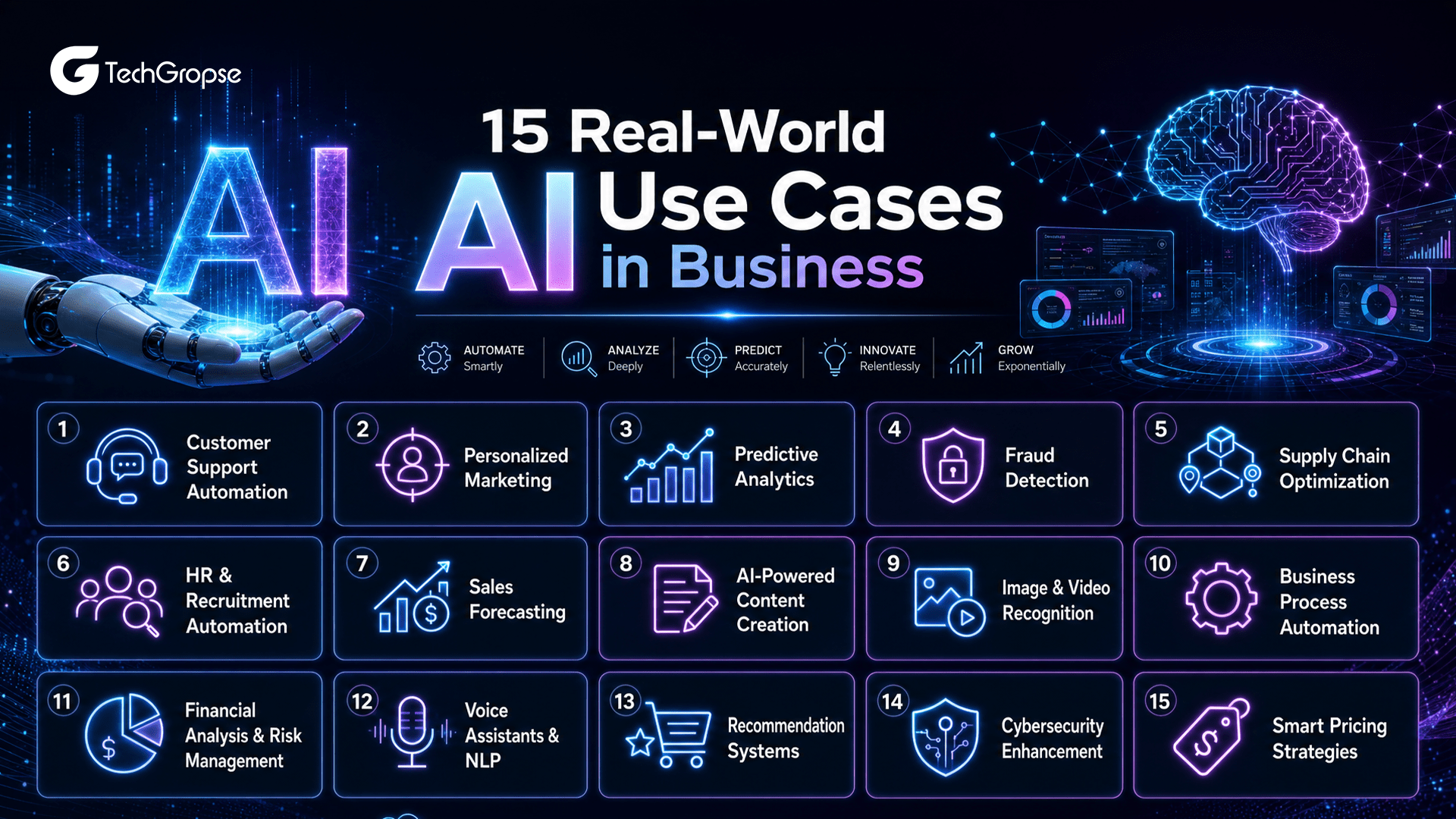
15 Real-World AI Use Cases in Business
1. Customer Support Automation
The other widely used application of AI use cases in business nowadays is the automation of customer service. It allows firms to give their customers effective and immediate assistance without necessarily having to keep a large number of staff employed in addressing their problems. This way, it increases the effectiveness of customer relationships as well as customer satisfaction. AI customer support systems can deal with many types of requests coming from the clients, including solving known problems, instructing users, and performing transactions.
Another reason supporting the common use of online customer support systems is due to the natural language processing function, which enables the system to communicate with the customer more humanly and to make customers feel that an individual message is conveyed to solve a particular problem. The third advantage, which is worth mentioning, is that AI-based support systems are available 24 hours a day, which proves to be very useful for companies dealing with international customers.
In addition, these technologies can gather information about how customers interact with them, thus enabling businesses to identify shared issues, implement improvements for their product/ service, and boost customer satisfaction. AI solutions for business growth will be able to save expenses by reducing the number of tasks performed by human agents.
2. Personalised Marketing
The second area where AI has demonstrated its advantages is in personalised marketing, where AI enables companies to develop tailored marketing campaigns that directly cater to each customer using insights collected from their data and behaviors. Personalised marketing allows companies to deliver the right message at the right time to the right customer for maximum effectiveness.
Customised marketing increases the effectiveness of marketing campaigns, and it is also more valuable for businesses because they can offer their clients a deeper customer experience.
By using AI technology, companies can automate a lot of marketing processes- from email push campaigns, to finding the best places for ads, recommending related products and services, and many others- and also they can implement in-the-moment personalisation, increasing people engagement. As one of the most effective ways in which AI tools for business productivity lead to high performance, personalised marketing presents vast opportunities for companies to generate revenue, maintain customer relationships, and establish brand-esteem.
3. Predictive Analytics
By using patterns and other context or information taken from past data, predictive analytics utilises AI technologies to predict future events, enabling prospective actions to be performed. Employing predictive analytics could be immensely useful, particularly in an industry where being able to predict future events impacts business success.
Examples of the application of this technology to other areas of work are as follows: Inventory management in retail stores and assessing financial risks of banks to prevent defaults.
Also, marketing managers are able to use the technology to predict customer behaviour and develop appropriate marketing strategies. Can Predictive analytics help organisations reduce risk, uncertainty, and opportunity? Predictive analytics is one of the most popular enterprise AI use cases.
4. Fraud Detection
Fraud detection is one of the most important applications of artificial intelligence, in particular in the financial, insurance, and e-commerce sectors, where security is such a delicate issue. The AI system can make a real-time analysis of all the records of transactions and recognize abnormal behaviors and alert the enterprise about potential risks, so they can react there and then and prevent being affected. The capability of an AI system is that it can continuously learn from new data, so that it can adapt and perform better, unlike rule-based systems.
Furthermore, an AI system cannot only actively detect the fraudulent activity but also can actively prevent the fraud by recognising any possible threat to recommend what action should be taken. By eliminating any fraud and safeguarding from data breaches, businesses will be able to keep their assets protected and secure, preserve customer trust, and comply with all regulations and real-world AI applications in business 2026.
5. Supply Chain Optimization
Strategic industry management using AI enables businesses to leverage their operations to their advantage via demand prediction, inventory management, planning of logistics, coordination of the supply chain, etc. It allows the firm to analyse data that the business can produce, which can give suggestion points such as analysis on data generated by past sales records and trends of the business that may give the firm an indication of its disadvantages, so that the firm can then think of ways to solve this issue. As such, it would lead to fewer inefficiencies and the produce would be delivered on time. This would lead to better customer experience and satisfaction, and then loyalty. In those competitive times, highly effective supply chain management.
6. HR & Recruitment Automation
Thanks to AI technology, however, the process of recruiting is also taking a different shape. It is now possible to shortcut the process by, for instance, having AI evaluate your resumes, identify the best candidates, set interview times, and perform first-round screenings. The application of artificial intelligence methodology makes it possible to analyze a large number of applications during a short period of time and to identify the perfect applicants among them.
Furthermore, the application of AI implementation in business examples for the HR process removes any sort of bias and ensures finding the right applicants in an efficient and fast way. Companies that want to move fast can partner with dedicated AI staffing providers to access pre-vetted engineers with machine learning, MLOps, and prompt-engineering skills. Additionally, AI can be used to increase employee engagement or assess performance, making it the most beneficial application.
7. Sales Forecasting
The sales forecasting software, powered by artificial intelligence, relies on historical data, customer interest, and Market trends to accurately predict sales performance for the period ahead. This helps businesses to be more prepared for their strategy.
It enables companies to allocate their resources more efficiently, fulfil their inventory needs, and identify growth areas, thus leading to more profits and less risk.
8. AI-Powered Content Creation
Generative AI is revolutionising industries worldwide, especially in content creation. It offers businesses the opportunity to create relevant and high-quality content much more quickly and efficiently, without the loss of creativity and relevance. This can be used for everything from generating blog posts to updating social media accounts to producing new product descriptions or marketing copy, all in accordance with brand standards and messaging objectives.
This process is not only time and effort-saving, but it also opens opportunities for companies to expand their marketing efforts with scalable content marketing campaigns. Generative AI business use cases for content creation are one of the hottest uses.
9. Image & Video Recognition
Some of the applications of AI-based image and video recognition are related to quality control, security, behavioural studies, product recognition, etc. This technology has the ability to analyze images and find patterns and irregularities, thereby helping companies get ahead of their competitors. Retailers may use image recognition to observe their safety activities, while manufacturers may use it to detect flaws.
10. Business Process Automation
Some tasks are monotonous and can be easily automated through AI, such as data entry, invoicing, reporting, and workflow management, freeing people to work on strategic and forward-thinking jobs. This will prevent any mistakes because of humans, which brings good accuracy and reliability. The AI automation in business benefits that a company can derive after implementation.
11. Financial Analysis & Risk Management
The AI apps examine financial data to understand what each likely danger is and how to put the best investment plan into action, and provide successful support with timely and accurate advice to contribute to the financial health and remaining competitiveness of the business in the ever-changing circumstances of the market. The AI programs can identify irregularities, forecast trends, and recommend ways of reducing financial risks.
By using the AI, companies could carry out some complicated finance work, such as budgeting, forecasting, auditing, and compliance, etc., automatically with less manual work and more accurately. The AI systems could analyze huge financial data within seconds.
Key Benefits:
- Real-time financial insights and reporting
- Improved risk detection and fraud prevention
- Better investment decision-making
- Reduced human errors in financial processes
- Enhanced compliance with regulatory standards
12. Voice Assistants & NLP
National Language Processing (NLP) based voice assistants are tools that enable interaction with applications using voice, helping to make them more consumable and making for all users a more friendly interaction with applications in different domains, mainly in customer service, smart devices, and enterprises. Increasing numbers of companies are seeking to endorse the use of voice AI technology in their systems, as it can allow them to give help without any user input.
Key Benefits:
- Faster and more convenient user interaction
- Improved accessibility for users
- Enhanced customer engagement
- Reduced dependency on manual inputs
- Better user experience across platforms
13. Recommendation Systems
Recommendation systems use AI systems to recommend services, products, and content suitable for consumers based on their interests and behavior patterns. The use of recommendation systems results in an increase in sales and customer interactions with the business.
An AI recommendation system takes various pieces of data to better understand consumer behavior and develop timely recommendations for the target consumers. These systems can be applied to a wide range of industries, such as e-commerce, streaming applications, and other digital goods, and increase both customer retention and conversion.
Key Benefits:
- Increased sales and conversion rates
- Improved customer engagement
- Personalised user experience
- Higher retention and loyalty
- Better understanding of customer behavior
14. Cybersecurity Enhancement
Artificial Intelligence enhances cybersecurity by threat detection, risk assessment, and prevention, and keeps data away from harmful breaches and cyber-attacks. AI automatically monitors everything happening inside the network and finds out which activities are anomalous and could be potentially threatening.
Artificial Intelligence produces immediate responses for such hazards, thus preventing data theft and cybercrimes. As data security holds the highest priority in today’s world, AI has made its relevance felt unquestionably in cybersecurity.
Key Benefits:
- Real-time threat detection and response
- Improved data security and protection
- Reduced risk of cyberattacks
- Continuous monitoring of systems
- Enhanced trust and reliability
15. Smart Pricing Strategies
With the help of AI, dynamic pricing gets simpler as modifications can be made based on the current situation of the market, fluctuations in demand, the prices set by the competitors, and customer behavior, so as to maximize profit with a competitive edge.
Dynamic pricing is a widely used method by companies that need to respond quickly to any market changes and want to grow their profits and win customers by offering more appealing prices.
Key Benefits:
- Increased revenue and profit margins
- A real-time price optimization system
- Positioning your business for competition
- An improved demand management system
- A higher level of customer satisfaction
How Companies Use Artificial Intelligence in Real Life?
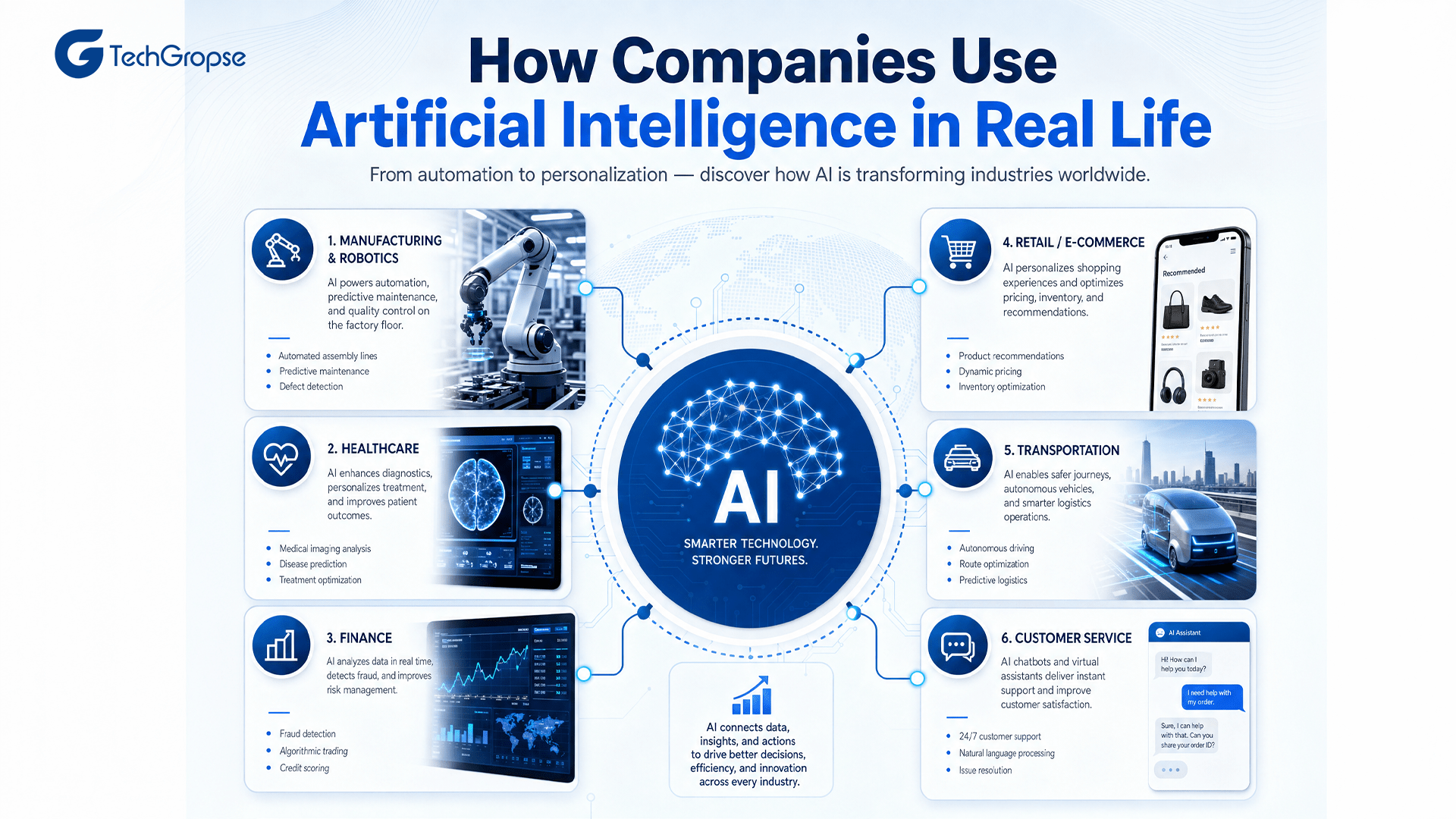
Then, some practical implementations of AI have been used within the business by means of integrating it into some departments of the business in order to increase the efficiency of the business, improve customer experience, and increase profit. In practical applications or implementations of AI, it has been used to foresee customer service functions, customize marketing campaigns, and even make better decisions. The AI can be used in the process of the business, by solving problems from time to time.
AI will be combined with other technologies like cloud computing, big data, IoT, etc., to develop smarter systems. This will lead to the development of intelligent ecosystems that will work under all conditions efficiently.
Where AI is Used:
- Customer service and support
- Marketing and advertising
- Sales and lead generation
- Operations and supply chain
- Finance and risk management
Business Impact:
- Increased efficiency and productivity
- Better decision-making
- Enhanced customer experience
- Faster business growth
- Competitive advantage
Best AI Use Cases for Small Business
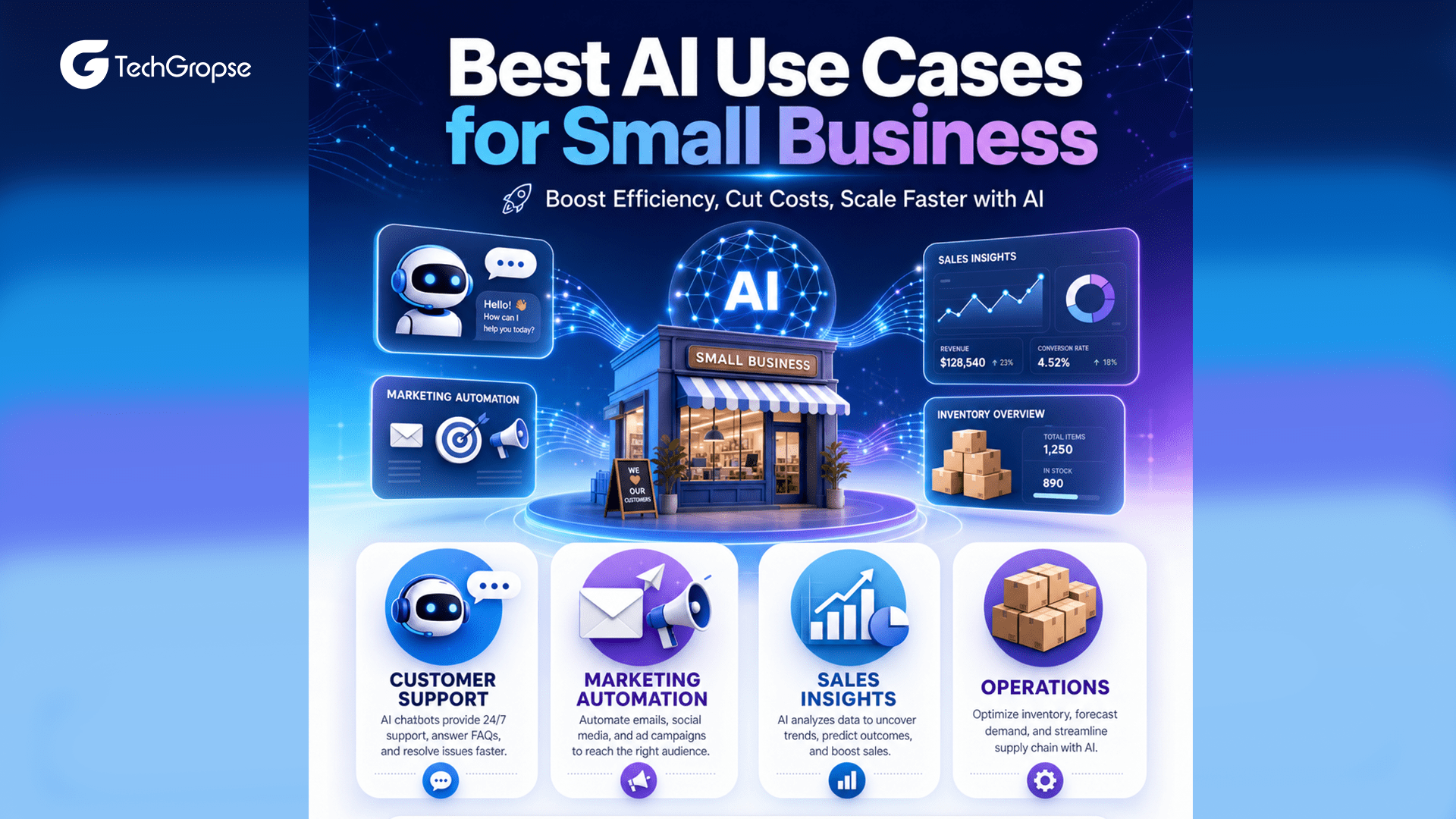
Small businesses have much to improve on with the implementation of AI in the form of affordable technologies such as chatbots delivering consistent and quick customer care services, automated emails, to reach a broad audience with marketing campaigns and applications helping in updating and maintaining the social networks, just to name a few. Technologies like these are inexpensive, easy to adopt, and free and well-suited for use on a lean budget, flexibly incorporated into the process. By adopting technology like this, small businesses should be able to keep pace with larger companies while maintaining development.
Top AI Tools for Small Business:
- Chatbots for instant customer support
- Email automation for marketing campaigns
- Social media scheduling and analytics tools
- CRM tools with AI capabilities
- Basic data analytics platforms
Key Advantages:
- Low cost and easy implementation
- Time-saving automation
- Improved customer engagement
- Better marketing results
- Scalable growth opportunities
AI ROI for Businesses
The ROI of AI can be calculated in terms of saving costs, generating more revenue, increasing efficiency, and also customer satisfaction, and may eventually be considered one of the most worthwhile investments for modern business entities. Thanks to artificial intelligence, companies can acquire many benefits from automation, error reduction, and optimisation.
Another reason why AI is useful is that it provides a more logical way to make decisions, which leads to success. Companies that use artificial intelligence tend to grow at a faster rate and be highly profitable.
ROI Factors:
- Reduced operational costs
- Increased sales and revenue
- Improved productivity
- Better customer retention
- Faster decision-making
Long-Term Benefits:
- Sustainable business growth
- Competitive advantage
- Innovation and scalability
- Enhanced brand value
Conclusion
Through the implementation of AI within their business processes, firms are able to become more efficient, make better decisions, and create greater value for customers. This blog on AI applications in business demonstrates how there are many ways that AI is used in business.
Businesses will be able to enhance their current operations and get ready for the future when they successfully integrate AI. Since AI is vital to modern businesses, its influence in the industry cannot be understated.
Final Takeaways:
- The use of artificial intelligence improves efficiency and productivity
- The use of artificial intelligence leads to better decisions
- Enhancing the customer experience with artificial intelligence
- Increasing revenue and reducing costs are two benefits of AI
- Long-term business growth is ensured by artificial intelligence
In order to flourish in the future, businesses will need to use information and technology more intelligently, and artificial intelligence will be crucial to this process.
FAQs (Frequently Asked Questions)
AI automates processes, improves decisions, and enhances overall operational efficiency.
AI reduces operational costs, increases productivity, and drives higher revenue growth.
Healthcare, finance, retail, logistics, and manufacturing widely adopt AI technologies.
Chatbots, predictive analytics, personalization, fraud detection, and intelligent automation solutions.
Costs vary, but long-term ROI outweighs initial implementation investment significantly.
AI personalizes interactions, offers instant responses, and improves customer engagement quality.
Yes, scalable AI solutions enable affordable adoption for small businesses today.
AI automates repetitive tasks, minimizing manual effort and improving operational efficiency.
AI includes advanced security protocols protecting sensitive business data from breaches.
AI will enable innovation, automation, and smarter decision-making across industries globally.

Hello All, Aman Mishra has years of experience in the IT industry. His passion for helping people in all aspects of mobile app development. Therefore, He write several blogs that help the readers to get the appropriate information about mobile app development trends, technology, and many other aspects.In addition to providing mobile app development services in USA, he also provides maintenance & support services for businesses of all sizes. He tried to solve all their readers' queries and ensure that the given information would be helpful for them.


 info@techgropse.com