



























































After the advancement of social media, physical fitness has become the new trend in our society. It has already been projected that by 2026, this industry will exceed the total evaluation of $22.3 billion. This massive growth clearly showcases that we are heading towards developing more applications like Strava.Â
Key Takeaways:Â
- Market Opportunity of Building an App Like Strava
- What Is Strava and Why Should You Build a Similar App?Â
- Key Features of a Fitness App Like StravaÂ
- How to Develop a Fitness Tracking App Like Strava: Step-by-StepÂ
- Best Tech Stack to Build an App Like Strava in 2026Â
- Cost to Build an App Like Strava: Full BreakdownÂ
- Strava vs Competitors: How to Differentiate Your AppÂ
- How to Find the Best Fitness App Development Company?Â
- Bottomline: Choose TechGropse to Build an App Like Strava in 2026
- FAQs (Frequently Asked Questions)
Market Opportunity of Building an App Like Strava
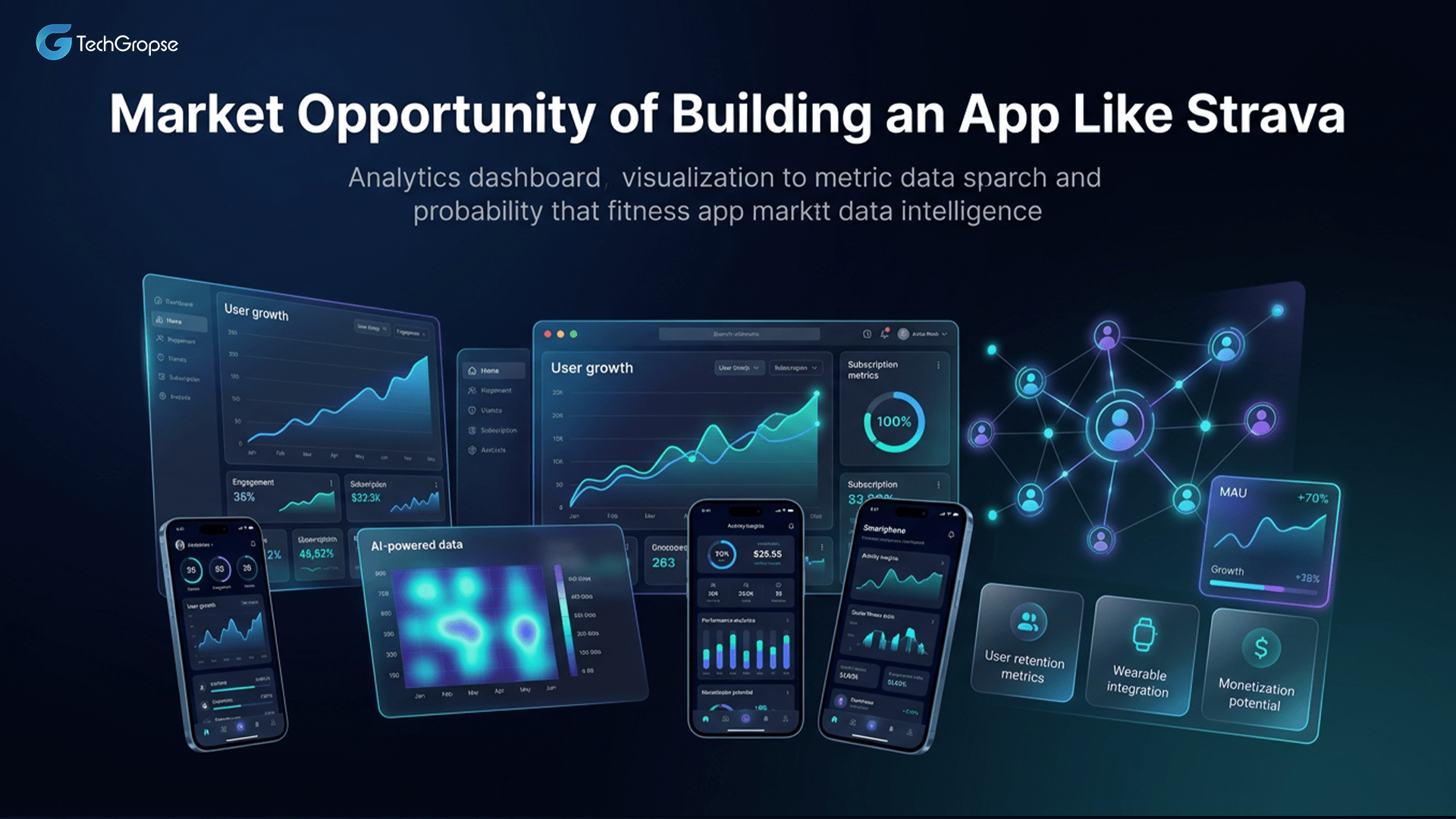
Grand View Research says that the overall market of the global fitness industry is supposed to reach $33.58 billion by 2033. This also forecasted the massive GAGR of 13.4% from 2026 to 2033. Now, if the fitness industry will witness an uphill elevation in terms of revenue, any application like Stvara will also have an exceptional demand in the market.Â
A research paper from TechCrunch claims that Strava recorded downloads of around 50 million users in 2025. Now, such numbers clearly show how a fitness application built with proper features and attributes is going to rise in popularity in the coming days.Â
A Zipdo statistics says that 78% of fitness applications are integrated with IoT and wearable features like smartwatches, Whoop bands, and fitness trackers. Now, if the wearable gadgets are highly selling in the market, it is very certain that building an application like Strava would certainly have a profitable impact.Â
Another Grand View Research says that there are more than 858 million fitness applications downloaded in 2023. With the accelerating demand of health-conscious workout, cycling, running, and gymnasium, the demand for fitness application would further rise.Â
Why Should You Build a Similar App?Â
Strava isn’t just a GPS tracker; it’s a digital locker room. With over 180 million users globally, it has mastered the art of community-driven fitness.
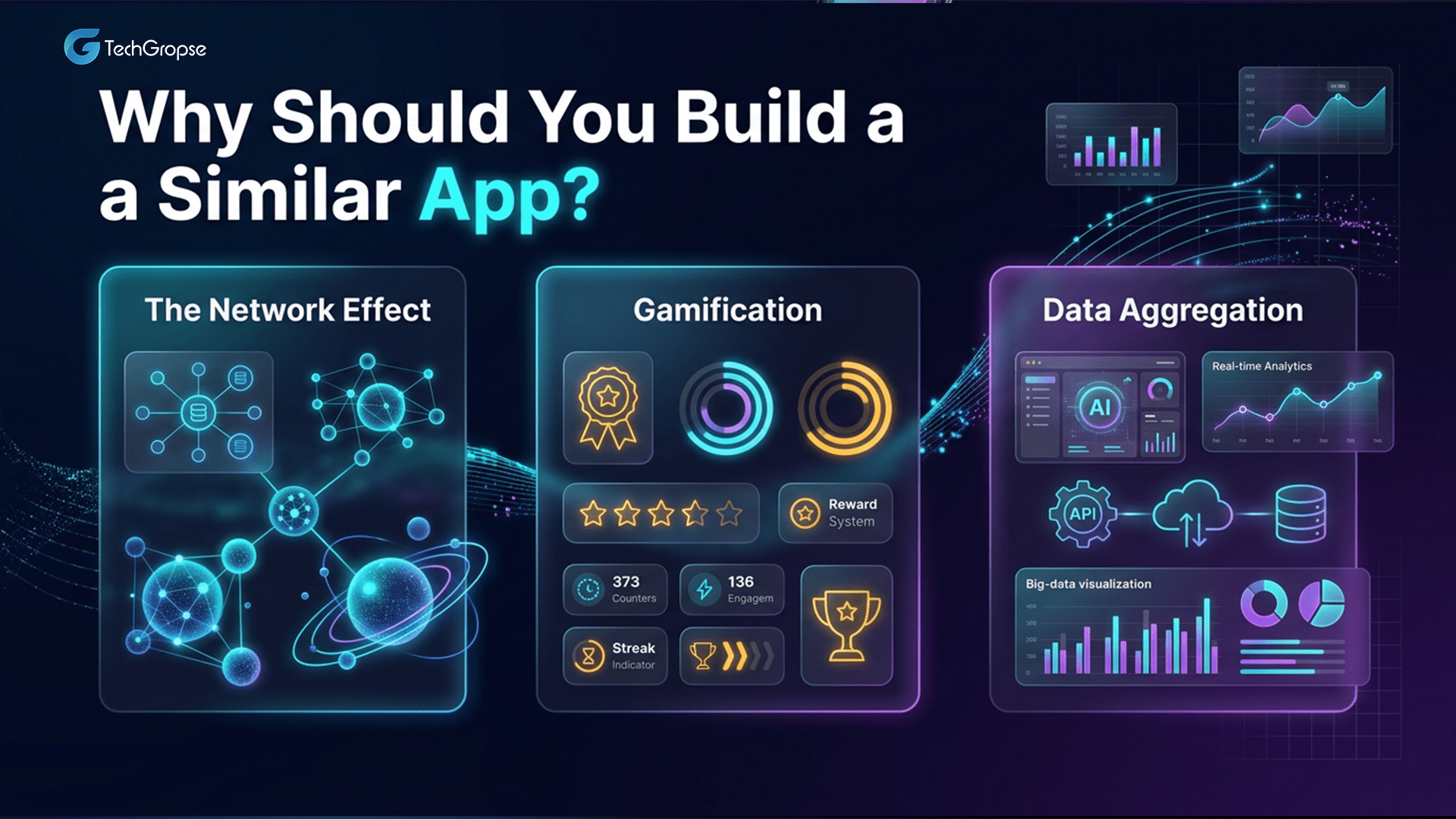
- The Network Effect: Every new user adds value to the community through segments, heatmaps, and “Kudos.”
- Gamification: Features like “King of the Mountain” (KOM) turn a solitary Tuesday run into a competitive event.
- Data Aggregation: It serves as a central hub for data from Garmin, Apple Watches, and even smart e-bike systems.
In 2026, the gap in the market lies in niche communities. While Strava dominates cycling and running, there is a massive opportunity for apps focusing on specific demographics (e.g., postpartum fitness, adaptive athletes) or emerging sports like Padel and Pickleball.Â
Key Features of a Fitness App Like StravaÂ
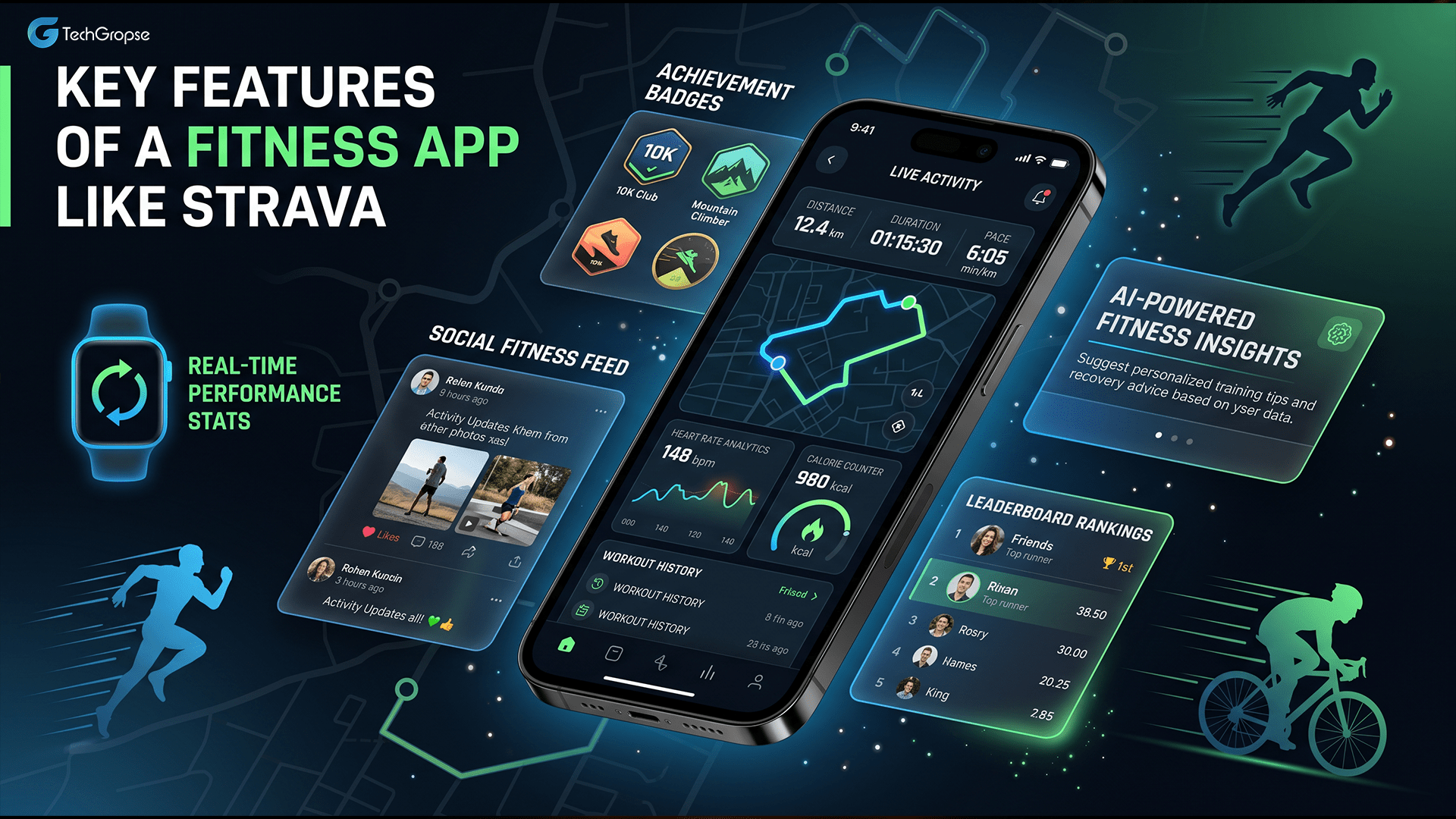
To compete in the modern landscape, your feature set must go beyond basic logging.Â
1. GPS Tracking & Route Mapping Architecture
The heart of the app. In 2026, users expect sub-meter accuracy.
- Real-time Tracking: Utilizing CoreLocation (iOS) and Google Location Services (Android).
- Heatmaps: Show users the most popular routes in their city using aggregated, anonymized data.
- Offline Maps: Crucial for trail runners and hikers in “dead zones.”
2. Social Feed, Kudos & Community Gamification
- The Feed: A vertical scroll of activities with rich media support (4K video snippets of the finish line).
- Segments: User-defined stretches of road where athletes can compare times.
- Clubs & Challenges: Virtual trophies and local leaderboards to drive daily active usage (DAU).
3. Wearable Device Integration
An app like Strava is only as good as its ecosystem.
- Standard Sync: Apple HealthKit and Google Fit.
- Advanced Hardware: Integration with WHOOP, Oura, and Garmin Connect.
- 2026 Trend: Integration with Smart Rings and ECG-enabled earbuds for real-time biometric overlay on GPS maps.
Top 5 Reference Points for Building an App Like Strava
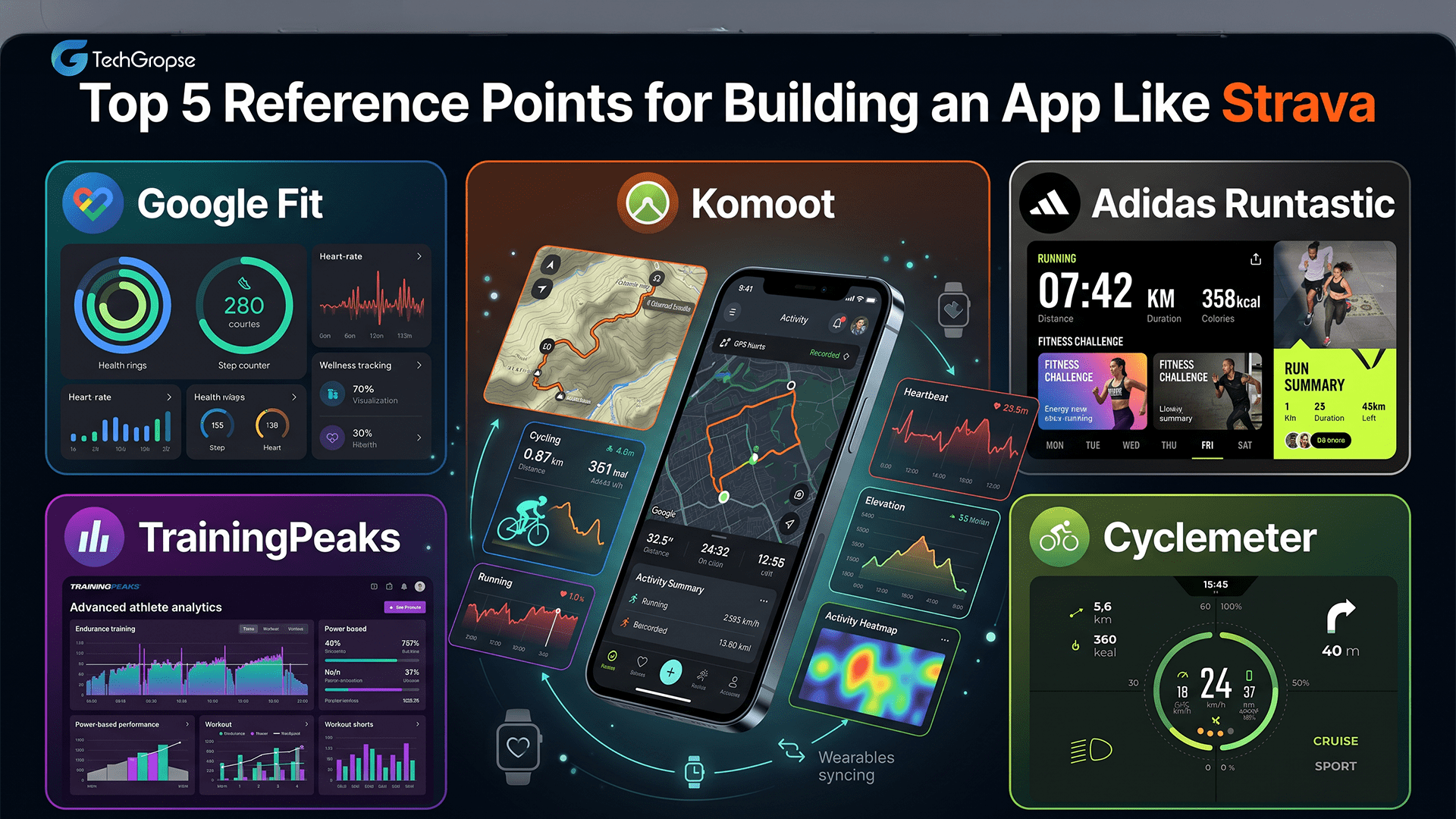
Whenever you start building an application like Strava, competitive analysis is of key significance in the process. Thus, here we have listed the 5 best alternatives or reference points that can help you seamlessly build an application like Strava.Â
GoogleFit
This application collaborates with the WHO, where it helps people with excellent data storage capacity, map integration, calculative measurement, and goal tracking. It helps you to track daily activities, calorie intake, heart rate, and daily steps with AI-driven insights, a usable smartwatch ecosystem, a less complicated UI, and third-party fitness app synchronization through Google Health APIs.Â
TrainingPeaks
This application is particularly built for top-notch athletes, where many consolidated digital features would help you to boost your performance. The advanced workout planning is driven by AI-focused analysis, personalized scheduling, and IoT fitness integration, progress report, and goal management to support sports like swimming, running, cycling, and other endurance endeavours.Â
Komoot
Komoot is basically a hiking and cycling-focused application that has been built to improve the performance of these respective sports. The application helps you to improve the distance coverage, speed, and elevation. With strong GPS tracking, voice-guided navigation, community & venue recommendations, and offline mapping experience, you have the full-fledged facility to leverage the trail discovery and engagement.Â
Adidas Runtastic
This app was developed by Runtastic, and in 2015, it was acquired by Adidas, making it entirely. This solution is also made for athletics, running, cycling, and the improvement of fitness workouts. Here, you also get features like social sharing and community engagement with different badges, milestones, and challenges planning, and performance retention schedules.Â
Cyclemeter
As the name suggests, this application has been dedicatedly made for cyclists, with features like performance metrics on customized dashboards, voice announcements, GPS tracking, workout analysis, and a dedicated report for distance, speed, and cadence.Â
How to Develop a Fitness Tracking App Like Strava: Step-by-StepÂ
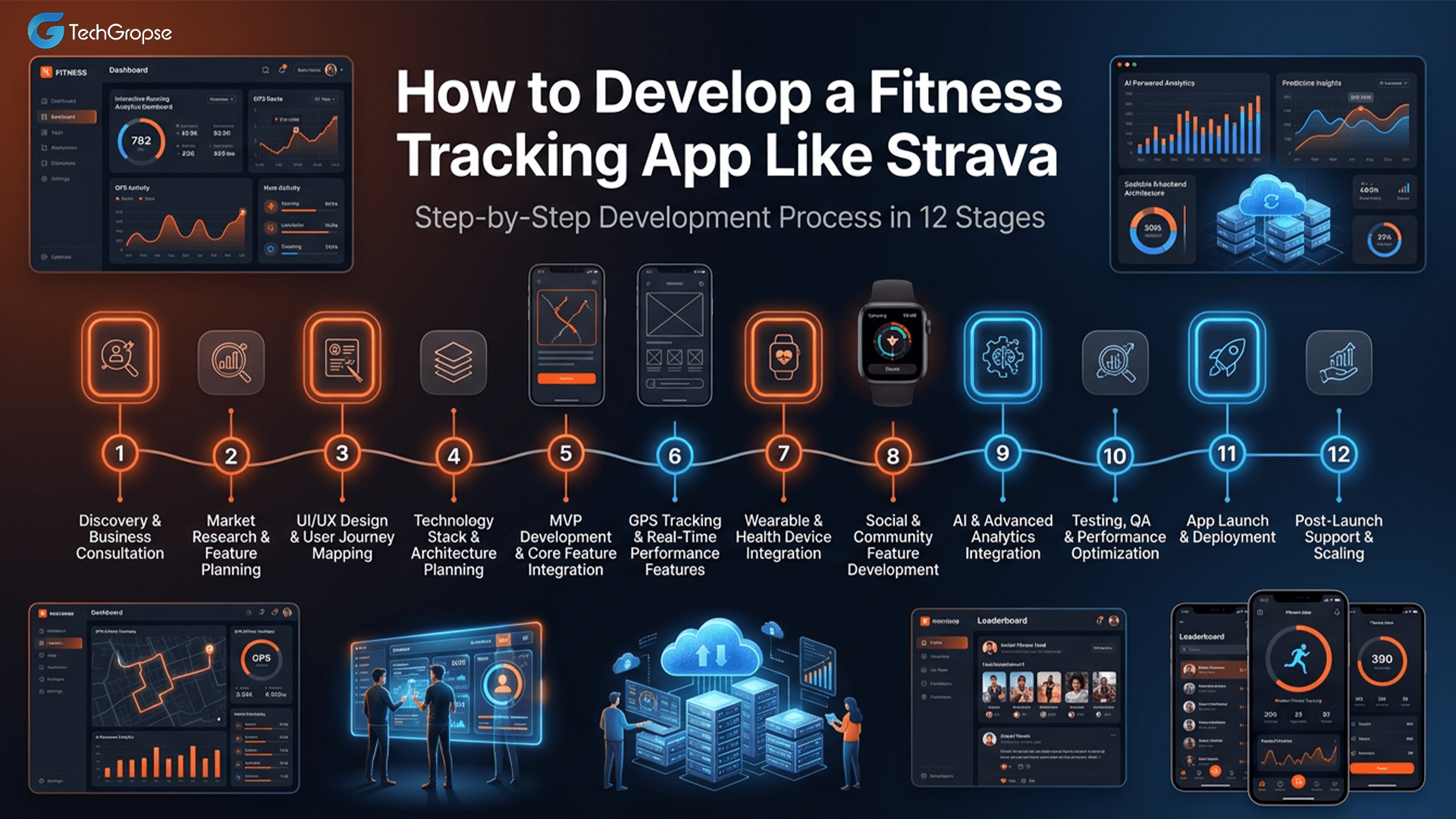
Learn how to develop a fitness tracking app like Strava with step-by-step guidance covering planning, UI/UX, GPS tracking, wearables, AI features, launch, and post-launch scaling.
Step 1: Discovery & Business Consultation
- Define the fitness niche, such as running, cycling, gym workouts, or outdoor sports
- Identify the target audience, user behavior, and engagement expectations
- Finalize monetization strategies like subscriptions, ads, or coaching services
- Analyze competitors, including Strava and other fitness platforms
- Create a complete product vision, roadmap, and development strategy
Step 2: Market Research & Feature Planning
- Research trending fitness app features and user demands in 2026
- Identify differentiators like AI coaching, gamification, or niche communities
- Prioritize MVP and advanced features for phased development
- Define core modules, including tracking, analytics, social feeds, and challenges
- Prepare technical and functional documentation for the development team
Step 3: UI/UX Design & User Journey Mapping
- Design intuitive onboarding and user registration experiences
- Create engaging dashboards with workout stats and analytics visualization
- Build interactive route maps and real-time tracking interfaces
- Develop gamified UI elements such as badges, rewards, and leaderboards
- Optimize user flows for retention, usability, and seamless navigation
Step 4: Technology Stack & Architecture Planning
- Select frontend technologies like Flutter or React Native
- Choose scalable backend technologies such as Node.js or Python
- Integrate cloud services like AWS or Firebase for scalability
- Use Mapbox or Google Maps APIs for GPS and route mapping
- Plan database architecture for activity tracking and analytics storage
Step 5: MVP Development & Core Feature Integration
- Develop user authentication and profile management systems
- Integrate activity tracking for running, cycling, and workouts
- Enable GPS-based route recording and pace monitoring
- Add social sharing and activity feed functionalities
- Build workout history and performance analytics dashboards
Step 6: GPS Tracking & Real-Time Performance Features
- Implement accurate live GPS location tracking functionality
- Develop route visualization with maps and elevation analysis
- Add speed, distance, pace, and calorie calculation modules
- Optimize battery usage during long workout tracking sessions
- Enable live activity synchronization across devices and wearables
Step 7: Wearable & Health Device Integration
- Connect Apple Watch and Wear OS devices seamlessly
- Integrate Apple Health and Google Fit APIs
- Sync heart rate, calories, sleep, and workout metrics
- Support Garmin, Fitbit, and other wearable ecosystems
- Enable real-time health data synchronization and analysis
Step 8: Social & Community Feature Development
- Build leaderboards and fitness ranking systems
- Create community groups and activity-sharing feeds
- Add comments, likes, and social interaction functionalities
- Develop fitness challenges and achievement-based rewards
- Enable friend invitations and community engagement features
Step 9: AI & Advanced Analytics Integration
- Implement AI-powered workout and recovery recommendations
- Provide personalized fitness insights based on user behavior
- Add predictive analytics for performance improvement tracking
- Develop smart notifications and fitness reminders
- Use AI to enhance engagement and retention strategies
Step 10: Testing, QA & Performance Optimization
- Conduct functional and usability testing across all devices
- Test GPS accuracy and wearable synchronization performance
- Perform security and data privacy compliance testing
- Optimize app speed, battery consumption, and scalability
- Fix bugs and ensure smooth real-time activity performance
Step 11: App Launch & Deployment
- Publish the app on Apple App Store and Google Play
- Optimize app listings with ASO and keyword strategies
- Launch pre-release testing and beta user campaigns
- Create marketing campaigns targeting fitness communities
- Monitor launch performance and initial user engagement
Step 12: Post-Launch Support & Scaling
- Continuously monitor crashes and performance issues
- Release regular updates and feature improvements
- Scale backend infrastructure based on user growth
- Integrate user feedback for future enhancements
- Provide long-term maintenance, security updates, and technical support
Best Tech Stack to Build an App Like Strava in 2026Â
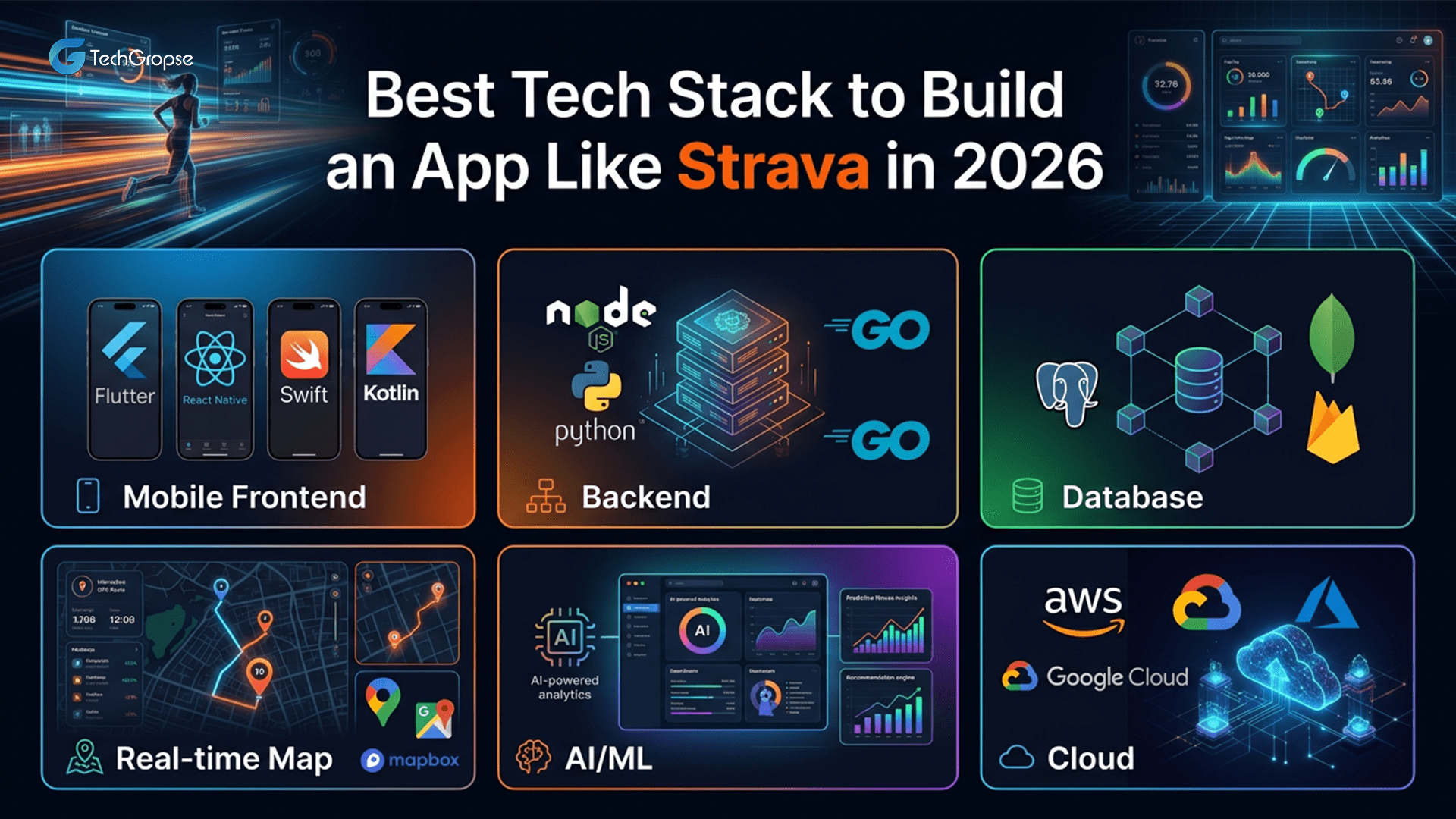
To handle millions of data points and real-time GPS pings, you need a robust, scalable stack.Â
| Component | Recommended Tech | Reason |
|---|---|---|
| Mobile Frontend | React Native or Flutter | Cross-platform efficiency with near-native performance. |
| Backend | Node.js or Go | Go is preferred for high-concurrency GPS data processing. |
| Database | PostgreSQL + TimescaleDB | TimescaleDB is optimized for time-series fitness data (HR, Pace). |
| Real-time Map | Mapbox SDK | Superior customization over standard Google Maps. |
| AI/ML | Python (PyTorch) | For personalized coaching and route recommendations. |
| Cloud | AWS (Lambda & S3) | To handle burst traffic during global marathon events. |
How to Find the Best Fitness App Development Company?Â
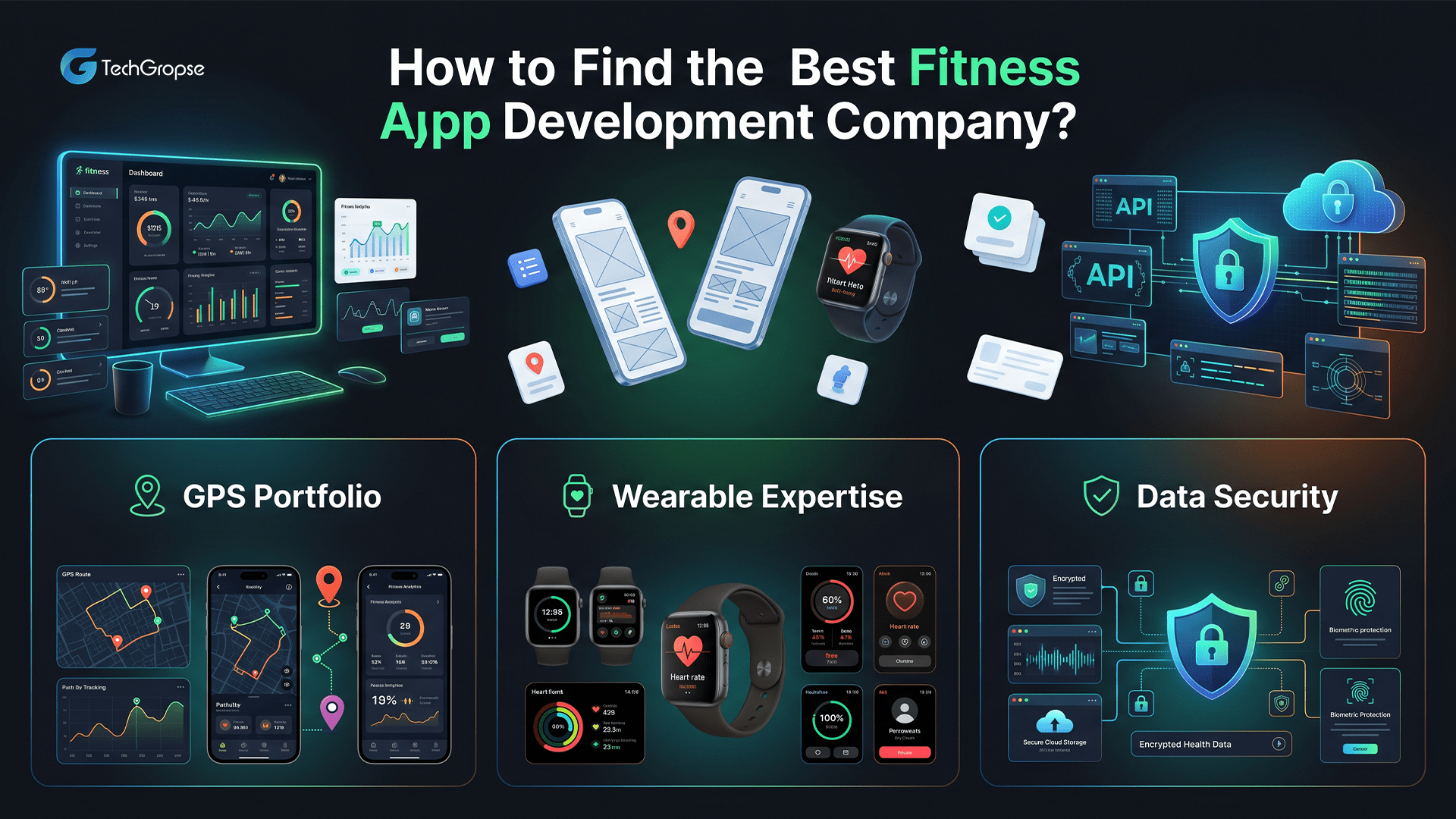
When looking to hire fitness app developers, look for:
GPS Portfolio
Have they built apps that function well in the background? A decent mobile app development company will certainly have a strong market portfolio. Look for the past track record that they have performed in the market. Evaluate the ROI% after the adoption of those applications.Â
Wearable Expertise
To build an application like Strava, you basically require a broad expertise in IoT and wearable technology product development. A well-to-do mobile app development company would show you substantial evidence that will advocate its IoT expertise.Â
Data Security
In 2026, fitness data is considered “Medical Data.” Ensure they are GDPR- and HIPAA-compliant. Fitness and health products are often considered in the YMYL (Your Money Your Life) category. Thus, data security is a vital factor that any mobile app development company must ensure.Â

Cost to Build an App Like Strava: Full BreakdownÂ
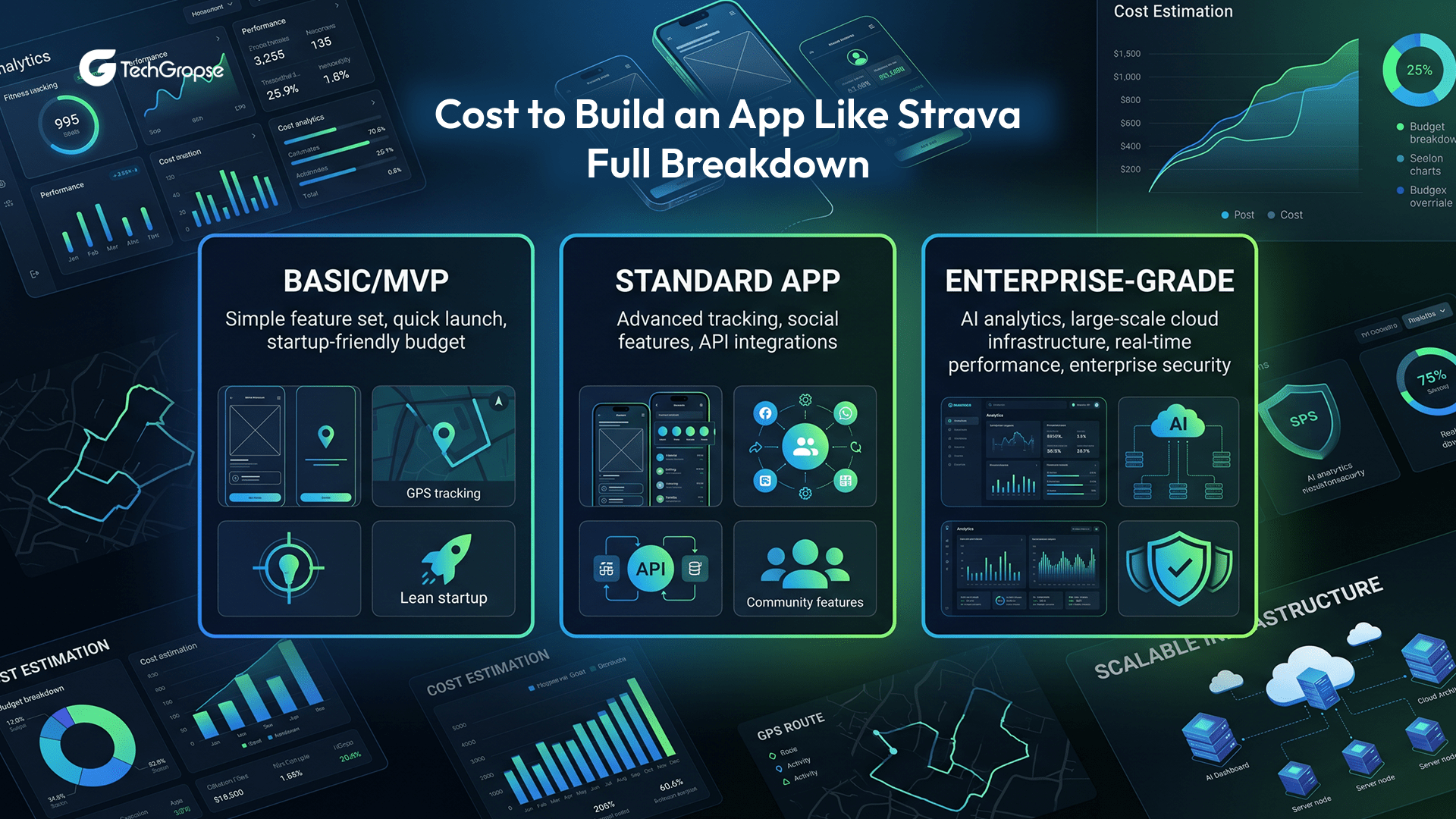
Cost is an important factor that must be taken care of while building an app like Strava. To understand the cost in a better way, we have divided the application into three versions:Â
- Basic or MVPs
- Standard App
- Enterprise-Grade Applications
| App Version | Estimated Cost | Development Timeline | Key Features |
|---|---|---|---|
| MVP (Basic Tracking & Social) | $40,000 – $75,000 | 3–4 Months | Activity tracking, user profiles, social feed, basic analytics |
| Standard App (Segments, Wearables, Heatmaps) | $80,000 – $150,000 | 6–9 Months | GPS segments, wearable integration, heatmaps, and advanced tracking |
| Enterprise/Advanced (AI Coaching, 4K Video, Full Ecosystem) | $250,000+ | 12+ Months | AI coaching, video content, ecosystem integrations, enterprise scalability |
AI Features to Add to Your Fitness App in 2026
Artificial Intelligence is the “Secret Sauce” of 2026 fitness apps.
- Predictive Injury Analytics: Analyzing changes in gait or heart rate variability (HRV) to warn users before they get a stress fracture.
- AI Route Generator: “Find me a 10km loop that is mostly shaded and has less than 50m of elevation.”
- Computer Vision Form Analysis: Using the smartphone camera to check a user’s squat form or running posture in real-time.
Strava vs Competitors: How to Differentiate Your AppÂ
To stand out from Strava competitors, focus on AI-driven coaching, niche fitness communities, gamification, wearable integrations, and personalized insights that enhance user engagement and retention.
| Feature | Strava | Nike Run Club | Your App (Opportunity) |
|---|---|---|---|
| Primary Focus | Social/Competitive | Coaching/Brand | Hyper-Local/Niche |
| Monetization | Subscription | Free (Product Sales) | B2B / Marketplace / Crypto-Rewards |
| Community | Global | Corporate | Micro-Communities/Interest Groups |
Monetization Strategy: How to Make Money
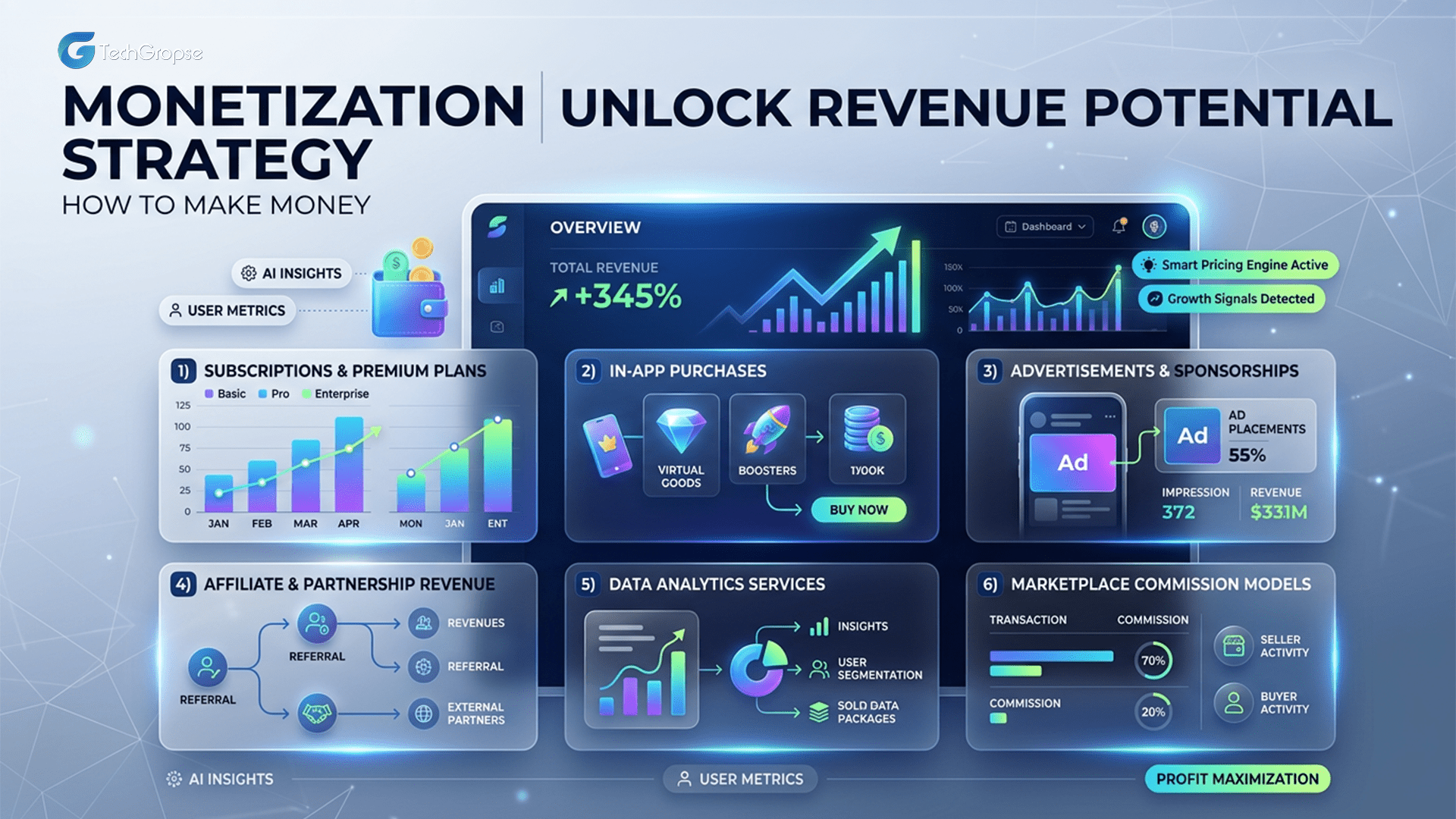
How do you turn “sweat into cents”? Let’s figure it out with the best monetization strategy.Â
Freemium Model
Core tracking is free; advanced “Deep Insights” and “Live Segments” are paid.
Corporate Wellness
Sell bulk licenses to companies looking to lower insurance premiums through active employees.
Affiliate Marketplace
Integrate “Shop the Look”, allowing users to buy the shoes or bike components used by top athletes in their feed.
Sponsored Challenges
Brands like Red Bull or Nike pay to host “The 50-Mile May Challenge.”
Bottomline: Choose TechGropse to Build an App Like Strava in 2026
With more than 10 years of experience as a leading IT company, we have delivered 1,000+ custom software solutions for 800+ global clients. Our 95% client retention rate reflects our expertise in building scalable, secure, and high-performance software.Â
What do we offer the best in this business?Â
- Expertise in Building GPS-Based Fitness Tracking Applications Like Strava
- Advanced AI-Powered Workout Recommendations and Personalized Fitness Experiences
- Seamless Wearable Device Integration With Apple Watch, Fitbit, Garmin, and More
- Real-Time Activity Tracking, Route Mapping, and Performance Analytics Solutions
- Scalable Social Fitness Features Including Challenges, Leaderboards, and Community Engagement
- Custom UI/UX Design Focused on Athlete Engagement and Long-Term User Retention
- High-Performance Cloud Infrastructure for Handling Large Fitness Communities and Live Data
- End-to-End Cross-Platform Development for iOS, Android, and Smartwatch Ecosystems
- Secure Health Data Management With GDPR, HIPAA, and Global Compliance Standards
- Continuous App Optimization, Feature Upgrades, and Post-Launch Growth Support for Fitness Platforms
FAQs (Frequently Asked Questions)
Core features include GPS tracking, activity feeds, social sharing, leaderboards, wearable integration, route mapping, analytics dashboards, challenges, and real-time performance monitoring capabilities.
The development cost typically ranges from $40,000 for MVP apps to over $250,000 for advanced AI-powered fitness ecosystems with scalable infrastructure.
A basic MVP may take 3–4 months, while advanced applications with AI, wearable integrations, and video capabilities can require over 12 months.
Popular technologies include Flutter, React Native, Swift, Kotlin, Node.js, Python, Firebase, Mapbox, Google Maps API, and wearable integration frameworks.
GPS tracking enables accurate distance measurement, route visualization, pace monitoring, elevation tracking, and real-time activity analysis, enhancing overall user engagement significantly.
Revenue models include premium subscriptions, in-app purchases, sponsored challenges, brand partnerships, fitness coaching services, and advertising opportunities within the platform ecosystem.
Major challenges include real-time GPS accuracy, battery optimization, scalable cloud infrastructure, wearable synchronization, user retention, and ensuring data privacy compliance standards.
Yes, AI enhances personalized coaching, workout recommendations, predictive health insights, performance analytics, injury prevention suggestions, and intelligent user engagement experiences effectively.
Wearable integrations improve user experience by syncing health data, heart rate monitoring, calories burned, sleep tracking, and real-time workout performance metrics seamlessly.
New apps can differentiate through niche fitness communities, AI-powered personalization, gamification, advanced social experiences, affordable pricing, and innovative wellness-focused feature ecosystems.

Hello All, Aman Mishra has years of experience in the IT industry. His passion for helping people in all aspects of mobile app development. Therefore, He write several blogs that help the readers to get the appropriate information about mobile app development trends, technology, and many other aspects.In addition to providing mobile app development services in USA, he also provides maintenance & support services for businesses of all sizes. He tried to solve all their readers' queries and ensure that the given information would be helpful for them.



 info@techgropse.com