



























































The digital commerce ecosystem in the UAE and KSA is developing at a fast pace. There is growing exploration of marketplace business models where businesses facilitate connecting buyers and sellers through a single digital platform. Whether it comes to retail or grocery marketplaces, or even procurement platforms and service aggregators, multi-vendor marketplaces are gaining popularity among businesses of all sizes.
One of the most frequent questions being asked by interested parties in the digital marketplace ecosystem is: What is the Multi-Vendor Marketplace Development Cost in 2026?
There are various aspects that affect this question’s answer. Let’s consider what factors will determine the marketplace platform development cost in the UAE and Saudi Arabia.
Key Takeaways
- Understanding Multi-Vendor Marketplace Platforms
- Why Marketplace Development Costs Are Rising in 2026
- Key Components Influencing Multi-Vendor Marketplace Development Cost
- Core Features That Affect Marketplace App Development Cost
- Mobile App vs Website Development Costs
- Technology Stack and Cost Implications
- Cost Breakdown by Development Stage
- Marketplace Development Cost in UAE
- Marketplace App Development Cost in Saudi Arabia
- Cost Ranges for Multi-Vendor Marketplace Development in 2026
- Hidden Costs Businesses Often Overlook
- How to Reduce Marketplace Development Costs….
- Future Trends Affecting Marketplace Development Costs
- Why Choose TechGropse for Multi-Vendor Marketplace Development in UAE & KSA?
- Conclusion
Understanding Multi-Vendor Marketplace Platforms
A multi-vendor marketplace platform is an online environment where numerous sellers can post and sell their goods/services from an online platform. The multi-vendor marketplace can be designed for use across different sectors like retail, wholesale, services, rentals, last-mile deliveries, automotive, and real estate. While conventional ecommerce sites operate under the principle of selling products of a single entity, multi-vendor marketplaces require the support of various parties at once. Therefore, some of the features that a multi-vendor platform needs are the ability to onboard and manage vendors, track commissions, allocate payments, manage inventory, process orders, and communicate with customers. As such, it is evident that creating such a website requires much effort. The Multi-Vendor Marketplace App Development exceeds that of ecommerce platforms.
Market Scope of Multi-Vendor Marketplaces in 2026
According to Statista, Saudi Arabia’s eCommerce market is expected to generate $15.88 billion in revenue in 2026.
Research and Markets projects the Saudi Arabian eCommerce market to reach $31.29 billion by 2026, growing at a CAGR of 11.92% through 2031.
The Saudi Central Bank (SAMA) reports that digital payments now account for more than 79% of retail transactions in the Kingdom.
According to UNCTAD, digital marketplaces remain one of the fastest-growing segments of the global digital economy.
Why Marketplace Development Costs Are Rising in 2026? 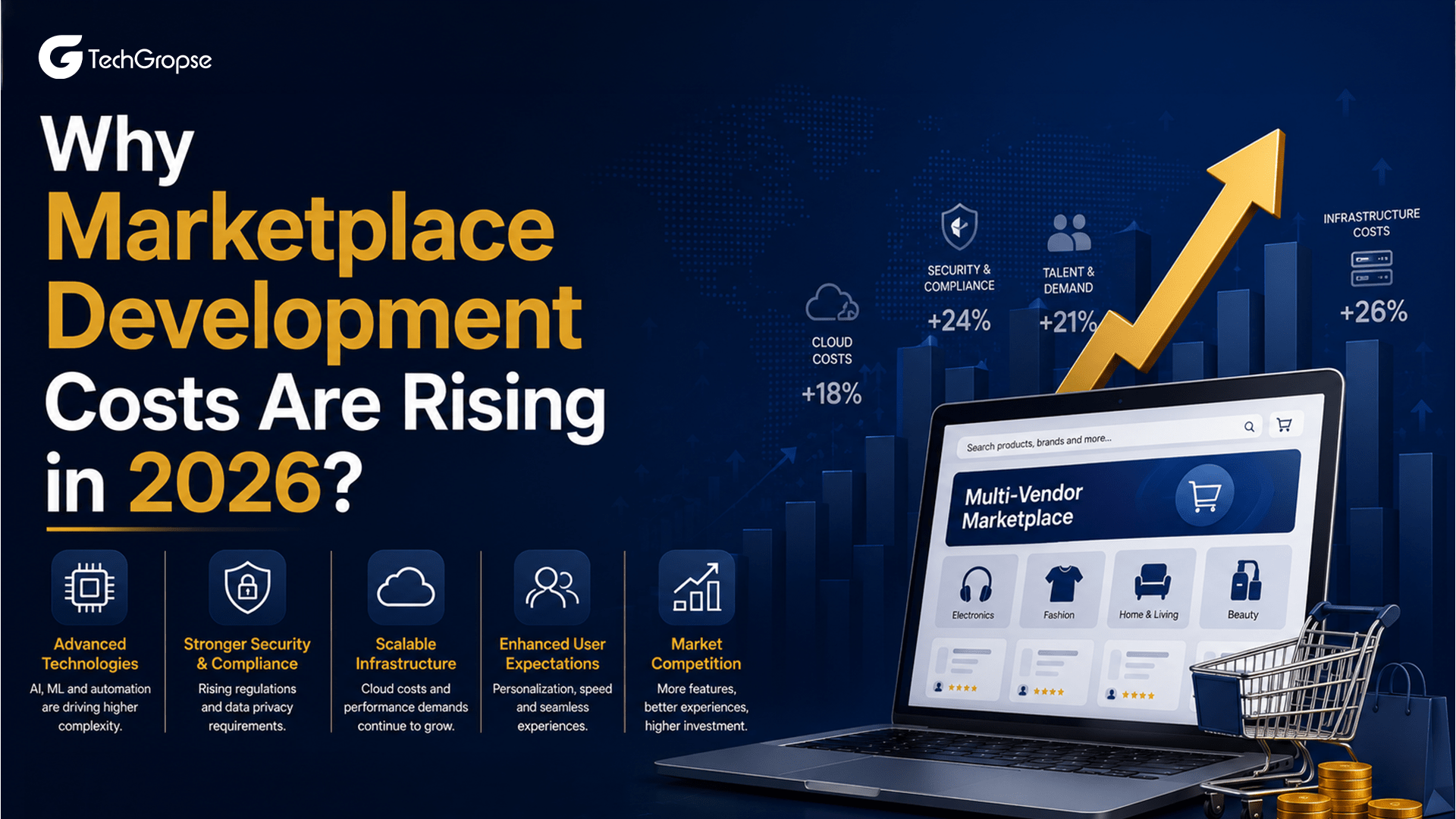
The following technological and business trends are impacting marketplace development costs in the Gulf region. Due to the growing popularity of e-commerce in both the UAE and Saudi Arabia, there is an increase in the usage of more advanced and dynamic marketplaces with many features to cater to their changing needs and help them succeed in the competition. Thus, because of such demands as customization, compliance, security, and ease-of-use, there is a need for advanced marketplace development techniques, making the development process costly.
Increased User Expectations
Customer expectations have increased considerably and are among the main contributors to development costs within the market environment. The modern consumer expects personalized suggestions, convenient and safe payments and checkout processes, real-time notifications, improved search capabilities, support in multiple languages, and a consistent user experience on both websites and mobile applications. Achieving all these objectives involves significant development effort and costs.
Regulatory Compliance
Compliance with regulations is another crucial requirement for the marketplaces to run in the UAE and Saudi Arabia. Companies need to be compliant with the various laws related to data protection, VAT, e-payment standards, and cybersecurity laws. Some of the features, like secure login, encryption, and anti-fraud systems, may increase the Online Marketplace Development Cost, yet they are necessary for safety purposes.
Scalability Requirements
Scalability will be another big concern related to cost in 2026. The marketplaces need to have scalability because of high volumes of users, increasing numbers of vendors, huge catalogues, and multi-national presence. Developing a scalable system with the use of cloud computing infrastructure and a well-optimised database might incur higher development costs initially; however, it saves on redevelopment costs later on.
Key Components Influencing Multi-Vendor Marketplace Development Cost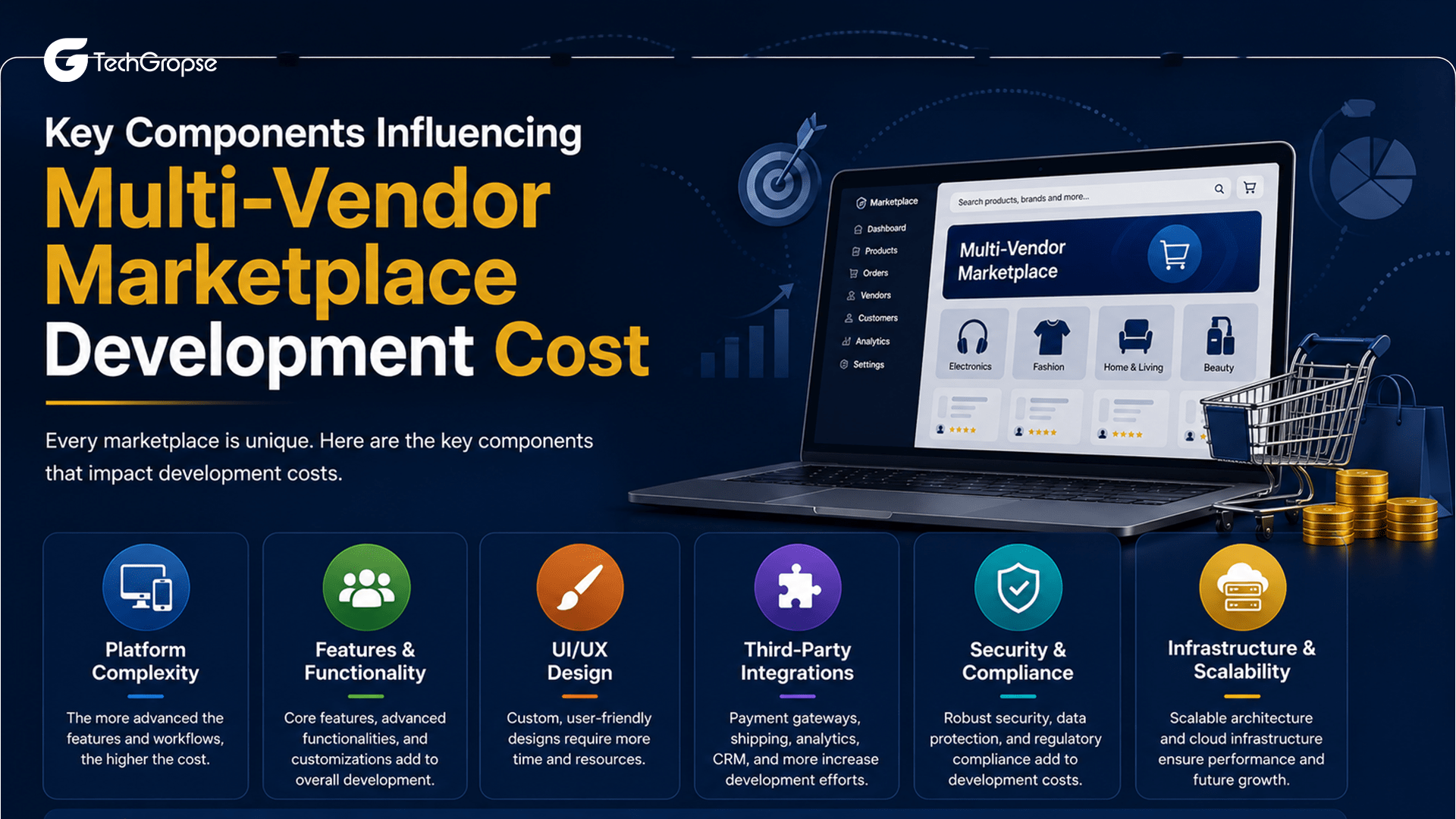
There are a number of elements that determine the Multi-Vendor Marketplace Development Cost, but the most important one is the type of marketplace to be created. Various marketplaces have varying degrees of requirements and complexities.
B2C Marketplace
Marketplaces of the B2C (Business-to-Consumer) type involve businesses being linked directly with consumers, and some of the common characteristics of such platforms are product listings, shopping cart systems, payments, and order tracking options. The development expenses of these marketplaces are usually reasonable since their functionality is relatively simple.
B2B Marketplace
The B2B Marketplace Development Cost is usually higher because of the high business requirement level. These marketplaces typically need various functionalities like bulk orders, RFQ system (Request for Quotation), company accounts, contract pricing, and purchasing approval process.
Service Marketplace
Service marketplace platforms match buyers and sellers, which means they need some additional functions like booking services, scheduling, verifying sellers, and reviews. These extra elements add up to more development expenses than conventional ecommerce marketplaces.
Core Features That Affect Marketplace App Development Cost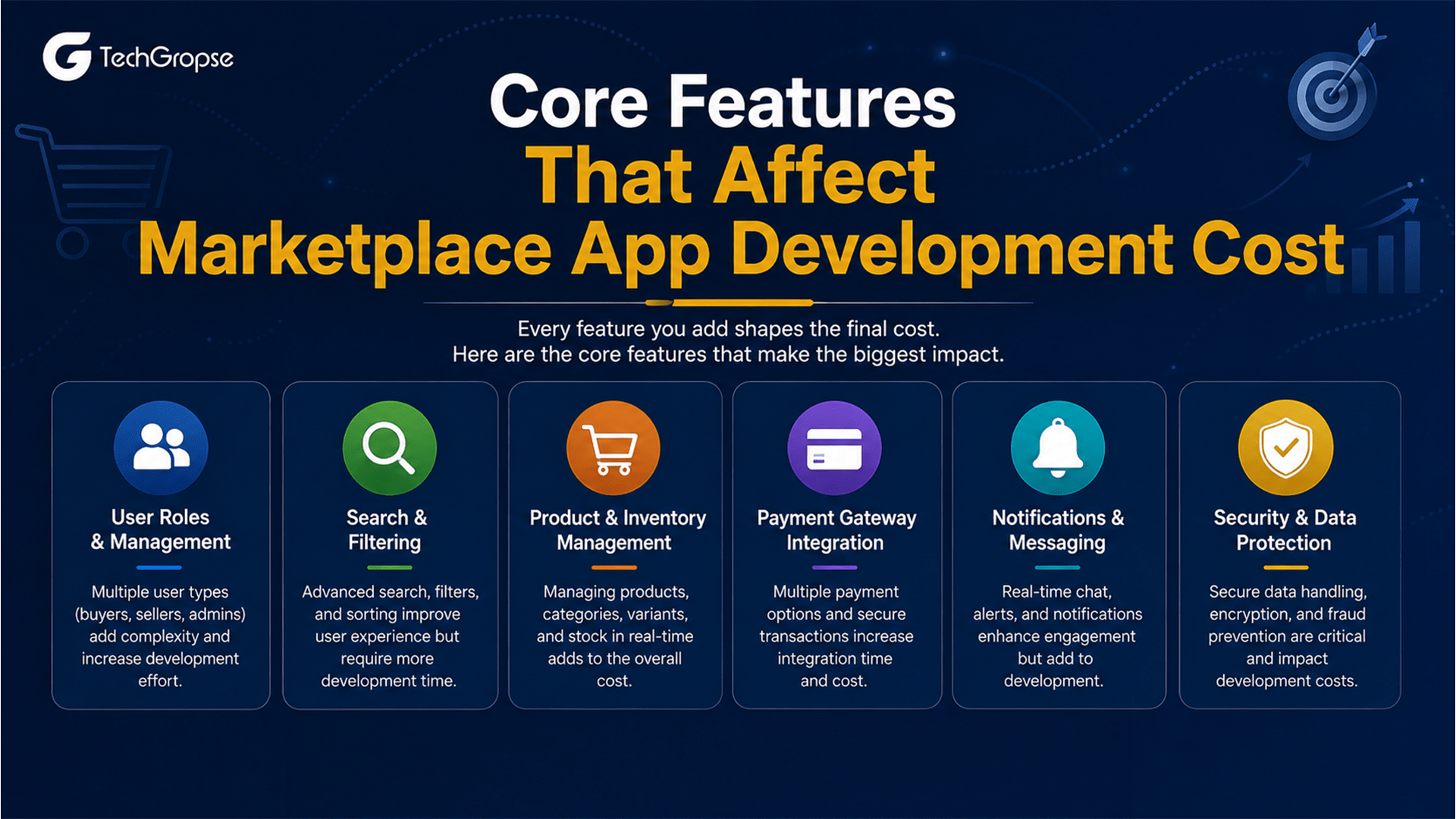
The functionality incorporated into a marketplace app platform is an essential part of defining the total Marketplace App Development Cost. As a multi-vendor marketplace meets the needs of customers, vendors, and administration, special attention must be given to their particular requirements.
Customer Panel
Commonly, the consumer-oriented side of the platform will consist of elements like customer registration, product browsing, advanced searching, wish lists, ordering services, ratings and reviews. With more companies integrating personalization options into their systems, there is increased development cost and complexity.
Vendor Dashboard
The Vendor Dashboard is among the major features of a multi-vendor marketplace platform. It typically has the following functions: product management, inventory management, sales tracking, orders management, customer communication and marketing tools. Full-featured vendor dashboard development involves great effort and plays an important role in determining the total Marketplace Website Development Cost.
Admin Dashboard
In an admin dashboard, one can exercise complete control over the entire marketplace system. Typical functionalities include managing sellers, commissions, dispute resolution, managing users, financial reporting, and analytics dashboards. Such platforms generally demand significant back-end development because of the nature of their work with the data of the platform.
Mobile App vs Website Development Costs
There comes a point when companies have to choose between creating their marketplace website, mobile app or even both. The Marketplace Website Development Cost is lower since it involves greater accessibility, maintenance and faster development. Mobile apps offer advantages like improved performance, push notifications, engagement and the ability to work offline.
Creating two versions of a marketplace mobile application, one for each platform – iOS and Android, may be a costly endeavour as it increases the total Marketplace App Development Cost. Many companies save costs by using cross-platform frameworks that allow creating applications for both OSs using one common codebase.
Technology Stack and Cost Implications
Technology selection is highly significant in calculating the total Marketplace App Development Cost. The technology selection determines the performance and scalability of your platform, security issues, and future expansions.
Frontend Technologies
React, Angular, and Vue.js are the types of frontend technologies often used for building user interfaces that are both interactive and responsive. If you want to have more sophisticated user experiences, that usually means that you will need to invest more hours in the development, customization and testing of the features. Because the overall costs of the project should go up.
Backend Technologies
Well-known backend technologies include Node.js, Laravel, Django, and ASP.NET. The backend becomes the basis for your marketplace since it manages data processing, integrations, security, and the functionality of your platform. Thus, a strong backend architecture will help you ensure long-term scalability and performance of your marketplace.
Database Systems
Marketplace platforms collect large amounts of data that includes users’ information, product data, transactions, analytics, and much more. With the growth of your marketplace, it is vital to optimize the work of your database.
Cloud Infrastructure
The cloud infrastructure is where your marketplace platform will be hosted, offering you options for storage and scalability. Hosting services can be offered by Amazon Web Services, Microsoft Azure, and Google Cloud.
Cost Breakdown by Development Stage
The total Multi-Vendor Marketplace Development Cost consists of multiple development steps, each of which affects the end cost of investment into the process.
Discovery and Planning
Research and analysis, business analysis, planning of app features, and designing its architecture are among the initial steps. The proper strategy at this stage enables us to find out possible problems and avoid risks during further development.
UI/UX Design
A marketplace usually needs distinct interfaces for both buyers and sellers, and the administrator. A good and user-friendly design is the main guarantee of platform success.
Development
This step is likely to consume the most significant share of funds. Frontend/backend, integration of API, databases and security – these are the main components of the development stage. The final custom marketplace app development cost depends on the number of features and their level of customization.
Quality Assurance
Testing is highly important in order to ensure the performance, security, compatibility of the platform with the different devices, and the absence of bugs. Proper quality assurance will help avoid high costs related to post-launch issues and provide the user with a good experience.
Deployment
Deployment refers to configuring servers, setting up cloud infrastructure, security implementation, and publishing on app stores. This process prepares the platform for launch and adds to the overall cost of development.
Marketplace Development Cost in UAE
The UAE is still considered one of the most technologically advanced digital commerce marketplaces within the Middle East region, thus attracting various marketplace companies to operate in the region. Several aspects influence the price of the Marketplace Development Cost in UAE, among which are the country’s advanced digital infrastructure, high internet usage, advanced logistics services, and the rapid adoption of ecommerce technologies.
Several marketplace applications in the UAE need bilingual support in English and Arabic, thus making the process of their design, development, testing, and maintenance more complex. At the same time, marketplace companies implement various payment methods such as bank systems, regional gateways, and online wallets to ensure a convenient shopping experience for users.
Marketplace App Development Cost in Saudi Arabia
Saudi Arabia is still witnessing a high rate of digitization in relation to its Vision 2030 goals, resulting in increased demand for digital marketplace services. Therefore, the Marketplace App Development Cost in Saudi Arabia depends on several other regional and industry-specific factors.
First, there is an evident growth in the number of e-commerce marketplaces in the country. As a result, it necessitates scalable marketplace software that will be able to accommodate more users. Furthermore, different types of marketplace software may require localization features, such as software designed for the Arabic language and payment gateway interfaces. This will increase the cost of developing the software.
Finally, there is an increased demand for enterprise-class marketplaces in industries like B2B procurement, industrial trading, and wholesale ecommerce. The latter requires a high degree of customization and security measures, which would raise software development expenses even further.
Cost Ranges for Multi-Vendor Marketplace Development in 2026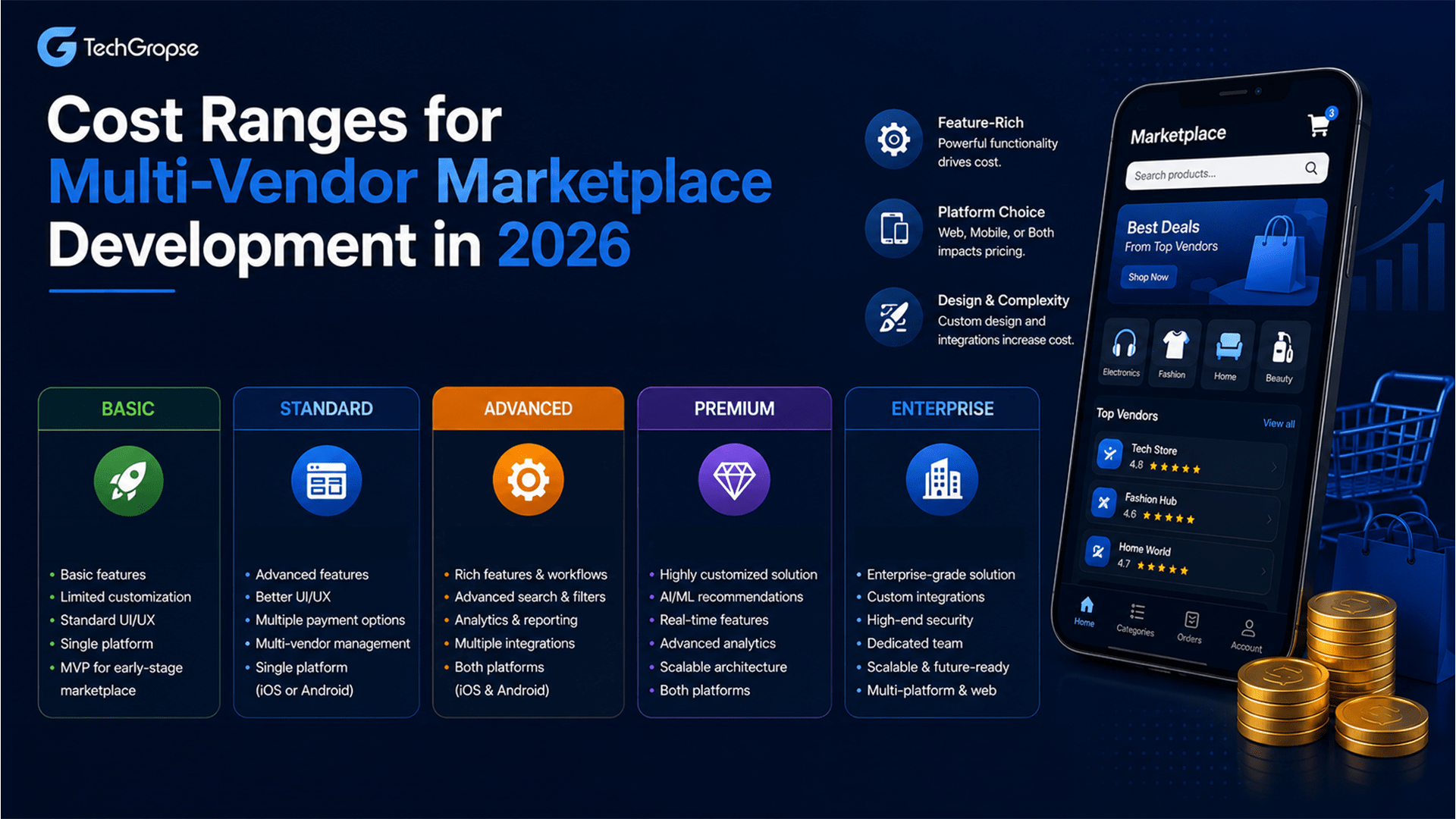
Multi-Vendor Marketplace Development Cost is determined depending on the complexity and requirements for the chosen platform. There are three types of marketplace platforms that exist.
Basic Marketplace Platform
Basic marketplaces consist of basic features like registration, product listing, management of vendors, and payments. Simple marketplaces are perfect for young businesses that want to test their business idea using minimal costs.
Mid-Level Marketplace
The features that can be provided by medium-tier marketplaces include applications for mobile phones, analytics dashboards, search capabilities, marketing tools, and vendor reports. These are relevant to firms that will experience growth and require expansion into new regions.
Enterprise Marketplace
An enterprise marketplace includes more sophisticated functionality like AI-based recommendations, ERP integration, advanced analytics, multinationals, and enterprise-level security. Despite a higher initial cost, enterprise marketplaces deliver more scalability and ROI. The ultimate price will depend on the type of features, customizability needs, and expected growth in the future.
Cost Ranges for Multi-Vendor Marketplace Development in 2026
| Marketplace Type | Key Features | Ideal For | Estimated Cost (UAE) | Estimated Cost (KSA) |
|---|---|---|---|---|
| Basic Marketplace Platform | User registration, product listings, vendor management, payment gateway integration, order management | Startups & MVPs | AED 90,000 – AED 180,000 | SAR 95,000 – SAR 185,000 |
| Mid-Level Marketplace | Mobile apps, advanced search & filters, analytics dashboard, marketing tools, vendor reporting, customer reviews | Growing Businesses | AED 180,000 – AED 450,000 | SAR 185,000 – SAR 460,000 |
| Enterprise Marketplace | AI-powered recommendations, ERP/CRM integration, advanced analytics, multi-language support, enterprise security, high scalability | Large Enterprises | AED 450,000 – AED 920,000+ | SAR 460,000 – SAR 940,000+ |
Hidden Costs Businesses Often Overlook
Many firms tend to concentrate on the developmental costs and ignore the operational costs involved in running a marketplace platform. Operational costs could make a big difference in the overall cost involved and thus, they need to be taken into consideration from the onset.
Cloud Hosting
The cloud hosting service represents a major recurring cost for marketplaces. As the number of users, vendors, and storage space requirements increases, infrastructure costs usually go up. There may also be a need for extra resources during peak hours when trying to keep the platform running at top speed.
Security Updates
Security maintenance is key in safeguarding customer data and transactions on the website. Regular platform upgrade, testing, and assessment are very significant activities that will not only make the platform secure but also trusted to handle modern cyber threats.
Technical Support
Marketplace development is just one of many stages. Technical support will be needed after that to deal with bugs, monitoring, improvements, and maintenance. Updates will contribute to the smooth functioning of your platform.
Third-Party Services
The use of third-party systems such as payment gateways, SMS notification, email marketing software, analytical tools, customer support, and business apps through the cloud is a common practice within various business environments. While each one of these may appear insignificant in terms of cost at first glance, their cumulative value can quickly add up.
Considering this issue from the very start will help to establish a better estimate of budgeting for future expenses.
How to Reduce Marketplace Development Costs
Setting up a marketplace platform first can be somewhat expensive. Yet, with good forecasting and a phased launch, companies can still keep a good grip on the level of their spending. When they limit themselves to the essential features and at the same time make the platform scalable, they will not only be able to save money at the very first stage but also after some time.
Start with an MVP
A Minimum Viable Product (MVP) is a chance for companies to experiment in the market, get useful and rich feedback from the users, and ensure that the investments are used more productively. Instead of designing a complete platform right away, a company can first make a product that satisfies customers’ basic needs and then develop it further.
Prioritize Core Features
The first functions to concentrate on should be those critical to the workings of the business environment, including user sign-up, vendor management, product listing, transactions, and order management. Other functions can then be incorporated slowly into the platform.
Use Scalable Architecture
Designing the system to be scalable from the onset will go a long way in ensuring that any future expansion is made possible without having to spend additional money redeveloping the system for growth.
Automate Administrative Tasks
Automation of the processes will help make tasks like vendor approvals, calculating commissions, stock updates, and order notification processes more efficient and effective. These tips should help businesses save money on their marketplace platform development budgets.
Future Trends Affecting Marketplace Development Costs
Marketplace platform evolution is now significantly influenced by new technologies which are dictating requirements and costs. Companies doing business in the UAE and Saudi Arabia keep updating their offers by adopting technology and thereby get an edge over others in the digital world.
Artificial Intelligence
Artificial Intelligence (AI)- driven product recommendations, fraud detection, customer support and search optimization are only a few examples of ways artificial intelligence is being implemented in growing scenarios. Through the use of AI, marketplaces can deliver highly tailored experiences, free up human resources by automatically handling mundane tasks and elevate the entire platform’s functioning to a new level. From now on we should not be astonished to come across AI deeply intertwined in the transformation of modern marketplace platforms since the number of AI users is soaring.
Headless Commerce
There are many benefits of headless commerce development services, one of which is more flexibility since the frontend user experience is separated from the backend system. Because of this, a company will be able to deliver the same user experience through websites, mobile apps, and other digital channels, and at the same time, make future changes and integrations much easier.
Predictive Analytics
The marketing department has begun implementing predictive analytics techniques to guide their decision-making in a more intelligent way as well as to target their customers more effectively. Offering a product or marketing a campaign are two key things that can be improved by a company through market and customer behavioral pattern analysis via a predictive tool.
Hyper-Personalization
Personalized shopping experiences have become more of a need rather than an option. With the help of customer data and artificial intelligence, marketplaces are now able to offer personalized product recommendations and promotions to their customers, thereby making their experiences better.
Though there might be some added expenses for the initial development process, personalization can definitely add long-term benefits for companies.
Why Choose TechGropse for Multi-Vendor Marketplace Development in UAE & KSA?
TechGropse is deeply experienced in creating top-notch, highly functional, endless multivendor marketplace solutions that perfectly meet the diverse requirements of business enterprises in the UAE and Saudi Arabia markets. TechGropse has an in-depth understanding of the marketplace and mobile app development with custom digital platforms. This is why the company only delivers scalable, dependable, and easy-to-use solutions. With features ranging from vendor management to payment gateways and sophisticated analytical tools, TechGropse makes sure companies get the best marketplace platform that can be scaled up in the future.
Conclusion
To accurately estimate the Multi-Vendor Marketplace Development Cost, one must go beyond assessing a mere pricing quote. After all, the marketplace platform is a highly sophisticated digital ecosystem including customer interaction, vendor management, payments, security system, analytics, and scalable infrastructure.
Such aspects as platform type, technological solution, need for localization, creation of mobile application, compliance needs, and required scalability influence the overall expenditure amount. Companies based in UAE or Saudi Arabia are strongly recommended to consider both the cost of development and operation when creating a marketplace platform.
With the digital revolution and increasing presence of digital commerce in the Gulf markets, businesses that build their scalable marketplace solution even at the early stages of their development will be able to gain a competitive advantage in the coming times.
If you are going to create your multi-vendor marketplace in the UAE or Saudi Arabia, then deciding what your business goals, main customers, and essential features are will be a great help for you to estimate the right costs of the development.
FAQs (Frequently Asked Questions)
Development costs typically range from AED 90,000 to AED 920,000+ in the UAE and SAR 95,000 to SAR 940,000+ in KSA, depending on features, integrations, scalability requirements, and platform complexity.
Key factors include platform type, vendor management features, payment integrations, custom design, security requirements, and third-party services.
Yes, launching an MVP reduces initial investment, validates demand, gathers user feedback, and minimizes long-term development risks.
Popular options include Stripe, HyperPay, PayTabs, Moyasar, and local banking integrations supporting regional payment preferences.
Development timelines range from three months for MVPs to twelve months for advanced enterprise-grade marketplace platforms.
Vendor onboarding, product management, secure payments, order tracking, reviews, analytics, and customer support are essential.
Yes, businesses must comply with VAT regulations, data protection laws, e-commerce rules, and payment security standards.
Cross-platform development reduces costs and speeds deployment, while native apps provide better performance and user experience.
Annual maintenance generally costs 15–20% of development expenses, covering updates, security patches, and performance improvements.
Yes, AI-powered recommendations, chatbots, fraud detection, and predictive analytics increase costs but improve user engagement.

Hello All, Aman Mishra has years of experience in the IT industry. His passion for helping people in all aspects of mobile app development. Therefore, He write several blogs that help the readers to get the appropriate information about mobile app development trends, technology, and many other aspects.In addition to providing mobile app development services in USA, he also provides maintenance & support services for businesses of all sizes. He tried to solve all their readers' queries and ensure that the given information would be helpful for them.

 info@techgropse.com