



























































Rapid advancements in AI technology are rewriting how people search for information. Instead of typing a few keywords into a search engine, consumers are increasingly using voice assistants and AI-powered tools to ask complete questions in a natural way. A user in Chicago is more likely to say “Which coffee shop near me is open right now and has good reviews?” than type a short search phrase. They expect an instant and accurate answer without scrolling through multiple websites.Â
The growth of AI-powered search experiences is making the shift more important in 2026 and beyond. Industry reports show that voice search and conversational AI adoption are increasing as users look for faster and more personalized ways to find information, products, and local services. Simply ranking for keywords is no longer enough for businesses across Chicago. The goal is to become the answer that AI assistants recommend.Â
Unlike traditional search systems that mainly match keywords, AI agents use Natural Language Processing (NLP), real-time data, location signals, and contextual understanding to interpret what users actually mean. When someone asks for an affordable electrician in Chicago who is available after business hours, an AI agent can analyze the request, verify business information, check availability signals, and deliver a highly relevant response within seconds.
As voice search becomes more conversational and AI-driven, businesses need to rethink how they approach search visibility. In this blog, we will explore how AI agents are transforming voice search optimization in Chicago, why they matter for local businesses, and what companies should do to stay competitive in the evolving search landscape.Â
What Chicago Businesses Need to Know About Voice Search in 2026
Voice search has become a default for billions around the world, and Chicago is no exception. Think about the time when people used to type short, choppy phrases like “pizza Chicago” or “plumber near me.” Today, they speak full sentences into their phones, smart speakers, and car systems. They ask things like “What’s the best deep-dish pizza place open right now near Wicker Park?” or “Which Chicago plumber can fix a burst pipe today?” That shift has changed everything for businesses.Â
According to the Marketing LTB, over 50% of the global online population uses voice search. In the U.S. alone, over half of all smartphone users use voice search at least once a day. What makes this even more important for Chicago businesses specifically is the intent behind voice searches. They are almost always local, immediate, and action-driven. The user is not browsing but ready to call, visit, or buy. Here’s what this means for businesses:Â
- People ask questions: Voice search queries are conversational. If your website content is written for only SEO and not users, then you are visible to a large share of voice search users.
- “Near me” searches dominate Chicago voice queries: Searches like “best coffee shop near me,: “Chicago accountant open Saturday,” or “emergency HVAC repair Chicago” are exactly the kind of queries voice search captures and that AI agents are now helping businesses rank for.Â
- Speed and direct answers win users: Voice assistants like Siri, Google Assistant, and Alexa pull answers from businesses that provide clear, fast, and structured information. If your Google Business Profile is incomplete or your website answers questions poorly, you lose that result to a competitor.Â
- Smart speakers are growing in Chicago: Over 35% of U.S. households own a smart speaker, according to a market.us report. For Chicago businesses in hospitality, food, retail, and home services, this is an opportunity to directly connect with customers in a buying moment.Â
The use of voice search in 2026 shows the opening of an active channel where Chicago customers are already searching for exactly what you offer. The businesses that understand this and optimize accordingly will be the ones that consistently show up.Â
How AI Agents Improve Voice Search Visibility
If you run a business in Chicago, you have probably heard the term “AI agents” multiple times. But what does it actually mean for your voice search visibility, and why should you care?Â
Let us break it down simply.Â
An AI agent is a software tool that works on its own to complete tasks, including analyzing data, making decisions, and taking action without you having to do everything manually. When it comes to voice search, AI agents work behind the scenes to make sure your business shows up when someone in Chicago asks their phone or smart speaker a question related to what you offer. Here’s exactly how they do it:Â
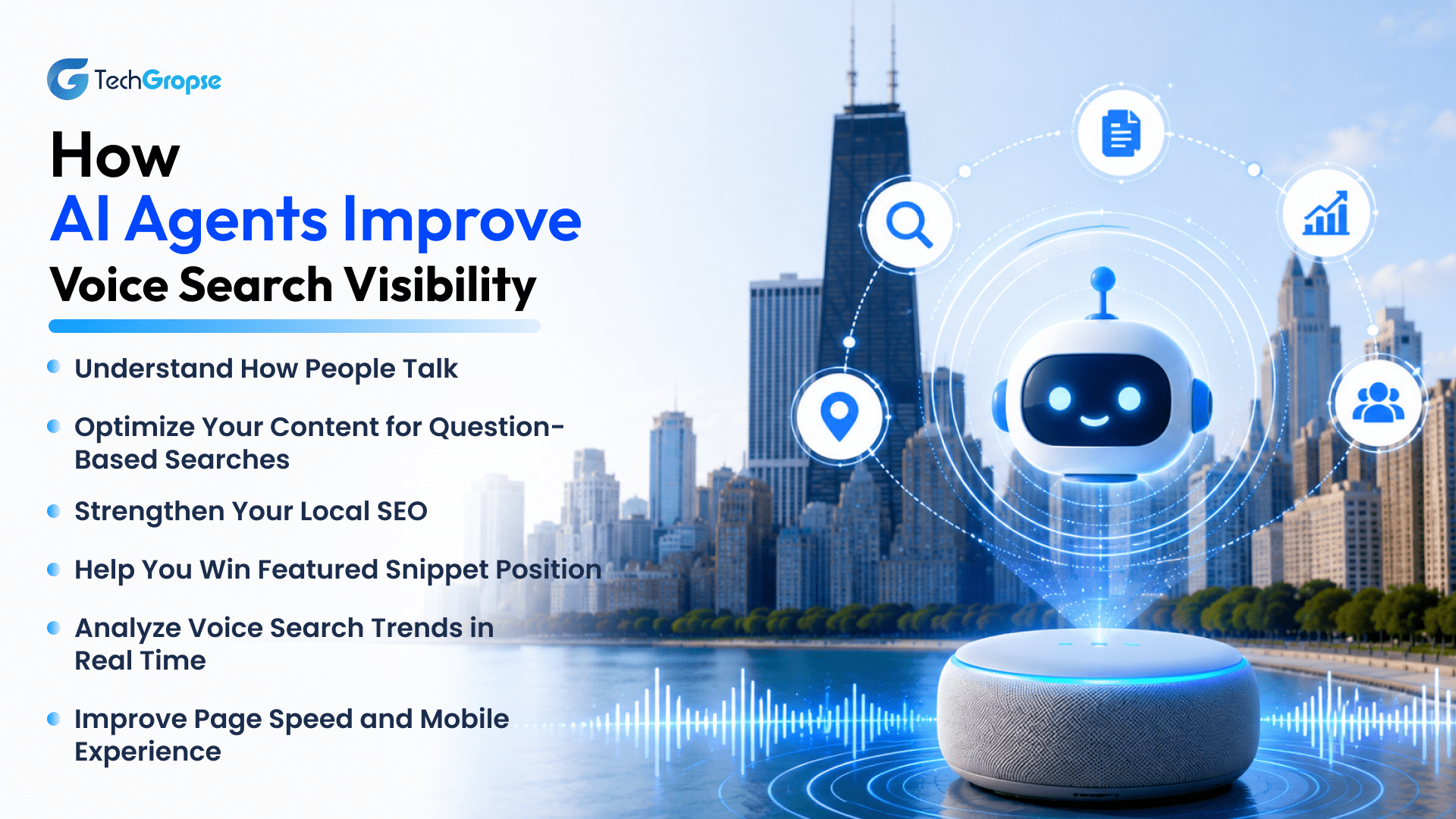
AI Agents Understand How People TalkÂ
When someone types a search, they write “best Italian restaurant Chicago Loop.” But when they speak, they say, “Hey Google, what is the best Italian restaurant near me in the Loop area that is open right now?”Â
These are two completely different queries, and they require two completely different content strategies. AI agents analyze thousands of these conversational voice queries specific to Chicago and identify patterns in how your potential customers speak. Then they help shape your website content, FAQs, and Google Business Profile to match that natural, spoken language.Â
This is called natural language processing (NLP), and it is the engine behind tools like Google Assistant, Siri, and Alexa. AI agents trained on NLP understand context, intent, and the way questions are phrased in real conversation.Â
So, you need to make sure that your content sounds like it was written for a real person asking a real question, which is exactly what voice search rewards.Â
AI Agents Optimize Your Content for Question-Based SearchesÂ
Voice searches are almost always questions, and words like Who, What, Where, When, Which, and How dominate voice query patterns.Â
According to the industry reports, question-based keywords make up a significant share of long-tail search queries, and voice search has accelerated this trend over time. AI agents scan your existing content and identify gaps (places) where your website fails to answer the questions your Chicago customers are actually asking. They help create or restructure content around those question-based queries.Â
For example, if you run an HVAC company in Chicago, an AI agent might identify that people are asking:
- How much does AC repair cost in Chicago?
- Which HVAC companies in Chicago offer same-day service?
- What should I do if my furnace stops working in winter in Chicago?
Once you identify the gaps, the content gets built around direct, clear answers because voice assistants almost always read out the single most relevant answer, and you need to get that one spot.Â
AI Agents Strengthen Your Local SEOÂ
Voice search is deeply local. When someone in Lincoln Park asks, “Where can I find a good barber near me?” – Google is pulling results from barbers within a close radius who have strong local SEO signals.Â
AI agents improve these signals in the following ways:Â
- Audit and optimize Google Business Profile: Your business name, phone number, hours, services, photos, and reviews all feed into local voice search rankings. AI agents identify what is missing or inconsistent and fix it because even a small inconsistency in your business name across different platforms can hurt your chances of appearing in voice results.Â
- Ensure NAP consistency: NAP stands for Name, Address, and Phone Number. If your business information appears differently across Google, Yelp, Facebook, and local Chicago directories, search engines lose confidence in your listing. AI agents audit every mention of your business across the web and flag or correct inconsistencies automatically.Â
- Target Chicago-specific queries: General local SEO and hyperlocal voice search optimization are two different things. AI agents go deeper as they target neighborhood-level queries like “best gym in Wicker Park” or “affordable dentist in Pilsen, Chicago.” These are the kind of searches that bring in customers who are physically close and ready to act.Â
AI Agents Help You Win Featured Snippet PositionÂ
Most Chicago businesses don’t know that when a voice assistant answers a question out loud, it is almost always reading from the featured snippet – a box that appears at the very top of Google search results, above everything else.Â
AI agents analyze what content currently holds featured snippets for queries relevant to your business and reverse-engineer what made that content win. Then, they help you structure your own content, using clear headings, concise answers, short paragraphs, and bullet points. So, Google considers your page as the best answer to read out loud.Â
Winning a featured snippet for even one high-intent Chicago voice query can drive a consistent stream of calls, visits, and enquiries to your business – without spending a single dollar on ads.Â
AI Agents Analyze Voice Search Trends in Real TimeÂ
Markets change rapidly. The way people search in Chicago in January is different from how they search in July. New businesses open, trends shift, and customer language evolves. The problem with traditional SEO is that it is slow. You optimize your content today, and by the time the results come in, the trend has already moved.Â
AI agents monitor voice search trends continuously. They track what questions are being asked in your industry and your city right now, not six months ago. When a new pattern emerges, they alert you or automatically adjust your content strategy to stay ahead.Â
This kind of real-time intelligence is something no human SEO team can match at scale, and this is a major reason why businesses using AI agents for voice search are pulling ahead of those still relying on manual keyword research alone.Â
AI Agents Improve Page Speed and Mobile Experience
Google’s voice search results heavily favor websites that load fast and work well on mobile. The reason is simple: most voice searches happen on smartphones. If your website is slow or hard to navigate on a phone, Google will not trust it enough to read your content out loud as an answer.Â
AI agents audit your website’s technical performance on metrics such as page load speed, mobile responsiveness, structured data markup, and Core Web Vitals. They flag exactly what needs to be fixed. Some tools even implement those fixes automatically.
According to Google, 53% of mobile users abandon a website if it takes longer than three seconds to load. Every additional second of delay further increases your bounce rate. For a Chicago business depending on voice-driven local traffic, it’s essential to improve the speed to reduce the chances of customers leaving your website.Â
Real Examples of AI Agents in Voice Search Optimization
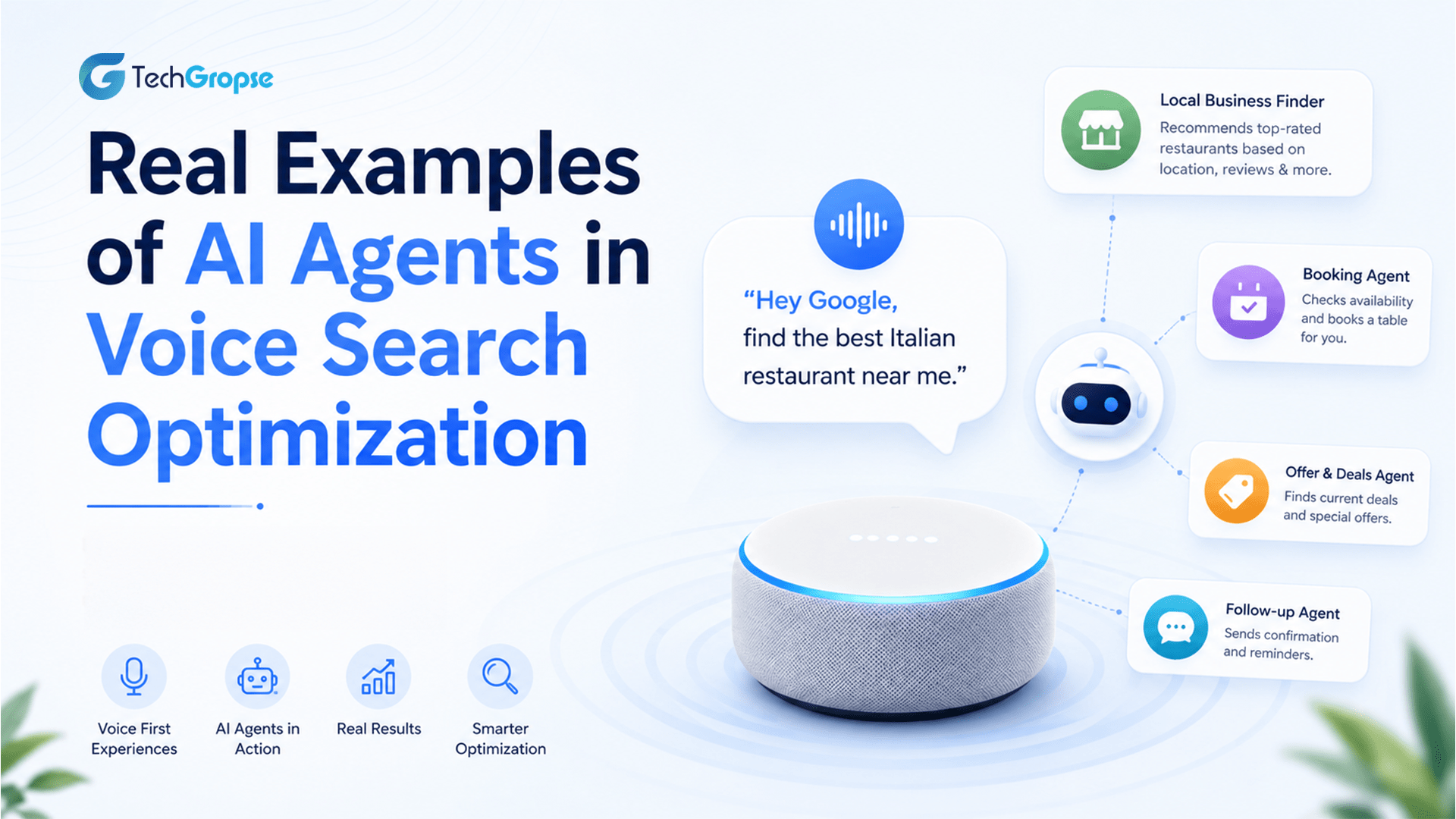
Many companies have started using AI agents across Chicago, and they are achieving measurable impact. Here are some examples of AI agents that can help businesses in Chicago and beyond:
ChatGPT and Claude For Conversational Content Creation
One of the biggest voice search challenges for Chicago businesses is creating content that sounds natural when spoken out loud. Most business websites are written for readers, not listeners.Â
AI tools like ChatGPT and Claude help businesses rewrite their existing content in a conversational tone that mirrors how Chicago customers actually speak. Instead of a generic page that says, “We provide HVAC services in the Chicagoland area,” these tools help you create content that answers real questions.Â
For a Chicago restaurant owner, this means your website can answer the exact questions the users are asking assistants before they decide where to go. Â
BrightLocal for Hyperlocal Voice Search SignalsÂ
BrightLocal is an AI-assisted platform specifically built for local SEO. It helps Chicago businesses manage and monitor the exact signals that voice search algorithms rely on.Â
It audits every place your business appears online, such as Google, Yelp, Bing, Apple Maps, and dozens of Chicago-specific directories. Then, it checks whether your business name, address, and phone number are listed consistently everywhere. A single inconsistency, like your address showing “Ave on one platform and “Avenue” on another, can quietly suppress your voice search visibility.Â
Along with that, BrightLocal also tracks how your business ranks for hyperlocal Chicago queries. So if you run a coffee shop, you can see exactly how you rank when someone in Bucktown searches “coffee shop open early near me” versus someone in Hyde Park doing the same search.Â
Semrush for Identifying Query GapsÂ
Most Chicago businesses have no idea what questions their potential customers are asking out loud. They optimize for the keywords they think people use, but voice search works on a completely different logic.Â
Semrush uses AI to surface the exact question-based queries people are asking in your industry and location. For a Chicago personal injury lawyer, Semrush might reveal that people are frequently asking “What should I do after a car accident in Chicago?” or “How long does a personal injury case take in Illinois?”Â
Once those gaps are identified, you can build content directly around those questions in a simple, direct format that voice assistants can easily pull from and read out as an answer. With its Keyword Magic Tool, Semrush also helps you filter question-based and conversational keywords, which provides you with a clear picture of exactly what to write about.Â
How To Start Using AI Agents for Voice Search in Chicago TodayÂ
Everything covered in this blog so far might have you thinking that voice search optimization with AI agents is complex and only for large businesses with dedicated marketing teams. That’s not the truth.Â
Chicago businesses of every size can start using AI agents for voice search optimization today. The starting point is simpler than most people expect, and you will start seeing the impact from day one. Here’s a clear path to get started:Â
Step 1: Audit Where Your Chicago Business Currently Stands
Before touching any tool or creating any content, spend time understanding your current voice visibility.Â
Ask yourself these questions honestly.
- Is your Google Business Profile 100% complete?
- Is your business name, address, and phone number identical across Google, Yelp, Apple Maps, Facebook, and every Chicago directory?
- Does your website answer the specific questions your Chicago customers are asking out loud?
- Does your website load in under three seconds on a mobile phone?
- Does your business appear when you search for your own business category with “near me”?
If the answer to any of these is no or you are not sure, that is the starting point. These are the foundations that AI agents build on. Without having these details in place, even the most sophisticated AI tools will have a limited impact.
Step 2: Fix Your Local DataÂ
This step is not very popular, but it is the most important technical action a Chicago business can take for voice search visibility.Â
Every inconsistency in your business information across the web is a signal to Google that your business cannot be trusted to give customers accurate information. And Google will not recommend a business it does not trust as a voice search answer.
Use an AI-powered tool like Yext or BrightLocal to identify every place your business appears online and correct any inconsistencies in one sweep. Make sure your address format, phone number, and business name are identical everywhere.Â
Step 3: Build Conversational Content Around QuestionsÂ
This is where you can take help from ChatGPT, Claude, and Semrush’s AI writing tools. Start by listing the ten most common questions your customers ask you. These are exactly the questions voice search users are asking Google, Siri, and Alexa about businesses like yours in Chicago.Â
Then create a dedicated FAQ page on your website that answers each question directly, clearly, and conversationally. Keep each answer between 40 and 60 words, concise enough for a voice assistant to read out loud, detailed enough to genuinely help the person asking.
Step 4: Implement Schema Markup on Your WebsiteÂ
This is the step most businesses skip without realizing that it is one of the highest-impact technical improvements you can make.Â
Schema markup is a small piece of structured code added to your website that tells Google exactly what your business is, where it is located, what it offers, and how customers can reach you. Voice assistants rely heavily on this structured information when deciding which Chicago business to recommend as a spoken answer.Â
Step 5: Set Up Continuous Monitoring with AI Tools
Voice search is not a set-and-forget strategy. The way Chicago customers search changes with seasons, trends, new businesses entering the market, and shifts in how people use voice technology.Â
Tools like Semrush and BrightLocal track your local keyword rankings, monitor your Google Business Profile performance, alert you when new questions are being asked in your industry across Chicago, and flag any inconsistencies in your business listing before they damage your visibility.Â
Step 6: Build Your Review Profile DeliberatelyÂ
Reviews are an active voice search ranking signal, and building them consistently is one of the most straightforward things any Chicago business can do starting today.Â
After every positive customer interaction, send a simple follow-up message asking them to leave a Google review. Keep the ask short and genuine, respond to every review: positive and negative, keep responses professional, warm, and specific. This signals to Google that your Chicago business is engaged, credible, and worth recommending to voice search users.Â
How Techgropse Can Help You Win at Voice Search
Running a business in Chicago is demanding enough without having to become an expert in AI agents, schema markup, and voice search algorithms on top of everything else. That is exactly where TechGropse comes in.Â
TechGropse is a world-class mobile app development company in Chicago that helps businesses build a strong, visible, and sustainable online presence with customized AI agents. We understand the way Chicago customers search for businesses has changed fundamentally, and we have built our approach around that reality.Â
Whether you run a restaurant in River North, a law firm in the Loop, or a medical practice on the North Side, we build a cutting-edge AI agent specifically for your business goals and your target audience to help you leave the competitors behind, create an unshakeable local authority, and stand at the forefront of your industry in Chicago.Â
Final ThoughtsÂ
Voice search has redefined how Chicago customers find the businesses they spend their money with, and that number will only increase in the future.Â
Winning at voice search is not about doing one big thing perfectly. It is about doing several important things consistently, such as optimizing your Google Business Profile, creating conversational content, maintaining accurate information, implementing structured data, keeping your website fast on mobile, and building a strong review profile over time.Â
AI agents have made all of this more achievable. They analyze how your Chicago customers speak, identify the gaps in your approach, and help you build a presence that shows up at exactly the right moment when someone nearby is ready to call, visit, or buy. Taking voice search seriously right now is important to build a compounding local authority that becomes harder for competitors to overcome.Â
FAQs (Frequently Asked Questions)
Voice search optimization is the process of making your business easy to find when someone searches using spoken language on their phone, smart speaker, or car system instead of typing. It matters for Chicago businesses because voice searches are almost always local and action-driven.Â
Traditional SEO tools help you research keywords and track rankings, but they require you to interpret the data and make decisions manually. AI agents go further. They analyze how your customers speak, identify content gaps automatically, optimize your listings across platforms, and adapt to changes in search behavior in real time.Â
Voice search optimization is a time-consuming process. Most Chicago businesses start seeing measurable improvements in local visibility within two to three months of consistent optimization and completing the Google Business Profile. Moreover, the results build steadily over time, and businesses that start now will have a meaningful advantage.Â
Not at all. Some of the highest-impact steps, such as completing your profile, correcting your business information across all platforms, adding FAQ content to your website, and asking satisfied customers for reviews, cost nothing but time. Paid AI tools like BrightLocal, Semrush, and Yext have plans designed for every size of business.Â
Regular local SEO focuses on helping your business rank in text-based search results, which appear on Google when someone types a query. Voice search optimization targets a single answer that a voice assistant reads out loud. It requires conversational content, question-based keywords, structured data markup, a complete Google Business Profile, and strong mobile performance working together.Â

Hello All, Aman Mishra has years of experience in the IT industry. His passion for helping people in all aspects of mobile app development. Therefore, He write several blogs that help the readers to get the appropriate information about mobile app development trends, technology, and many other aspects.In addition to providing mobile app development services in USA, he also provides maintenance & support services for businesses of all sizes. He tried to solve all their readers' queries and ensure that the given information would be helpful for them.


 info@techgropse.com