





























































Today, customer support forms the baseline of any business. However, human driven support team is no longer relevant in the market. This is because AI Assistant Chatbots in Mobile Apps are the new trends of any business operations. Thus, we have curated a blog that gives you end-to-end information on developing the best AI chatbots for mobile apps.Â
Whether you look at the virtual assistant in a bank or a basic customer service chatbot, Artificial Intelligence has a greater role to play. Inevitably, the whole ecosystem of support functions may rely on the hands of AI and NLP. However, to adopt the right AI assistant chatbots in mobile apps for business, you not only require a decent software company, but also the correct knowledge of the domain.
This blog aims to serve the same purpose!Â
Key Takeaways:Â
- Global Market Size of AI Assistant Chatbots in Mobile Apps in 2026
- Benefits of an AI Chatbot in a Mobile App for Business
- What are the 2 Approaches to developing AI Assistant Chatbots in Mobile Apps?
- What are the 2 Approaches to developing AI Assistant Chatbots in Mobile Apps?
- How do AI Chatbots Work in a Mobile App?Â
- How to Build AI Assistant Chatbots in Mobile Apps: Step-by-Step Guidelines
- Top 5 AI Assistant Chatbot Development Companies in 2026
- Cost of Building an AI Assistant Chatbot in Mobile Apps
- Bottomline: Hire an AI Chatbot Developer for a Mobile App
- FAQs (Frequently Asked Questions)
Global Market Size of AI Assistant Chatbots in Mobile Apps in 2026
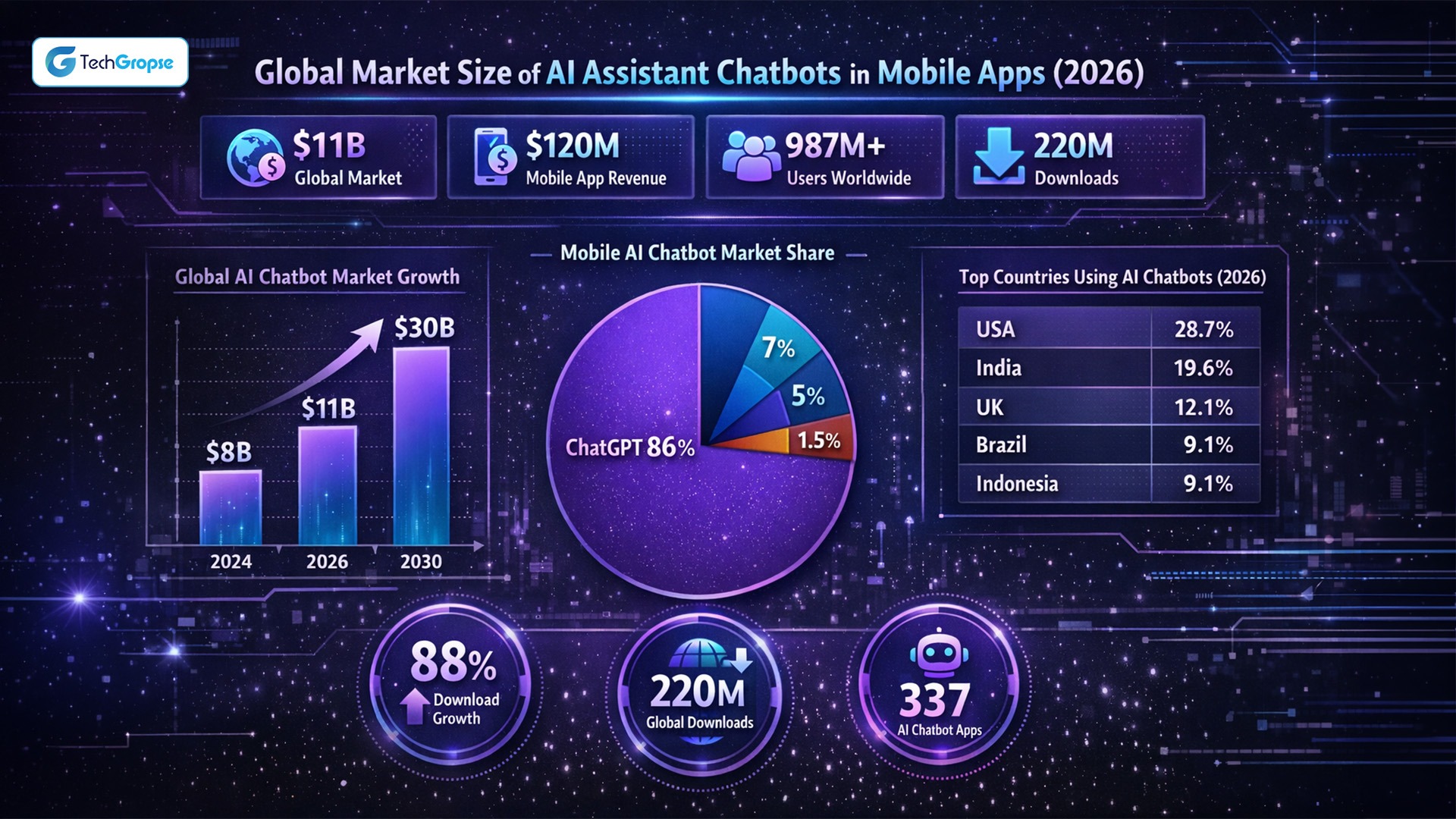
AI Business Weekly says that the global AI assistant chatbots in mobile apps is valued at approximately $10 – $11.45 billion in 2026, with an annual growth rate of around 23–26% as adoption expands across industries.
Another report from Fortune Business Insights reveals that Generative AI chatbot revenue is expected to reach about $12.98 billion in 2026, growing at a strong CAGR of 31% over the forecast period.
A Global Growth Insights report claims that the broader global AI chatbots market could hit $20.8 billion by 2026, showing very rapid growth from previous years.
Precedence Research claims: On a longer horizon, the generative AI chatbot market revenue may grow to over $151 billion by 2035, reflecting widespread enterprise and consumer adoption.Â
Another AI Business Weekly report says that multiple sources show adoption rising quickly, with projected market sizes reaching tens of billions by 2030, demonstrating sustained long-term expansion across industries and regions.Â
Benefits of an AI Chatbot in a Mobile App for Business
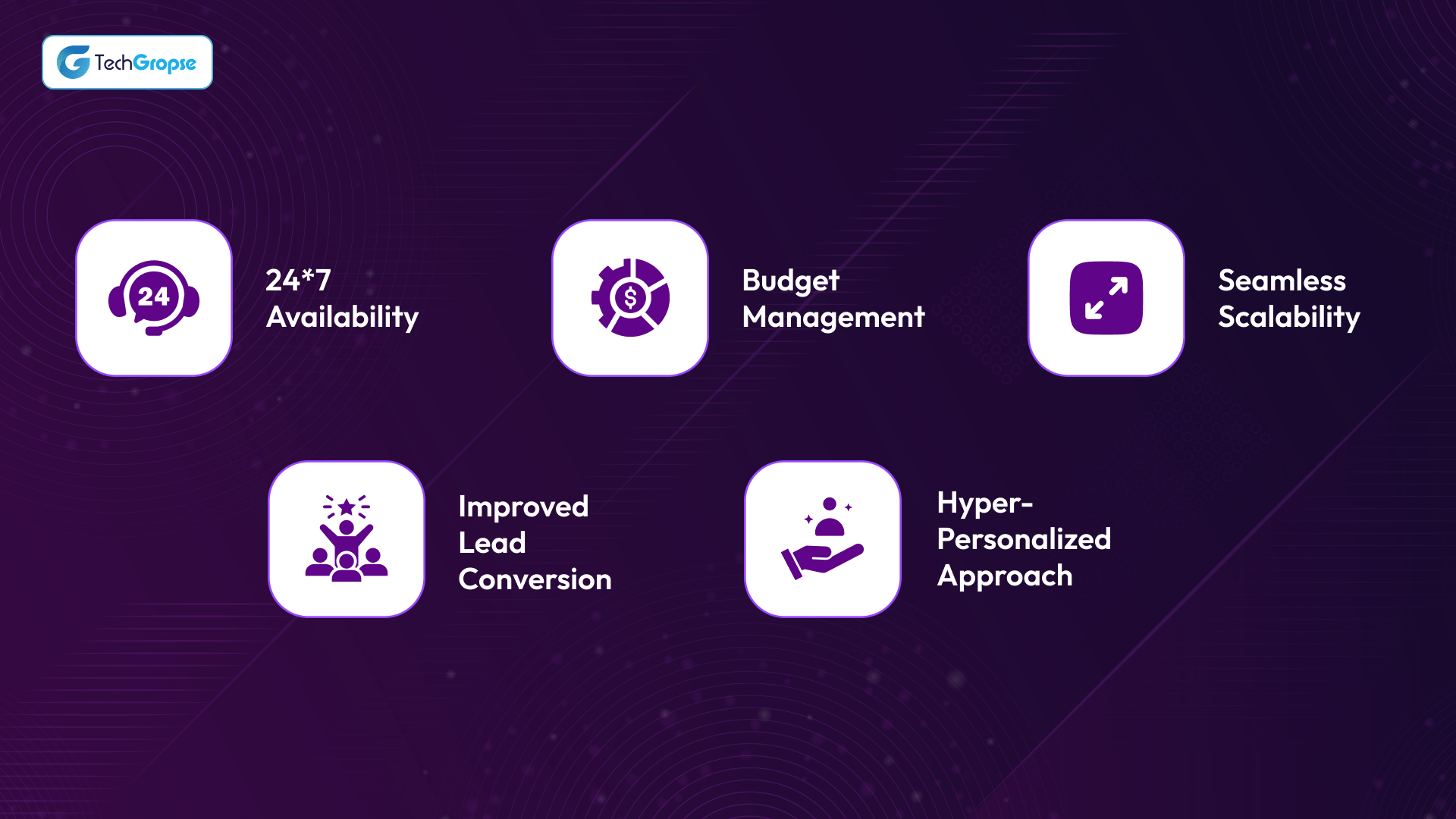
Well, now we have proper evidence that the adoption and growth of AI assistant chatbot apps for business will drastically rise in the near future. Now, let’s explore the operational advantages due to which businesses are quickly onboarding AI chatbots.Â
24*7 Availability
Unlike human resources, who are only available for a particular shift, AI assistant chatbots in mobile apps offer 24*7 and 365 days of operational and customer support. The quick response timeline, decision accuracy, and continuous support make it a good shot for any business. Â
- Instant answers and resolution
- Zero human dependency
- Mitigates the waiting pipeline
- Global consumer reach
- Complete user satisfaction
Budget Management
Dealing with the hiring and firing game is far more expensive than developing AI assistant chatbots in mobile apps. With zero downtime and continuous support, you earn the user’s trust, ultimately improving business ROI.Â
- Dilutes customer support cost
- Repetitive task automation
- Erradicates hiring expenses
- Elevates operational efficiency
- Offers long-term ROI
Seamless Scalability
Hiring and adding extra employees to your customer support team is again more costly than developing a scalable AI chatbot infrastructure. Add an AI assistant chatbot to your mobile app to scale effortlessly during high traffic, handling thousands of simultaneous interactions without performance issues, ensuring consistent service quality as your business grows.
- High-volume business management
- Supports business expansion
- Sustain continuous performance
- Zero extra staffing required
- Adapts to traffic spikes
Hyper-Personalized Approach
The interaction of a human resource may or might not be good enough. But AI not only delivers consistent performance but also offers a hyper-personalized experience to users. It analyses user behaviour, demographic preferences, and contextual conversation to scale up user support.Â
- Data-focused personalization
- Customized product recommendations
- Context-aware conversations
- Improved customer retention
- Higher engagement levels
Improved Lead Conversion
AI chatbots guide users through sales funnels, answer objections instantly, recommend relevant solutions, and automate follow-ups to increase conversion rates and revenue generation.
- Instant response to prospects
- Automated lead qualification
- Proactive product suggestions
- Reduces cart abandonment
- Boosts sales conversions
What are the 2 Approaches to Developing AI Assistant Chatbots in Mobile Apps?
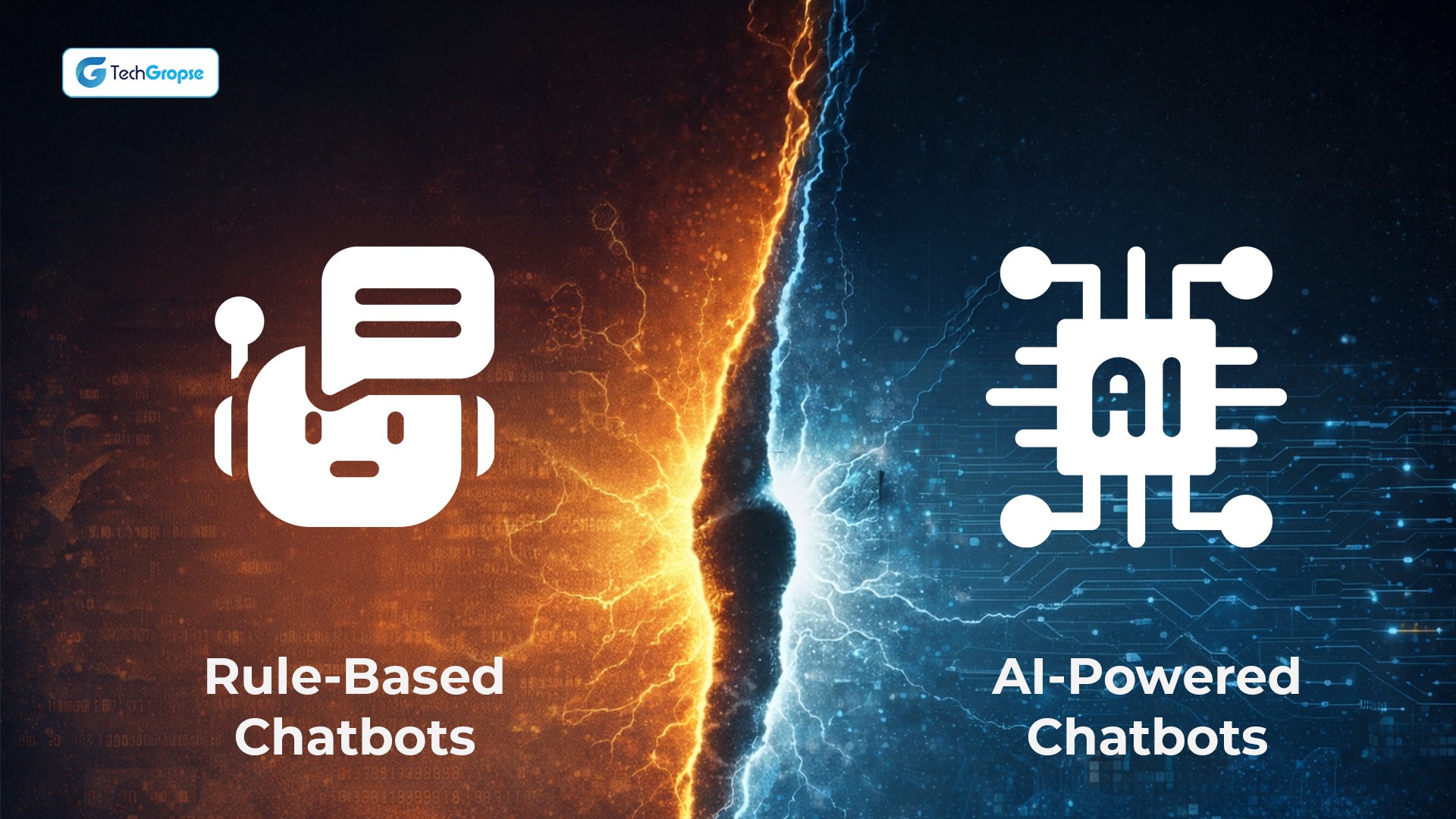
Well, there are 2 fundamental approaches to AI chatbot development. Before you proceed, it’s important to understand the category and development of these 2 chatbots.Â
Rule-Based Chatbots: The Traditional Approach
Based on the predefined scripts, these chatbots approach the decision-making process with an if-this-then-that algorithm. Rather than AI/ML data evaluation, these chatbots follow the continuous user input in a chronological order to foster the output.Â
Example
Let’s consider simple logistics AI assistant chatbots in mobile apps. The customer wants to track the delivery status of his product. The bot commands to enter the tracking number, and consequently, comes up with the current status of the product.Â
Best For
- Basic support automation
- Order tracking workflows
- Contact us forms
- Limited budget projects
- Corporate helpdesk queries
AI-Powered Chatbots: The Modern Standard
These AI assistant chatbots in mobile apps leverage multiple Artificial Intelligence branches, including Generative AI, Machine Learning, and NLP (Natural Language Processing), to foster dynamic results, personalizing human-level conversation and engagement. The goal is to interpret the intent and generate contextual responses.Â
Best For
- Automation of complex customer services
- Multilingual user at a global scale
- Enterprise-grade chatbot assistance
- Data-driven customer service and assistance
- Voice-focused app experience
Must-Have Features of AI Assistant Chatbots in Mobile Apps
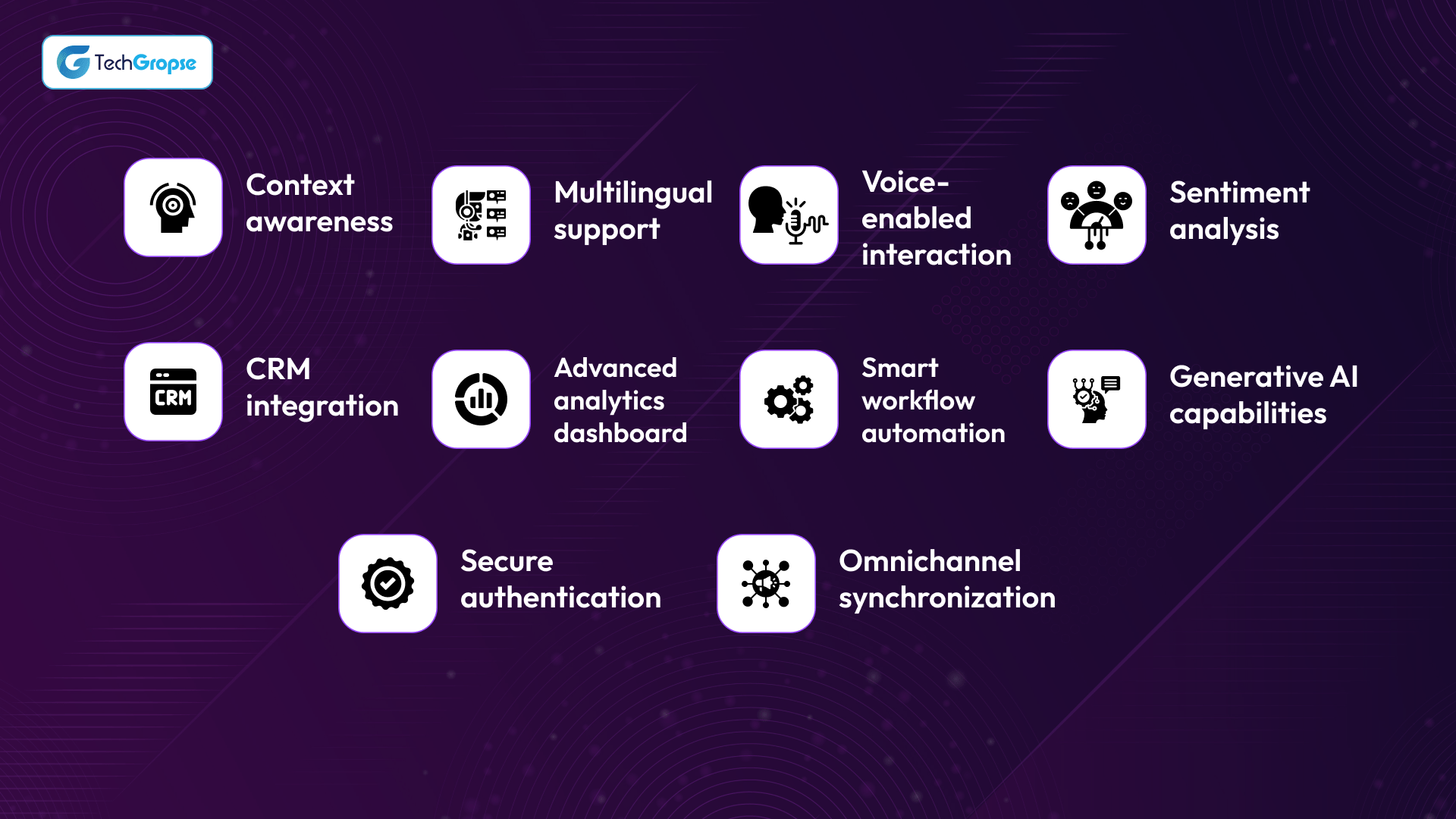
Now, let’s list out a couple of features that are essentially required to build a decent chatbot in 2026.Â
Context awareness
With a proper evaluation of historical patterns, behaviour analysis, and past interactions, AI assistant chatbots in mobile apps foster context aware response.Â
- Past user interactions
- High-level intent
- Multi-step conversion
- Repetitive input mitigation
Multilingual support
When it comes to serving the global customer base, AI assistant chatbots in mobile apps offer support in multiple languages.Â
- Global language support
- Region-specific customization
- Right-to-Left support for middle east region
- Inclusivity and accessibility
Voice-enabled interaction
Voice-enabled AI assistant chatbots in mobile apps will offer both speech-to-text and text-to-speech facilitations.Â
- Speech-to-text function
- Text-to-speech function
- hands-free customer support
- Voice command accessibility
Sentiment analysis
This feature processes the EQ (Emotional Quotient) of the customer to adjust the responses and improve customer satisfaction of the users.Â
- Identifies the emotional state of mind
- Dynamic tone adjustments
- Escalate sensitive conversation
- Accomplish 360-degree customer satisfaction
CRM integration
When CRM is integrated with AI assistant chatbots in mobile apps, it gets access to the customer data and conversations, eventually elevating the responses and satisfaction value.Â
- Accesses real-time customer data
- Personalizes sales conversations
- Syncs support tickets automatically
- Tracks customer interaction history
Secure authentication
Implements OTP, biometric login, encryption, and role-based access to ensure safe and compliant interactions.
- OTP-based verification
- 2-Factor authentication
- End-to-end encryption
- Compliance & data regulation
Omnichannel synchronization
With omnichannel synchronization, you maintain consistent and holistic engagement across all platforms, including social channels, WhatsApp, and websites.Â
- Website and application support
- Social media synchronization
- Chat history continuity
- Centralized communication management
Advanced analytics dashboard
A comprehensive and analytical dashboard to measure the success ratio with different KPI is an extremely important feature of advanced AI assistant chatbots in mobile apps.Â
- Calculate conversion rates
- Monitor resolution timelines
- Evaluate the behaviour pattern
- Offer performance insights
Generative AI capabilities
Uses large language models to generate intelligent, dynamic, and human-like responses beyond scripted flows.
- Dynamic response generation
- Context-based conversation
- Complex queries resolution
- Human-like conversation
Smart workflow automation
Focus on holistically automating the ticket generation process, order tracking, follow-up mechanism, and other operational tasks.Â
- Booking process automation
- Order tracking management
- Notification and reminders
- Mitigates manual workloads
How do AI Chatbots Work in a Mobile App?Â
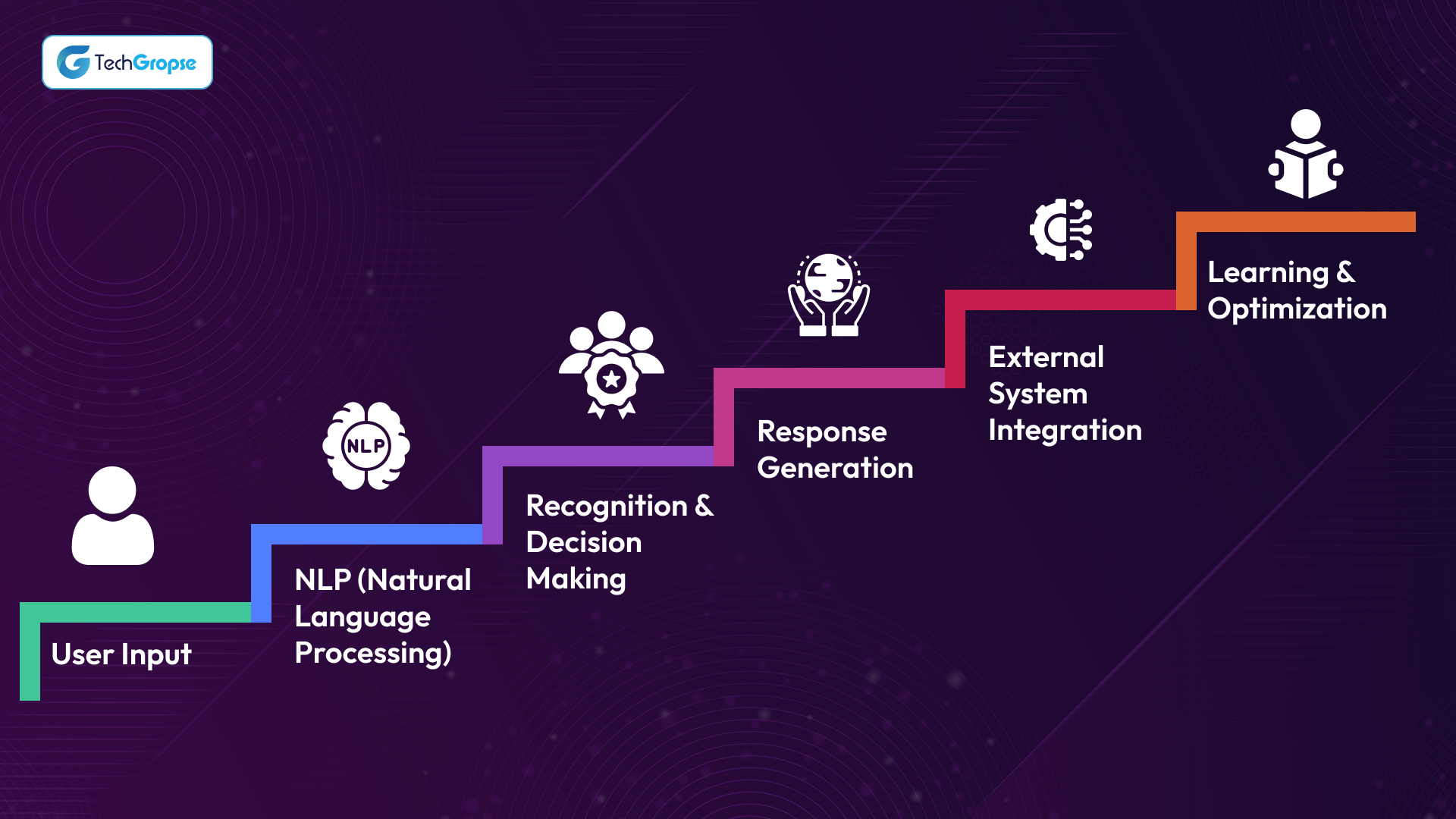
Behind every seamless conversation of AI assistant chatbots in mobile apps, there is a firm and reconciled algorithm and model orchestration. So, let’s explore the workflow automation of AI assistant chatbots in mobile apps.Â
Step 1: User InputÂ
Whether the user types the message or puts on a voice note, the conversation starts from there. The chatbot instantly receives the input and sends it for NLP (Natural Language Processing).Â
Step 2: NLP (Natural Language Processing)
The NLP layer works on breaking down the context and meaning of the message. There are fundamentally three aspects working over here: Intent, Entities, and Context. Intent refers to what exactly the user wants to fetch. Entities are the key elements required for fetching the required information.Â
Step 3: Recognition & Decision Making
After the chatbot perceives what exactly the user wants, it’s time to work with the decision logic layer. There could be multiple decisions. It can fetch the information from the database and give the right answer. It can prob the user with more questions for further inquiry. It can also route towards a third-party API for the outcome.Â
Step 4: Response Generation
The 4th step is generating the response for the user. The crafting of a response can be bifurcated into 2 categories: Retrieving and Generating. Retrieving is the retrieval of the answer from the database of the system. Generating involves using a generative model (like GPT), which builds sentences dynamically based on the user’s message and context.
Step 5: External System Integration
In this step, AI assistant chatbots in mobile apps may require integration with the ERP, CRM, database, or third-party APIs. For instance, the e-commerce chatbot may integrate with Shopify, further in the HR domain the chatbot may integrate with Slack, and in customer support, it may integrate with Hubspot.Â
Step 6: Learning & Optimization
In the final step, after offering the response to the user, the chatbot will use a machine learning algorithm to analyze the experience. It will identify unanswered questions, the intent recognition process, and the output given to prepare for a smarter and error-free response next time.
How to Build AI Assistant Chatbots in Mobile Apps: Step-by-Step Guidelines
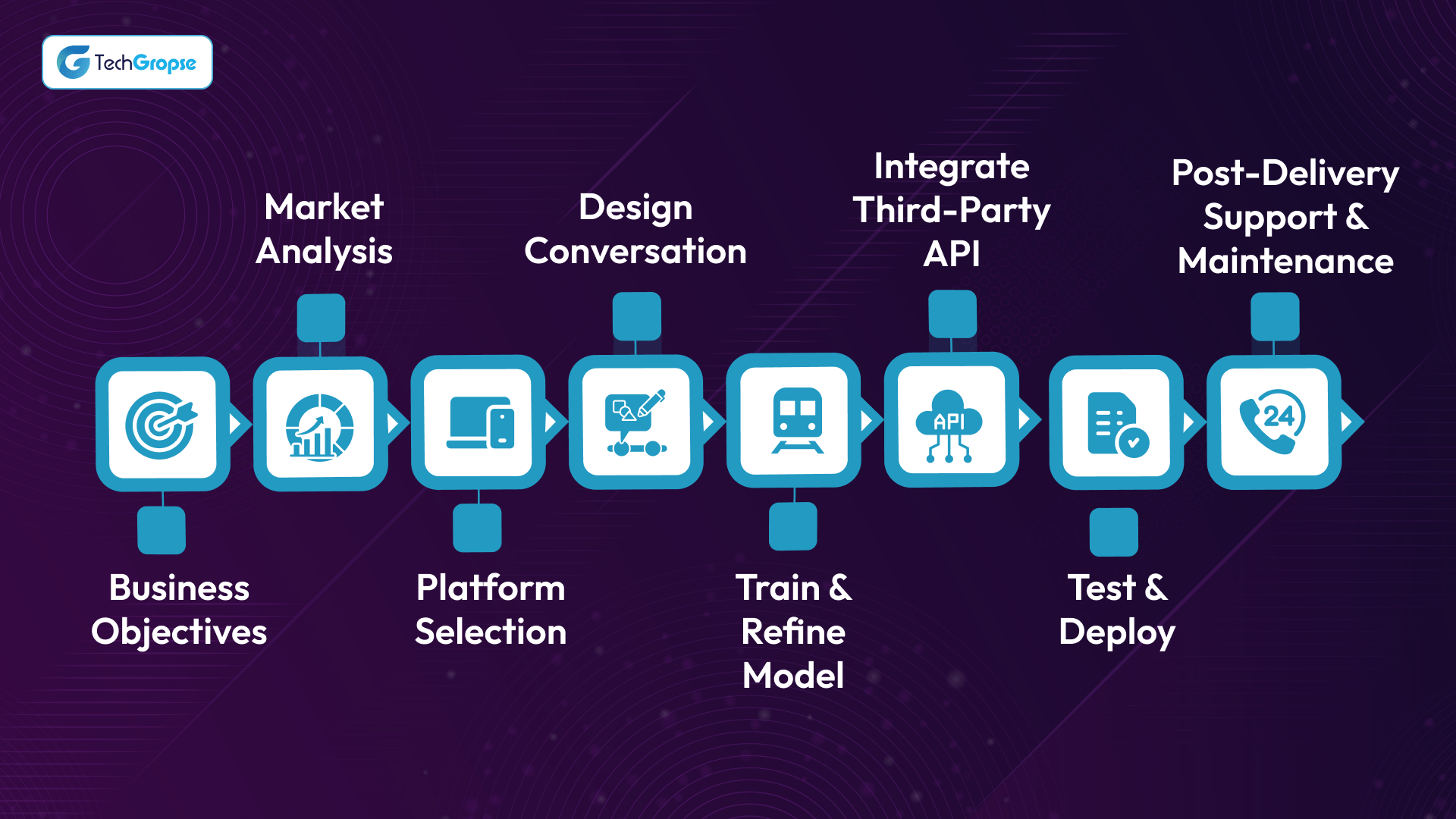
Now, let’s navigate through how a software company should build AI assistant Chatbots in Mobile Apps.Â
Business Objectives
The first and foremost step before you start building AI assistant chatbots in mobile apps is to define clear, crisp business goals and objectives. Identify the possible ROI, market scope, growth scale, and tech-stack for building the chatbot.Â
- Core business objectives
- Tech-stack selection
- Tentative profit scope
- Solution offered to users
- Possible automation bandwidth
Market Analysis
Here, we understand industry trends, competitor chatbot capabilities, user expectations, demographic preferences, and compliance regulations required to build AI assistant chatbots in mobile apps.Â
- Analyze competitor solutions
- Study customer behavior trends
- Identify industry regulations
- Evaluate the technology landscape
- Define competitive advantage
Platform Selection
Choose the right platform required for building AI assistant chatbots in mobile apps. This includes a cloud platform, AI models, and high-end technologies commissioned for the development journey.Â
- Feasible AI framework
- Compatible cloud platform
- Analyse integration capabilities
- Ensure compliance readiness
- Consider future scalability
Design Conversation
Create intuitive conversational flows with natural language understanding, context handling, fallback responses, and user-friendly prompts to ensure seamless, engaging, and human-like interactions.
- Map user journeys
- Build intent-response models
- Design fallback scenarios
- Maintain conversational tone
- Optimize UX simplicity
Train & Refine Model
Train the AI models for performance accuracy with relevant data processing, domain-focused datasets, and contextual awareness.Â
- Clean and filter datasets
- Elevate intent integration
- Refibe model parameters
- Use domain-specific datasets
- Feed past conversation sample
Integrate Third-Party API
To improve the function and performance of your AI assistant chatbots, integrate them with third-party plugins, payment gateways, ERP, CRM, and APIs.
- Integrate CRM system
- Integrate the ERP system
- Assign an analytical dashboard
- Ensure API security
- Integrate payment gateways
Test & Deploy
Perform comprehensive functional, performance, security, and user acceptance testing before deploying the chatbot within the mobile app to ensure reliability and seamless integration.
- Conduct functional testing
- Perform security validation
- Test conversation accuracy
- Optimize performance speed
- Deploy in a live environment
Post-Delivery Support & Maintenance
Ensure seamless after-launch support and maintenance services for better performance and effective service delivery.Â
- Performance optimization
- AI model update
- Speed testing
- Patch security vulnerabilities
- Responsive testing
Top 5 AI Assistant Chatbot Development Companies in 2026
Let’s explore the top 5 companies for building your next-gen AI assistant chatbots in mobile apps.Â
-
TechGropse
Address
- 29 A Street, Dubai, United Arab Emirates
Founded In
- 2015
No. of Employees
- 50 – 249
Hourly Rates
- $25 – $49 / hr
Industries Served
- eCommerce
- Information technology
- Business services
- Education
- Financial services
- Government
- Medical
- Automotive
- Manufacturing
- Real estate
Services Offered
-
Vention
Address
- 575 Lexington Avenue, New York, NY, United States, 10022
Founded In
- 2002
No. of Employees
- 1,000 – 9,999
Hourly Rates
- $50 – $99 / hr
Industries Served
- Advertising & marketing
- Automotive
- Education
- Financial services
- Gaming
- Information technology
- Medical
- Real estate
- Retail
- Supply Chain, Logistics, and Transport
Services Offered
- Blockchain
- Cloud Consulting & SI
- Custom Software Development
- DevOps Managed Services
- IT Staff Augmentation
- Mobile App Development
- Web Development
-
Sketch Development
Address
- 111 West Pacific Avenue, Webster Groves, MO, United States, 63119
Founded In
- 2015
No. of Employees
- 10 – 49
Hourly Rates
- $150 – $199 / hr
Industries Served
- Financial services
- Medical
- Business services
- Consumer products & services
- Government
- Information technology
- Utilities
- eCommerce
Services Offered
- AI Development
- Mobile App Development
- AI Consulting
- API Development
- Cloud Consulting & SI
- Generative AI
- AI Agents
-
BlueLabel
Address
- 18 West 18th Street, New York, NY, United States, 10011
Founded In
- 2009
No. of Employees
- 50 – 249
Hourly Rates
- $100 – $149 / hr
Industries Served
- Business services
- Consumer products & services
- Education
- Energy & natural resources
- Financial services
- Hospitality & leisure
- Media
- Medical
- Real estate
- eCommerce
Services Offered
- AI Consulting
- Generative AI
- AI Development
- Mobile App Development
- Product Design
- Web Design
-
Agix Technologies
Address
- 99 Derby Street, Hingham, MA 02043, Boston, USA
Founded In
- 2024
No. of Employees
- 10 – 49
Hourly Rates
- < $25 / hr
Industries Served
- Medical
- Arts, entertainment & music
- Education
- Financial services
- Manufacturing
- Media
- Retail
- eCommerce
- Hospitality & leisure
- Food & Beverage
Services Offered
- AI Agents
- AI Development
- Data Annotation Services
- Generative AI
- AI Consulting
- BI & Big Data Consulting & SI
- Robotics Process Automation
Cost of Building an AI Assistant Chatbot in Mobile Apps
Let’s break down the AI chatbot mobile app pricing plans in 2026. To make the pricing more comprehensive, we have bifurcated the bot type into three categories: Simple, Advanced, and Complex.Â
Simple AI Assistant Chatbot
This is the basic chatbot with simple workflows, restricted NLP initiatives, simple CRM integration, and a fundamental analytical dashboard. This chatbot is like another option given to the users for queries, concerns, and navigational problems.Â
Advanced AI Assistant Chatbot
An advanced AI assistant chatbot goes a step ahead of simple chatbots. They offer high-contextual aware decision making, a high-end analytical dashboard, and CRM & ERP integration to seamlessly improve business engagement and conversion ratio.Â
Complex AI Assistant Chatbot
A fully customized enterprise-grade AI assistant powered by generative AI, voice interaction, omnichannel synchronization, advanced security, and scalable architecture for high-volume operations and automation.
| Complexity Level | Estimated Cost | Key Features Included | Ideal For | Development Timeline |
|---|---|---|---|---|
| Simple | $8,000 – $15,000 | Basic NLP, predefined workflows, limited integrations, single language support | Startups & small businesses | 4 – 6 weeks |
| Advanced | $15,000 – $35,000 | Context awareness, CRM integration, multilingual support, analytics dashboard | Growing businesses & mid-sized enterprises | 6 – 10 weeks |
| Complex | $40,000+ | Generative AI, voice interaction, omnichannel sync, custom AI training, enterprise security | Large enterprises & high-scale platforms | 10 – 16+ weeks |
Bottomline: Hire an AI Chatbot Developer for a Mobile App
TechGropse is a leading mobile app development company with 10+ years of experience in the software business. Having deployed 1000+ projects across multiple industry verticals, our research analysts, development experts, and creative team have established a colossal global presence in 35+ nations.Â
TechGropse also has a 99.9% client retention rate along with a Clutch rating and C-SAT score of 4.9/5, and 100+ major industry awards backing its capabilities. However. These data are not sufficient to hire a mobile app development company.Â
So, let’s evaluate what we offer as a prominent IT AI assistant chatbot development service provider.Â
- Customized AI assistant chatbot development services.
- Development consultation to post-delivery support & maintenance.
- LLM-focused intelligent conversational design.
- Seamless ERP, CRM, and third-party API integration.
- Enterprise-level compliance and security integration.Â
- Performance optimization and advanced analytics.Â
- AI chatbot API for Android and iOS.Â
- Scalable cloud infrastructure for business sustainability.Â
- Post-delivery support and maintenance services.Â
- Voice-enabled and multilingual AI assistant chatbot.Â
- Demographic-focused AI assistant chatbot.Â
FAQs (Frequently Asked Questions)
An AI assistant chatbot is an intelligent virtual assistant integrated into mobile apps that automates conversations, support, and personalized user interactions.
AI assistants use machine learning and context understanding, while traditional chatbots rely on predefined scripts and limited rule-based responses.
AI chatbot development typically costs between $8,000 and $40,000+, depending on complexity, integrations, AI models, and customization requirements.
Development usually takes 4 to 12 weeks, depending on features, AI training needs, integrations, testing requirements, and deployment scope.
Healthcare, e-commerce, fintech, logistics, real estate, travel, and enterprise sectors benefit significantly from AI-driven automation and personalization.
Yes, AI chatbots integrate seamlessly with CRM platforms, payment gateways, ERP systems, APIs, and marketing automation tools.
Yes, with encryption, secure authentication, compliance protocols, and role-based access controls, AI chatbots safely manage sensitive data.
Modern AI chatbots support multiple languages, real-time translation, speech recognition, and voice-enabled responses for enhanced accessibility.
They provide instant responses, personalized recommendations, proactive assistance, and seamless guidance, increasing satisfaction, retention, and purchase decisions.
Custom chatbots offer scalability, flexibility, and competitive advantage, while pre-built solutions suit limited budgets and simpler requirements.

Hello All, Aman Mishra has years of experience in the IT industry. His passion for helping people in all aspects of mobile app development. Therefore, He write several blogs that help the readers to get the appropriate information about mobile app development trends, technology, and many other aspects.In addition to providing mobile app development services in USA, he also provides maintenance & support services for businesses of all sizes. He tried to solve all their readers' queries and ensure that the given information would be helpful for them.

 info@techgropse.com