



























































Gradually, we have come to a point of time, when seeking mental health is not a taboo any more. However, there are still some places in remote geographies that consider it awkward and rather pessimistic. Further, city people who positively adopted the therapist often suffer from lack of time management, budget inconvenience, and privacy issues. Thus, the development of a chatbot for mental health is an acute solution to these problems.Â
And now comes the hardest part. Even when you decide to build a chatbot for mental health sessions, there would be innumerable challenges. Right technologies, optimum resources, budget allocation, missing out competitive features, and ROI miscalculations. All these adversities would suddenly pop out of the blues.Â
Thus, we have curated a comprehensive blog on developing a chatbot for mental health that encapsulates the major information verticals that you would look for.Â
Key Takeaways:
- Market Size of Chatbot for Mental Health in 2026
- Why Are Enterprises Investing in Chatbot for Mental Health in 2026?Â
- Key Features of the Best Mental Health Chatbot in 2026
- Tech-Stack to Build an AI-Focused Chatbot for Mental Health
- How to Build a Chatbot for Mental Health: Step-by-Step Guidelines
- ROI Calculation of Your Chatbot for Mental Health: 5 Significant Parameters
- Cost to Develop a Chatbot for Mental Health (Based on App Type)
- Top 5 Chatbots for Mental Health in 2026
- Why Choose TechGropse for Your Mental Health Chatbot Development?Â
- FAQs (Frequently Asked Questions)
Market Size of Chatbot for Mental Health in 2026
Data from Towards Healthcare says that the mental health chatbot market is expected to reach ~$2.15 billion in 2026, driven by rising demand for accessible therapy solutions.
Future Market Insights reveals that the mental health chatbot market is projected to be around $2.8 billion in 2026, showing rapid adoption of AI-driven mental health applications globally.Â
A study from RESEARCH AND MARKETS says that the broader AI in the mental health market is valued at $2.7 billion in 2026, highlighting strong investment in AI-powered therapy solutions.
Another Towards Healthcare research says that the mental health chatbot industry is growing at a CAGR of 20%–21% from 2026 onward, indicating strong long-term scalability and demand.
So, here’s the bottom line:
- Mental health awareness in modern-day society is encouraging the growth of AI chatbot therapists.Â
- Due to AI therapy chatbots, mental health treatments & consultations are getting more accessible.
- Today, enterprises are broadly investing in high-scalable chatbots for mental health.Â
- Advanced AI is constantly elevating the level of mental health treatment.
- A mental health chatbot app would gradually become an integral part of digital healthcare in future.Â
Why Are Enterprises Investing in Chatbot for Mental Health in 2026?Â
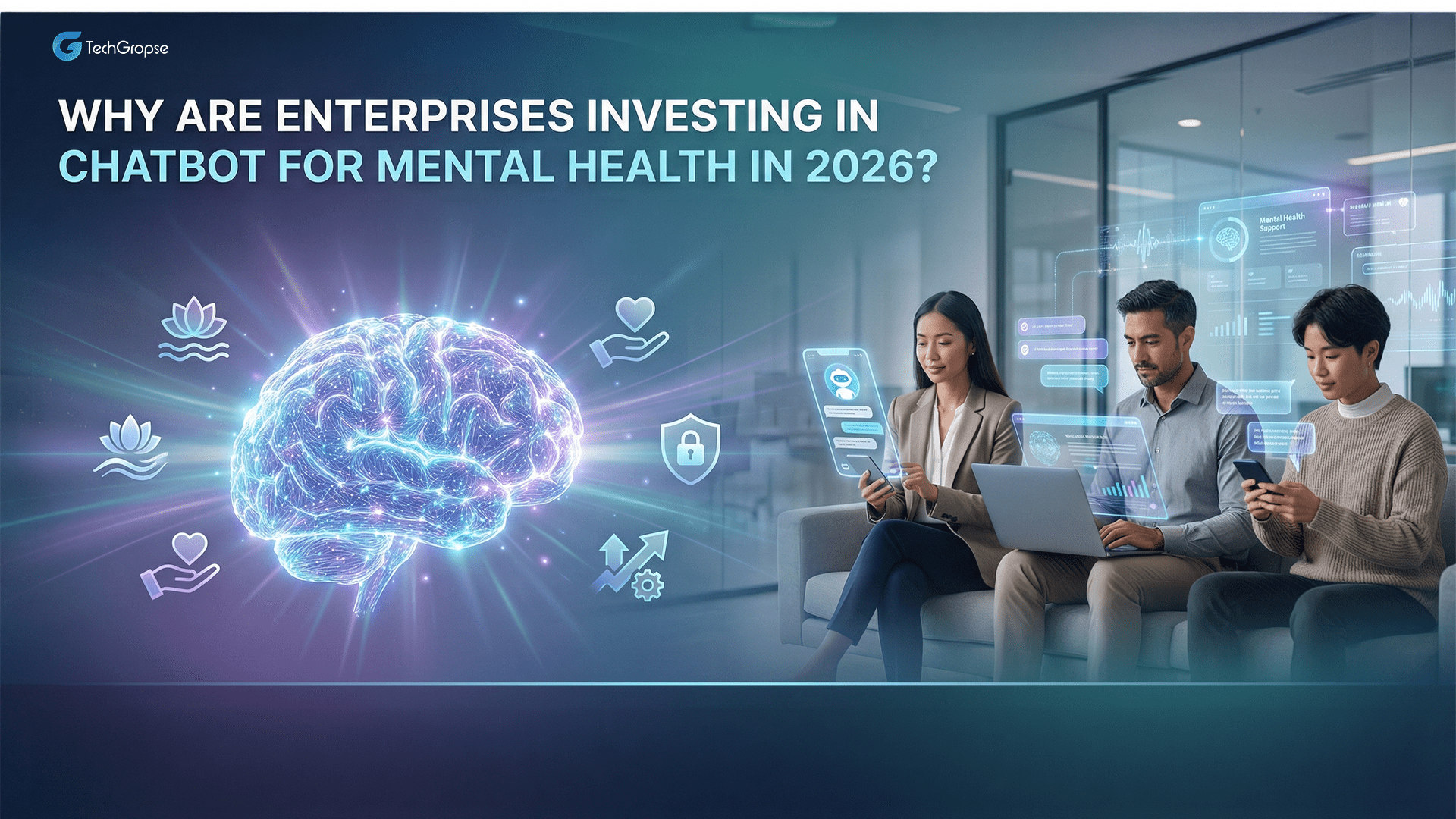
Firstly, let’s understand why enterprises are broadly investing in chatbots for mental health.Â
Addressing the Global Mental Health Crisis
With the rising cases of depression, anxiety, and stress, the digital investors are looking forward to addressing the global mental health crisis through a tech perspective. Mobile app solutions are one such medium that can narrow the disease-to-treatment gaps in modern society. Â
- Rising mental health issues
- Shortage of professionals
- High demand for support
- Need for early intervention
- Healthcare system burden
Improving Accessibility to Mental Healthcare
With features like chatbots, voice support, and email support, you get access to a broad range of mental health portals. Especially if we consider the underserved and remote regions, these applications eliminate significant barriers in terms of cost, locations, and accessibility.Â
- 24/7 availability
- Remote access
- No location barriers
- Cost-effective support
- Easy mobile access
Reducing Mental Health Stigma
People always hesitate meeting a mental health consultant directly in-person. There is a sense of “being judged” in clinics and centers. Meanwhile, a mental health chatbot application offers a judgement-free ecosystem, anonymous forum, and protected identity assurance for users.Â
- Anonymous support
- Judgment-free space
- Encourages openness
- Builds confidence
- Promotes awareness
Promoting Preventive Mental Healthcare
When users make it a habit of having a regular mental health check-up, there is a broad possibility that he/she will never suffer from severe scale mental illness. Continuous checkup through digital apps would offer right mental conditioning, eventually preventing chronic mental illness.Â
- Mood tracking
- Early detection
- Daily check-ins
- Prevents severity
- Supports well-beingÂ
Supporting Community Well-Being at Scale
Enterprises leverage chatbots to deliver mental health support to the mass population. This contributes to holistic societal well-being while making sure that no particular class or sect is untouched with consistent, reliable, and scalable care solutions.
- Large-scale support
- Consistent care
- Scalable solutions
- Supports communities
- Improves wellness
Key Features of the Best Mental Health Chatbot in 2026
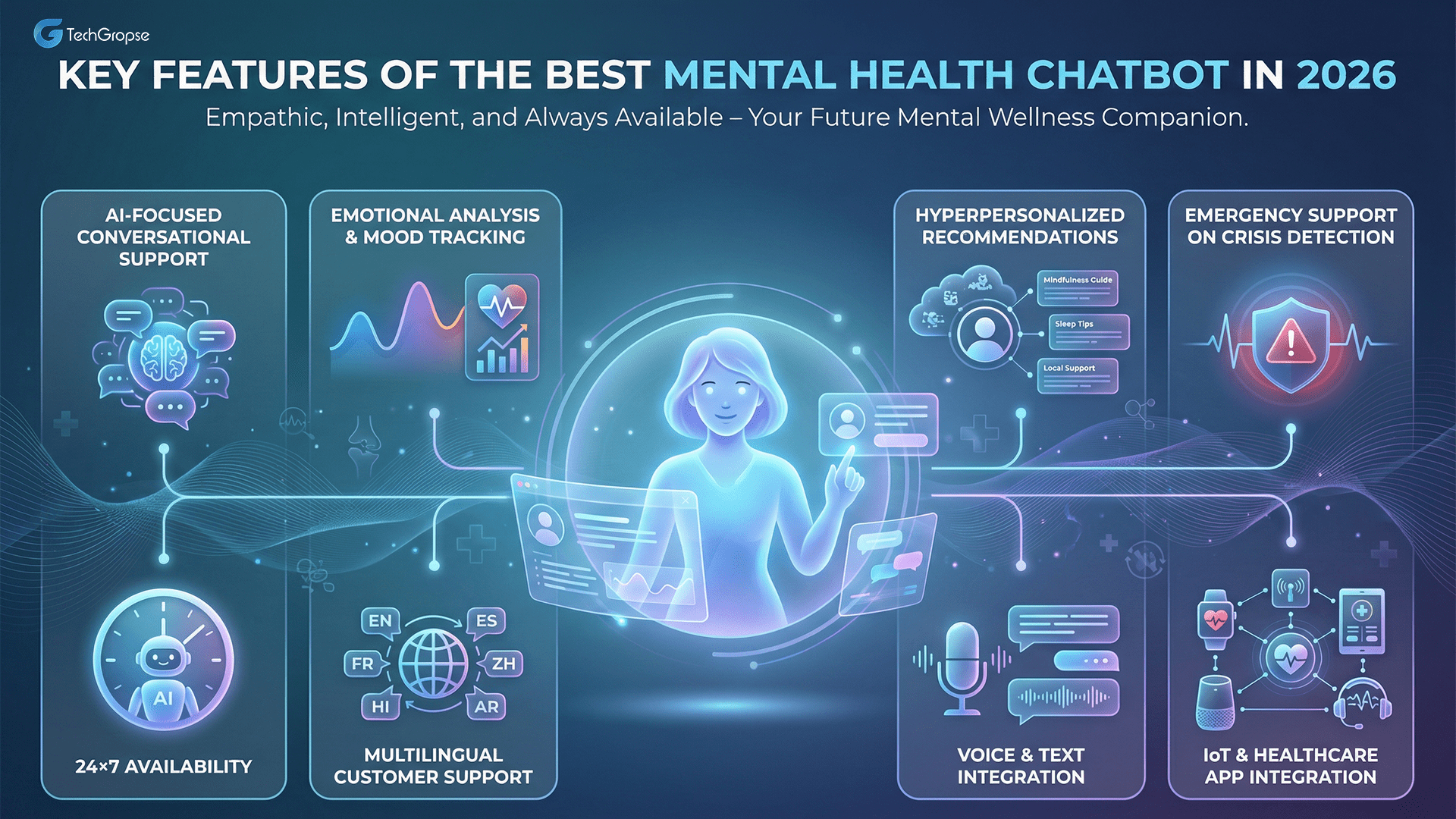
Now, let’s make a note of top 10 features that must be available with any chatbot for mental health management. While hiring a mobile app development company, you must ensure that they are offering all these features across the blueprint of your mental health chatbot development.Â
AI-Focused Conversational Support
The feature focuses on creating human-like empathetic conversation using AI algorithms and NLP framework. Here you also understand the mental conditioning and intent of the user to offer him/her the best support.Â
- Real-time chat support
- NLP smart engineÂ
- Context-aware responses
- Intelligent replies
- Empathy-driven conversations
Emotional Analysis & Mood Tracking
A chatbot for mental health evaluates the emotions and mood pattern through behaviour analysis and sentimental conversation to foster and deliver personalized insights for mental health and therapy.Â
- Mood logs and charts
- Sentiment AI integration
- Behaviour pattern tracking
- Active emotional detection
- Daily progress insights
Hyperpersonalized Recommendations
When AI integration joins your technical voyage, the users are certain to receive top-notch personalized suggestions with Smart Recommendation Engine. This feature offers you personalized therapy content, chronic mental disease coping strategies, customized affirmations and exercises.Â
- Intelligent user suggestions
- Personalized content delivery
- Dynamic response generation
- Context-based support
- Customized wellness programmes
Emergency Support on Crisis Detection
An AI-focused chatbot for mental health would always identify a high-risk situation like anxiety attacks and suicidal thoughts. In this situation that chatbot would follow the immediate protocol and connect to the nearest helpline for safety assistance and support management.Â
- Real-time emergency alerts
- SOS trigger matrix
- Safety protocol activation
- Emergency support routing
- Continuous AI monitoring
24*7 Availability
Today, most office-going people suffer from mental health crises. However, they procrastinate clinic visits due to a busy and hectic work schedule. A 24*7 available chatbot for mental health thrives as a solution to this problem. Be it emergency check-ups or odd-hours consultations, you get consistent support across all time-zones.Â
- 24*7 & 365 days availability
- Instant accessibility & scheduling
- Global support coverage
- Zero downtime privilege
- High-scale uptime reliability
Multilingual Customer Support
A cosmopolitan chatbot for mental health would cover the pole-to-pole demographies across the globe. With inclusive and multiple language support, you can cater to local, regional, and global audiences as well. This enhances user comfort, making mental health support more universally available.Â
- Multiple language support
- Global patient reach
- Local/regional focused support
- Cultural integration & adaptability
- All time-zones support
Voice & Text Integration
This feature allows users to interact with the chatbot using both voice and text, offering greater flexibility and accessibility. It enhances user experience by enabling natural communication, supporting hands-free usage, and catering to different user preferences and accessibility needs. So, it’s high time to leverage Voice Assistance & Chatbots in contemporary mental-health domains.Â
- Voice input support
- Text chat system
- Speech recognition AI
- Easy user interaction
- Dual communication mode
IoT & Healthcare App Integration
IoTs and wearable products are the new trends of the healthcare industry. When integrated with a chatbot for mental health, it collects real-time patient data, sleep patterns, physical activities, and other significant health metrics, directly or indirectly impacting the mental health and stability. This data enhances insights, enabling more accurate recommendations and a holistic approach to mental health management.
- Wearable device synchronisation
- Broad-range device connectivity
- Advanced health-analytics system
- Sleep cycle and pattern monitoring
- Exercise & fitness activity tracking
Tech-Stack to Build an AI-Focused Chatbot for Mental Health
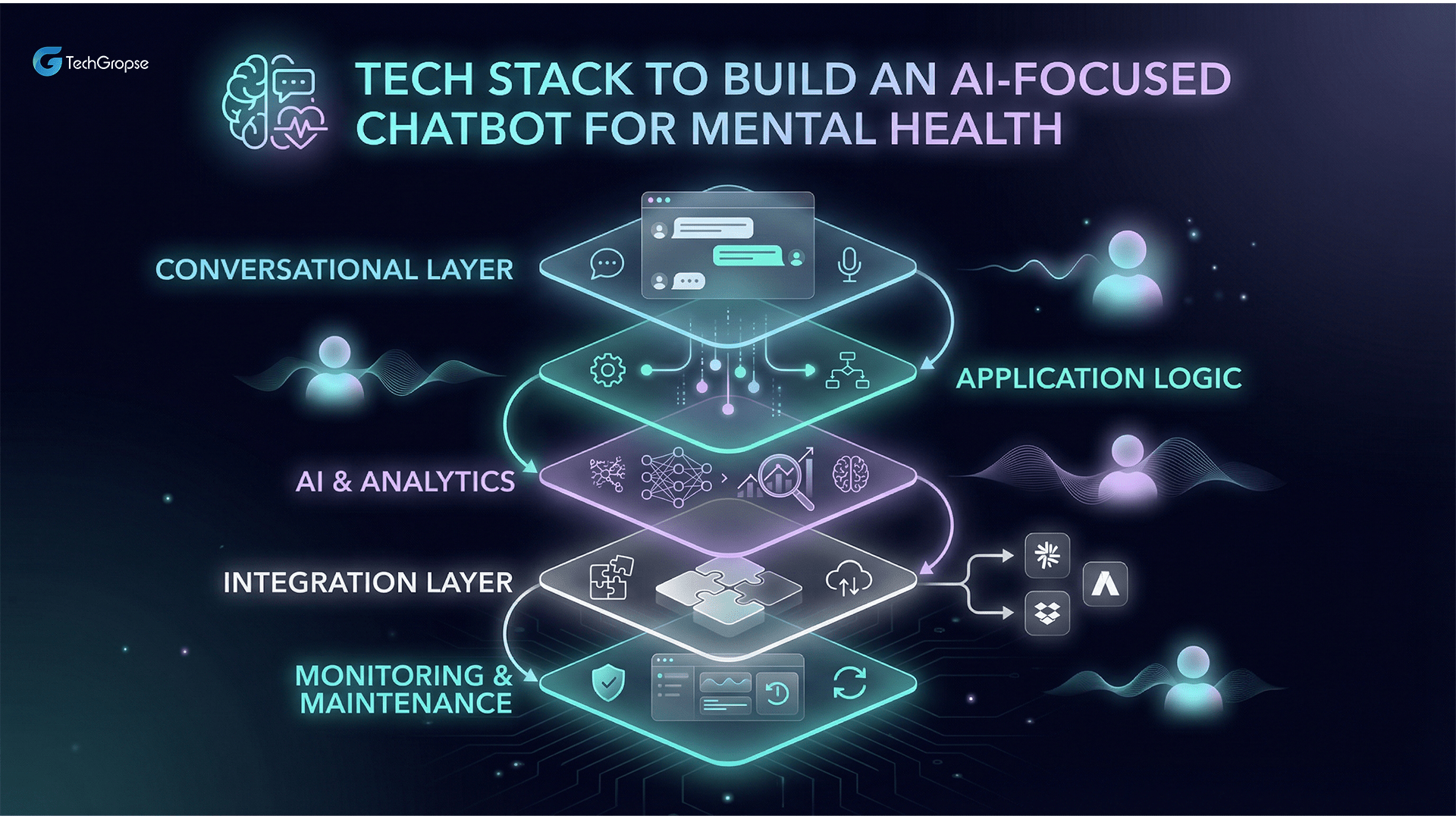
Before you start developing a chatbot for therapy, know the technologies required for the right development and execution.Â
Conversational Layer
Dialogflow | Microsoft Bot Framework | Rasa | IBM Watson Assistant | OpenAI GPT APIs | Amazon Lex | Chatfuel | Botpress | Tidio | Kore.ai
Application LogicÂ
Node.js | Python (Django/Flask) | Java (Spring Boot) | Ruby on Rails | .NET Core | Express.js | Laravel (PHP) | FastAPI | GraphQL | REST APIs
AI and Analytics
TensorFlow | PyTorch | Scikit-learn | Hugging Face Transformers | SpaCy | NLTK | Google AI Platform | AWS SageMaker | Azure AI/ML | Tableau | Power BI
Integration Layer
Twilio | Stripe | Firebase | AWS API Gateway | Zapier | MuleSoft | Webhooks | HL7/FHIR APIs | OAuth 2.0 | REST APIs
Monitoring & Maintenance
Google Cloud Monitoring | AWS CloudWatch | Azure Monitor | New Relic | Datadog | Sentry | ELK Stack | Prometheus | Grafana | Jenkins | GitHub Actions
How to Build a Chatbot for Mental Health: Step-by-Step Guidelines
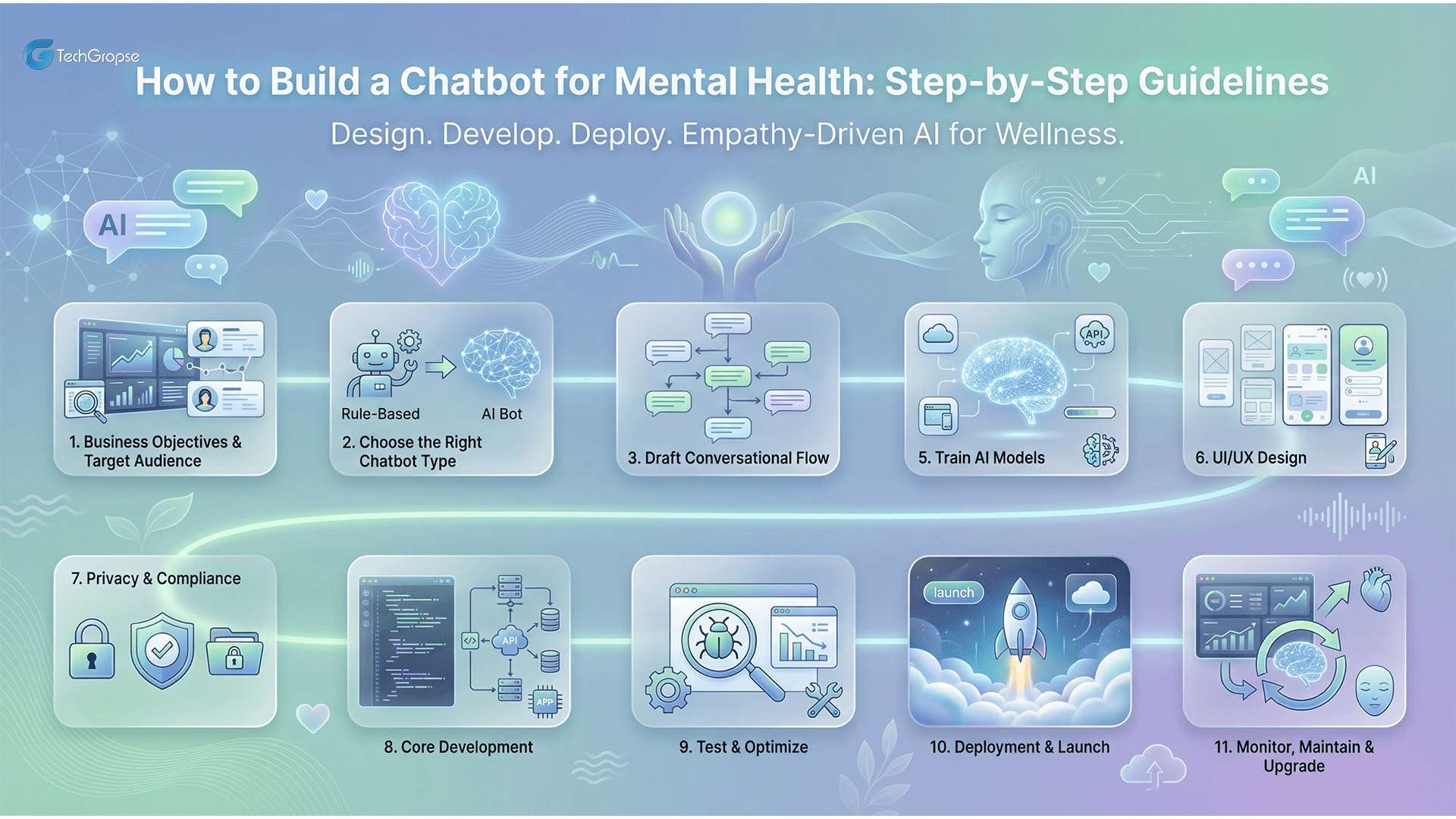
Now, you must learn about the pole-to-pole guideline of the mental health chatbot development for today’s healthcare institutions.Â
Business Objectives & Target Audience
- Define clear goals
- Identify target users
- Understand user needs
- Set success metrics
- Align business strategy
Choose Right Chatbot TypeÂ
- Rule-based option
- AI-powered chatbot
- Hybrid approach
- Define use cases
- Evaluate complexity
Draft Conversational Flow
- Design user journeys
- Create response scripts
- Add fallback flows
- Maintain empathy tone
- Ensure clarityÂ
Select Tech-Stack
- Choose backend tech
- Select NLP tools
- Decide cloud platform
- Plan integrations
- Ensure scalability
Train AI Models
- Use quality datasets
- Train NLP models
- Improve intent detection
- Enable learning loops
- Optimize accuracy
UI/UX Design
- Simple interface design
- User-friendly navigation
- Accessibility features
- Engaging interactions
- Consistent experience
Privacy & Compliance
- Data encryption
- Follow regulations
- Secure data storage
- User consent handling
- Risk management
Core Development
- Data encryption
- Follow regulations
- Secure data storage
- User consent handling
- Risk management
Test & Optimize
- Perform QA testing
- Fix bugs
- Improve responses
- Analyze feedback
- Enhance performanceÂ
Deployment & Launch
- Deploy on platforms
- Configure servers
- Ensure scalability
- Monitor launch
- Gather feedback
Monitor, Maintain, and Upgrade
- Track performance
- Update AI models
- Fix issues
- Add new features
- Continuous improvementÂ
ROI Calculation of Your Chatbot for Mental Health: 5 Significant Parameters
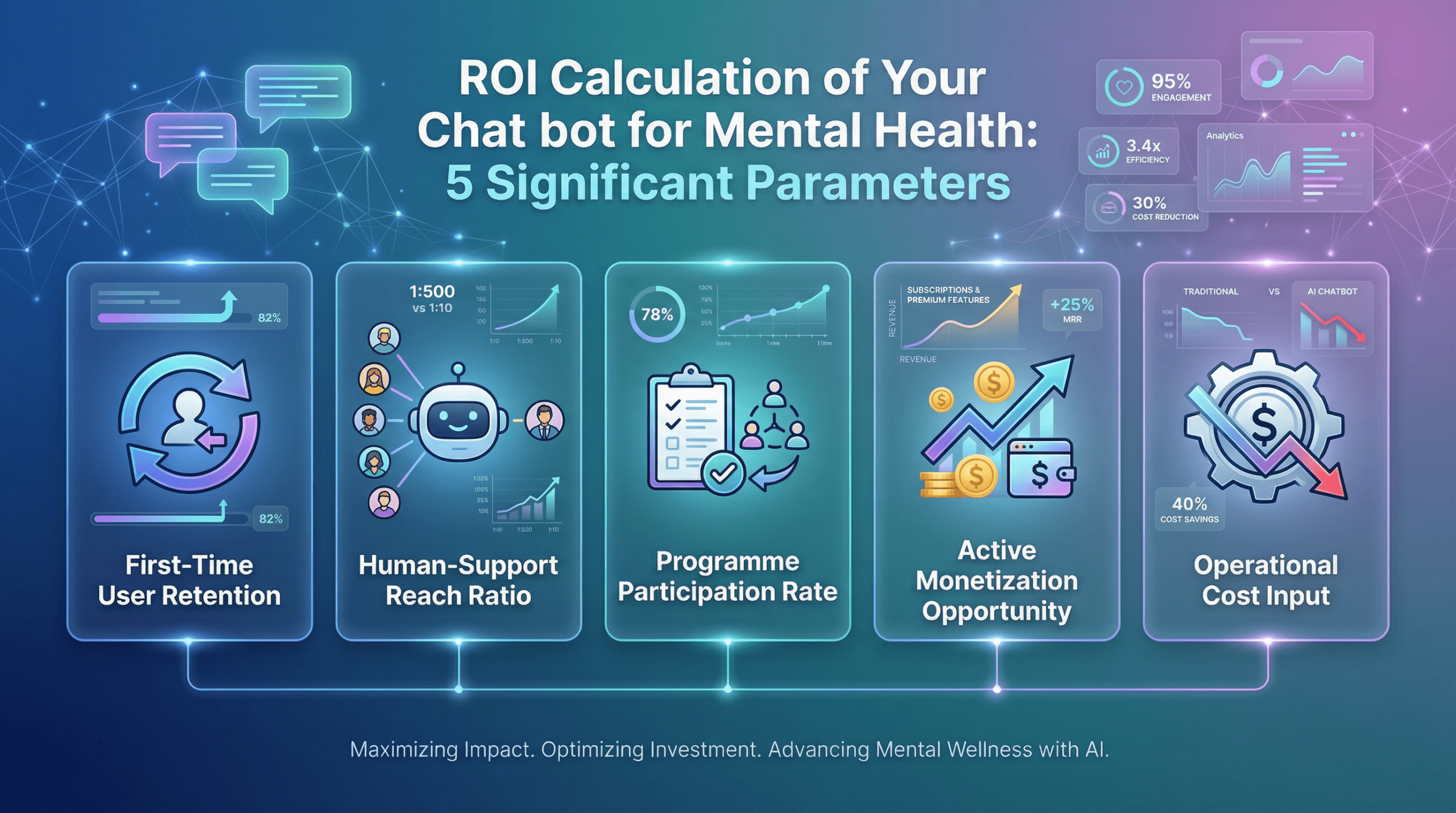
Let’s calculate the ROI scope on the basis of 5 significant parameters: First-Time User Retention, Human-Support Reach Ratio, Programme Participation Rate, Active Monetization Opportunity, Operational Cost Input
First-Time User Retention
This is the ROI data representation on how many users return to the application after using it for the first time. This also determines the initial satisfaction and potential long-term user engagement.Â
How to Improve?Â
- Foster best onboarding experience
- Offer personalized kick-start
- Continuous reminders and notifications
- Provide instant value (tips, insights)
- Ensure smooth and intuitive UI/UX
Human-Support Reach Ratio
Lesser the rate of human-support requirement of your chatbot, higher would be the possibility of ROI%. Reduced human-support showcases that the users are majorly satisfied with chatbot support.Â
How to Improve?Â
- High-end AI and NLP capabilities
- Train chatbots with the real-time datasets
- Automated FAQs on general queries
- Continuous response improvement
- Integration of intelligent escalation system
Programme Participation Rate
The ROI% is also directly proportional to the number of users actively participating in wellness programmes, therapy exercise sessions, daily meditation, journaling, and other similar real-time drills and activities.Â
How to Improve?Â
- Adopt gamification, rewards, and batches
- Offer personalized programme recommendations
- Keep simple and interactive sessions
- Track and display user progress
- Send notifications and reminders to the target audiences
Active Monetization Opportunity
Measures how effectively the chatbot generates revenue through subscriptions, premium features, or partnerships, while maximizing user lifetime value, improving conversion rates, and identifying sustainable monetization strategies for long-term business growth.Â
How to Improve?Â
- Introduce freemium pricing models
- Offer premium mental health programs
- Provide value-driven upselling
- Partner with healthcare providers
- Use targeted offers based on user behavior
Operational Cost Input
It is pretty understandable that less is the operational budget input, higher would be the ROI rate. However, you have to invest a decent and right amount in development, quality, maintenance, and infrastructure support.Â
How to Improve?Â
- Optimize cloud infrastructure utility
- Foster scalable AI framework
- Automate generic process
- Outsource cost-effective development
- Regularly audit and reduce unnecessary expenses
| Parameter | Description | Estimated ROI % Impact |
|---|---|---|
| First-Time User Retention | Measures how many new users return after their first interaction | +15% to +30% |
| Human-Support Reach Ratio | Compares chatbot vs human support usage | +20% to +40% (cost savings) |
| Programme Participation Rate | Tracks engagement in wellness activities | +10% to +25% |
| Active Monetization Opportunity | Revenue from subscriptions, upsells | +25% to +50% |
| Operational Cost Input | Development, maintenance, infrastructure costs | -10% to -30% (cost impact) |
Cost to Develop a Chatbot for Mental Health (Based on App Type)
It’s high time to evaluate the cost of developing a chatbot for mental health based on the type of application.Â
| Application Category | Key Features Included | Estimated Cost (USD) | Best For |
|---|---|---|---|
| Self-Help & Wellness Chatbot | Mood tracking, journaling, basic chatbot | $10,000 – $30,000 | Individuals, startups |
| Guided Meditation Chatbot | Meditation sessions, breathing exercises, reminders | $15,000 – $40,000 | Wellness apps |
| Therapy Support Chatbot | AI conversations, CBT techniques, and emotional analysis | $30,000 – $80,000 | Clinics, therapy platforms |
| Student Mental Health Chatbot | Stress management, academic support, chatbot guidance | $25,000 – $70,000 | Schools, universities |
| Enterprise Employee Wellness Bot | Employee engagement, HR integration, analytics dashboard | $50,000 – $120,000 | Corporates |
| Telehealth Integrated Chatbot | Video consultation, EHR integration, appointment booking | $80,000 – $200,000 | Hospitals, healthcare providers |
| Crisis Intervention Chatbot | Risk detection, emergency alerts, helpline integration | $60,000 – $150,000 | NGOs, healthcare orgs |
| AI Companion Chatbot | Conversational AI, personalization, and emotional bonding | $40,000 – $100,000 | Consumer apps |
| Voice-Enabled Mental Health Chatbot | Voice recognition, speech analysis, and real-time interaction | $70,000 – $180,000 | Advanced digital platforms |
| AI-Powered Advanced Therapy Bot | Predictive analytics, deep learning, personalization, multi-platform support | $150,000 – $400,000+ | Enterprises, large-scale platforms |
Top 5 Chatbots for Mental Health in 2026
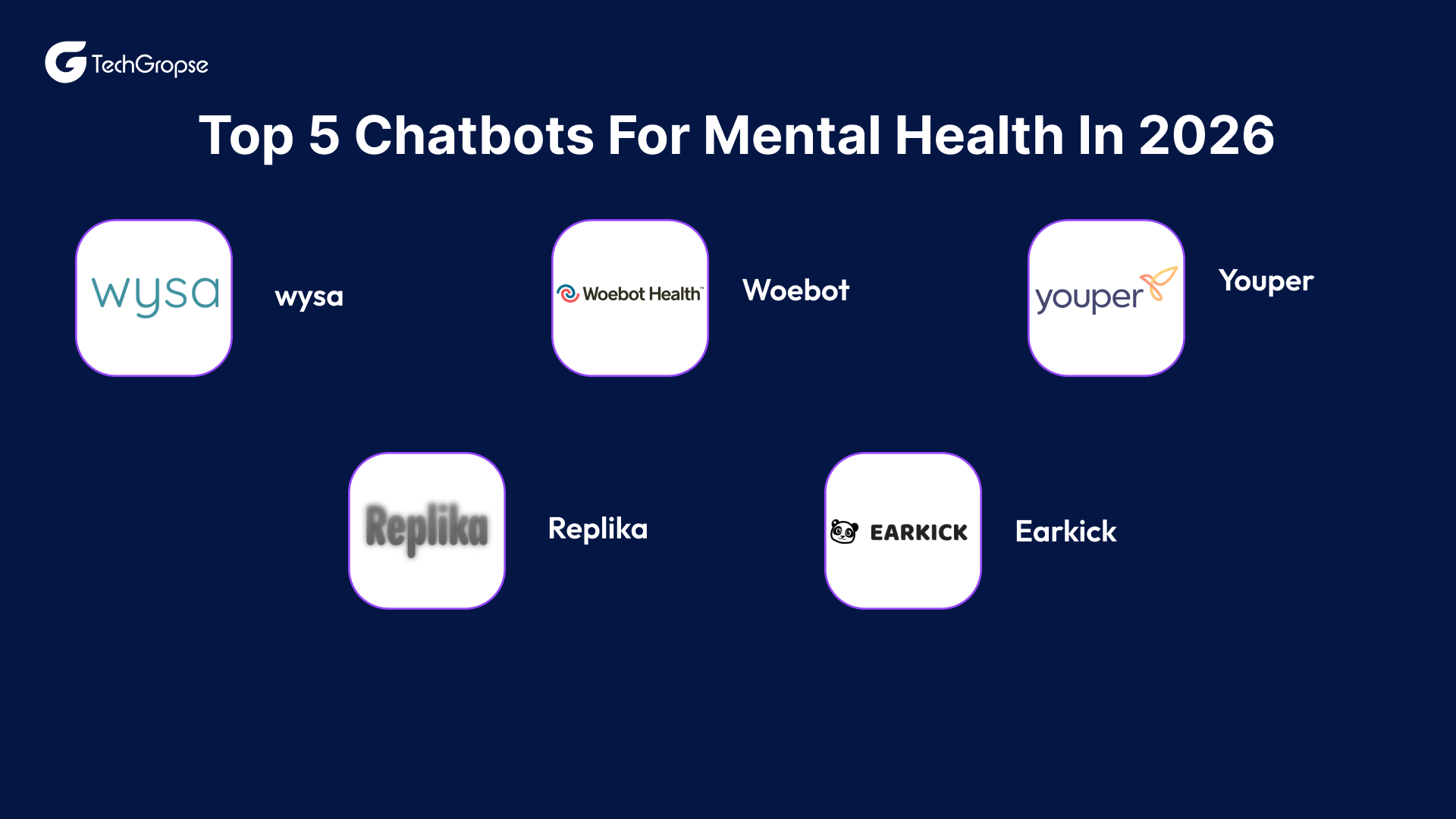
You must know the top 5 mental health chatbots that are transforming the mental therapy landscape in 2026.Â
WYSA
As you are welcomed with the tag line “Mental health redefined”, there is a different sense of confidence that you get with this brand. From first initiative to ongoing care, WYSA ensures that you get outstanding scale mental healthcare support from scratch to end.Â
- Founded: 2015
- Location: London, UK
- Founders: Jo Aggarwal, Ramakant Vempati
- USP: AI chatbot based on CBT, DBT, and clinically validated therapy techniques
- Special Highlight: Used by healthcare systems and global enterprises
- LinkedIn: https://www.linkedin.com/company/wysa-ai
Woebot
Being in the list of “World’s Best Digital Health Companies in 2024”, Woebot Health focuses on building an organic relationship with the patients, eventually offering him/her the best-in-class therapy sessions that assures long-term mental health sustainability. Â
- Founded: 2017
- Location: San Francisco, USA
- Industry: Digital therapeutics
- USP: Built by clinical psychologists with research-backed CBT approach
- Target Users: Healthcare providers, insurers, individuals
- LinkedIn:https://www.linkedin.com/company/woebot-health
Youper
In the era of digital automation, Youper thrives as an Artificial Intelligence application that relies on using conversational techniques for mood tracking, emotional check, and redefining your thought process.Â
- Founded: 2016
- Location: San Francisco, USA
- Founders: Diego Dotta, Jose Hamilton Vargas
- USP: AI-driven emotional health assistant with real-time mood tracking
- Core Offering: CBT-based therapy with AI insights
- LinkedIn: https://www.linkedin.com/company/youper
Replika
Replika is ideal for individuals seeking both mental health support and social engagement. Using memory-based interactions, it creates a unique experience for each user, offering companionship, emotional bonding, and mental wellness exercises.
- Founded: 2015
- Location: San Francisco, USA
- Developer: Luka, Inc.
- USP: AI companion with personalized conversations and emotional bonding
- Core Feature: Memory-based interaction system
- LinkedIn: https://www.linkedin.com/company/replikaai
EarKick
The tag line says “Your Personal AI for Mental Wellness”. The application helps you manage stress, anxiety, and other mental issues with a multimodel AI support system offering both text and voice support.Â
- Founded: 2021
- Location: San Francisco, USA & Zurich, Switzerland
- Founders: Dr. Herbert Bay, Karin Stephan
- USP: Real-time biomarker tracking with AI mental health insights
- Core Feature: Multimodal AI with voice and memory
- LinkedIn: https://www.linkedin.com/company/earkick
Why Choose TechGropse for Your Mental Health Chatbot Development?Â
With 10+ years of experience and 1000+ delivered projects, TechGropse is a leading software identity with a 92% retention rate. Our 150+ software engineers have worked in 25+ locations for 500+ business leaders to receive 100+ awards in the mobile app development services.Â
With end-to-end experience across industries, including manufacturing, pharmaceuticals, healthcare, eCommerce, FMCG, education, digital media, defense, aerospace, and other public & private sectors, we are the best Mental Health Chatbot Development Company to offer outstanding services in this healthcare domain.Â
FAQs (Frequently Asked Questions)
A mental health chatbot is an AI-powered application that provides emotional support, guidance, and self-care assistance through conversational interactions.
They use AI, NLP, and machine learning to understand user inputs, analyze emotions, and provide relevant, personalized responses and mental health support.
Core features include mood tracking, AI conversations, personalized recommendations, crisis detection, multilingual support, analytics dashboards, and integration with health systems.
Development costs range from $10,000 to $400,000+, depending on features, AI complexity, integrations, platform choice, and compliance requirements.
Yes, if built with strong data encryption, privacy policies, and compliance standards like HIPAA or GDPR to ensure user data protection.
No, chatbots provide initial support and guidance but cannot fully replace human therapists, especially for complex mental health conditions.
Technologies include artificial intelligence, natural language processing, machine learning, cloud computing, APIs, and data analytics tools to improve performance.
Individuals, enterprises, healthcare providers, students, and wellness platforms can benefit by improving accessibility, engagement, and mental health support services.
Development typically takes 2 to 6 months, depending on complexity, features, AI training requirements, and testing processes involved.
Future trends include voice-enabled bots, emotion AI, predictive analytics, AR/VR integration, and hyper-personalized mental health experiences using advanced AI models.

Hello All, Aman Mishra has years of experience in the IT industry. His passion for helping people in all aspects of mobile app development. Therefore, He write several blogs that help the readers to get the appropriate information about mobile app development trends, technology, and many other aspects.In addition to providing mobile app development services in USA, he also provides maintenance & support services for businesses of all sizes. He tried to solve all their readers' queries and ensure that the given information would be helpful for them.


 info@techgropse.com