






























































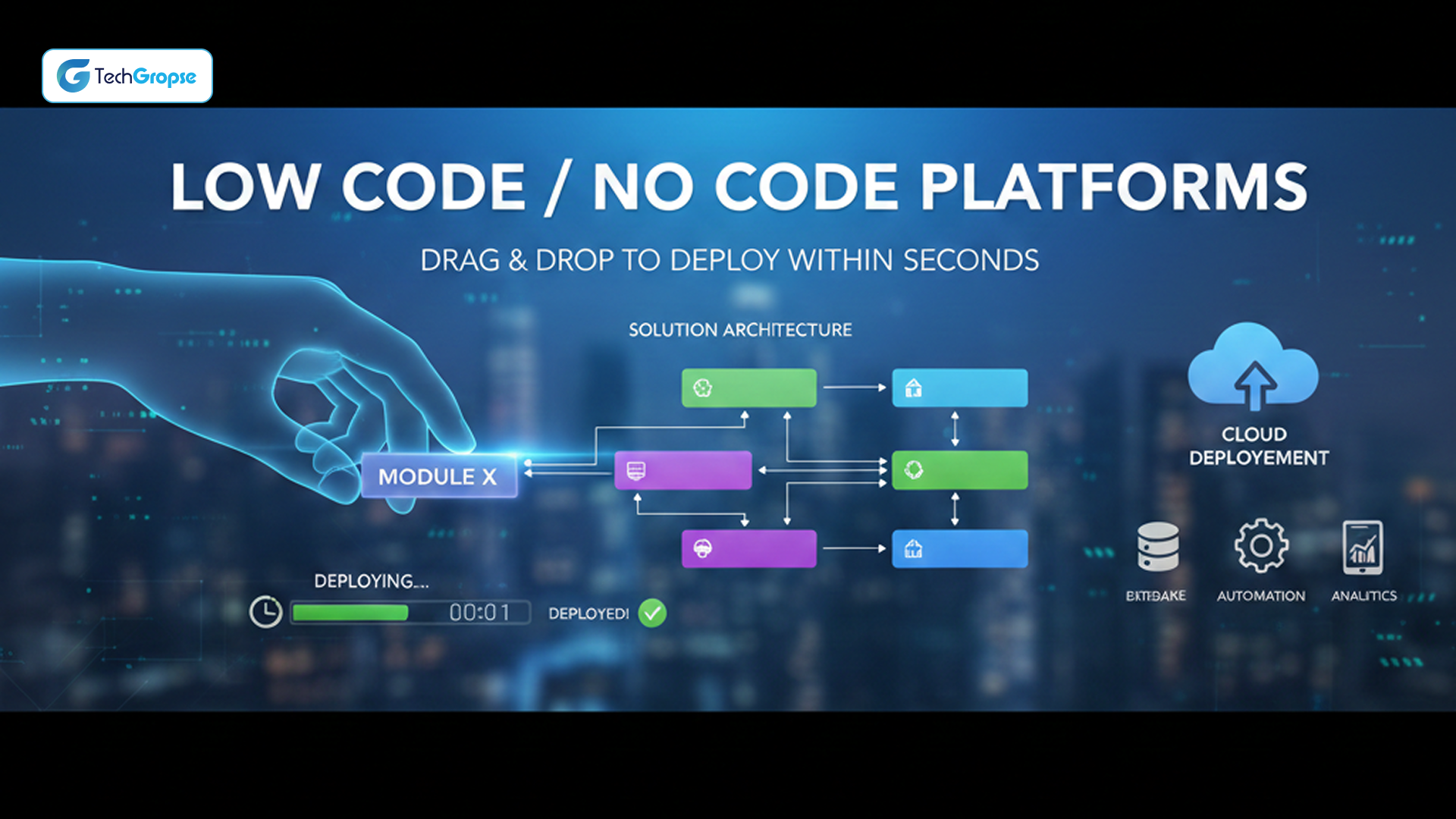
Today, the global software industry offers a broad range of mobile app development services. Traditional app development is tedious, expensive, and relies heavily on resources and a complex tech stack.
Low-code/no-code platform comes as a solution.
It is best suited for:
- IoT (Internet of Things) Applications
- Wearable App Solutions
- Custom App Development
- AI/ML-Driven Applications
- dApps (Decentralized Applications)
- AR/VR Solutions
- Chatbot & Virtual Assistant Apps
- Data Analytics & BI Dashboards
- Workflow & Process Automation Tools
- CRM, ERP & Enterprise Tools
So, in this blog, we will discuss the essential practices, execution methodologies, and cost bifurcation in Low-Code/No-Code App development.Â
What Exactly is Low-Code/No-Code App Development? Know the Core Difference Between Low-Code/No-Code App Development
Low-code app development, also known as Rapid Application Development (RAD), is initiated with minimalist code rather than complex coding. It includes Visual Drag-&-Drop builders, prebuilt components, automated workflows, and reusable templates.Â
Low Code works best for Business Process Automation, corporate internal tools, inventory management systems, MVPs & prototypes, mobile & web applications.Â
No Code is also a Rapid Application Development (RAD) that takes a complete step-back approach with no manual handwritten code, and 100% dependency on external tools.Â
No Code works best for landing pages & websites, business dashboards, content management platforms, web applications, and basic mobile apps.Â
So, how does Low Code differ from No Code?
| Function | Low Code | No Code |
|---|---|---|
| Coding Requirement | Minimum coding required | Zero coding required |
| Target Users | For semi-technical users | Non-technical users |
| Customization Level | High customization | Limited customization |
| Use Cases | Heavyweight business applications | Lightweight business apps |
| Speed | Moderately fast | Very fast |
| Flexibility | Highly flexible | Less flexible |
| Scalability | Highly scalable | Less scalable |
| Learning Curve | Moderate | Very high |
| Integration Capabilities | Strong integration | Moderate integration |
| Architecture | Highly potential & integrated architecture | Low potential & integrated architecture |
Industries Suitable for Low-Code/No-Code App Development
Let’s find the industry best best-suited for low code/no code mobile app development.
Manufacturing
Real-time production monitoring, inventory management system, asset management, quality control, production management, and order tracking; the manufacturing industry benefits the most.
Hospitality & Tourism
With a seamless reservation system and smart & automated guest tour, the hospitality and tourism industry makes the most out of low-code/no-code mobile app development.
Education
With interactive learning sessions and personalized classroom experiences crafted with low-code/no-code app development, the edTech industry is soaring high today.
Healthcare
The online consultation and smart health tracking built with low-code/no-code app development; the healthcare industry marks new height.
Banking & Financial Services
The digital banking system has opened new business opportunities that were never possible without low-code/no-code app development.
Logistics & Supply Chain Management
An application built for real-time tracking and route optimization has paved a new path for the logistics and supply chain industry.
Real Estate
The AR/VR property tour and automated search discovery have opened new boundaries for real estate businesses.
Insurance
Policy management and customer support have witnessed a new operational format with low-code/no-code app development.
eCommerce
AI recommendations and real-time TAT management were never automated unless low low-code/no-code platform hit the picture.
Government Sector
The public sector has set new standards with administrative management, with low-code/no-code app development.
Information Technology
Witness the revolution in the IT industry with no-code app development transforming developer capabilities.Â
Mobile App Development Services with a Broad Scope of Low Code/No Code Implementation
A low-code/no-code app development comes as a solution to the problems with traditional development. It minimizes the development timeline, mitigates development cost, and builds a rapid prototype solution. Moreover, the simplified maintenance that executes updates, integration, and UI changes with the least complex code is feasible and economical for small startups, midsize businesses, and large enterprises.Â
Plan-of-Action for our Low-Code/No-Code App Development
Let’s elaborate on our plan of action for your low-code/no-code app development.
Requirement Analysis
- Market research
- Requirement gathering
- Tech-stack evaluation
Platform Evaluation
- Platform assessment
- Feature listing
- Vendor evaluation
UI/UX & Prototypes
- User-focused wireframe
- Interactive prototypes
- Designing & branding
Rapid Development
- Drag-and-Drop Interface
- Component utility
- Quick Iterations
Custom API
- Third-party integration
- Platform functionality
- Scalable architecture
Deployment & Launch
- One-Click Deployment
- Real-time testing
- App store submission
Post-Launch Maintenance
- Feature update
- Platform upgrade
- Performance optimization

Conclusion
Given the discussion we had, you can draw a clear conclusion that Low Code/No Code is the future of the software business. Be it any industry or service vertical, Low Code/No Code is going to set a new benchmark in the domain.Â
FAQs
Low code/no code, or LC/NC, is a software development methodology that relies on a minimal coding or no coding approach, meanwhile capitalizing on visual tools, drag-and-drop functions, and prebuilt elements for developing a solution.
Solutions like mobile portals, CRMs, ERPs, HRMS, accounting software, and booking & reservation apps can be well built with low-code/no-code software development.
Depending on the complexity of the application, the time to build an app can vary from 1 week to 12 weeks with the LC/NC approach.
Yes. Low-code/no-code app development is absolutely fine for enterprise-level application development.
No. Even non-technical users unfamiliar with coding practices can execute low-code/no-code application development.
Built on reputable enterprise-grade platforms, low-code/no-code can help you build the most secure applications that you will ever come across.
Yes. Most of the low-code/no-code platforms allow convenient integration with third-party API and services.
The cost to build an application with low-code/no-code development depends on the app’s complexity and integrated features. The ideal cost is $300-$1,000/year (excluding extra features).
Limited customization, scalability challenges, complex progression, vendor lock-in, and limited backed control are some of the challenges of low code/no code development.
Industries like e-commerce, FMCG, accounting firms, and business consulting benefit the most from low-code/no-code app development.

Hello All, Aman Mishra has years of experience in the IT industry. His passion for helping people in all aspects of mobile app development. Therefore, He write several blogs that help the readers to get the appropriate information about mobile app development trends, technology, and many other aspects.In addition to providing mobile app development services in USA, he also provides maintenance & support services for businesses of all sizes. He tried to solve all their readers' queries and ensure that the given information would be helpful for them.


 info@techgropse.com