






























































Retail never suffers from data loss. It suffers from real-time data management problems. Price change, Inventory shifts, and catalogue updates are some of the disruptions that often cause situational havoc and confusion.Â
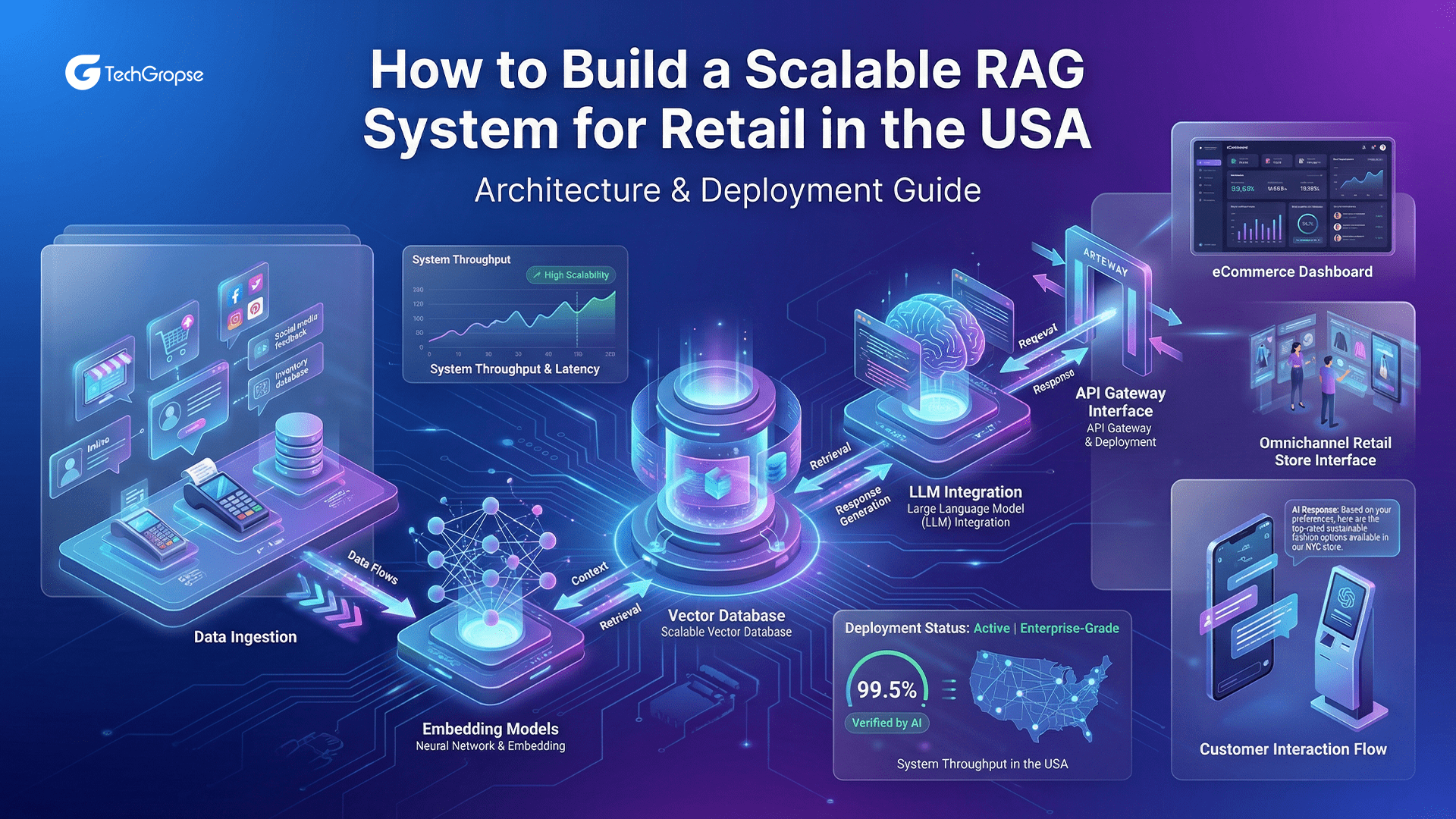
Retrieval-Augmented Generation (RAG) is making a huge transition in the retail domain by creating a proximity bridge between static Large Language Models (LLMs) and proprietary datasets. Unlike old-school Artificial intelligence models, the RAG system for retail is designed to connect with a real-time inventory matrix, customer transaction history, and updated price listing to foster personalized and context-aware responses.Â
Key Takeaways:Â
- Market Overview of the RAG System for Retail
- Why Do Businesses Require a Scalable RAG System for Retail?Â
- RAG System for Retail: A Practical Architecture for Every Brand Operation
- Implementation Roadmap of a RAG System for Retail
- Calculate Your ROI on the RAG System for Retail
- Future Trends of the RAG System for Retail Businesses
- How TechGropse Can Help You Build a Future-Ready RAG System for Retail Business?Â
- FAQs (Frequently Asked Questions)
Market Overview of RAG System for Retail
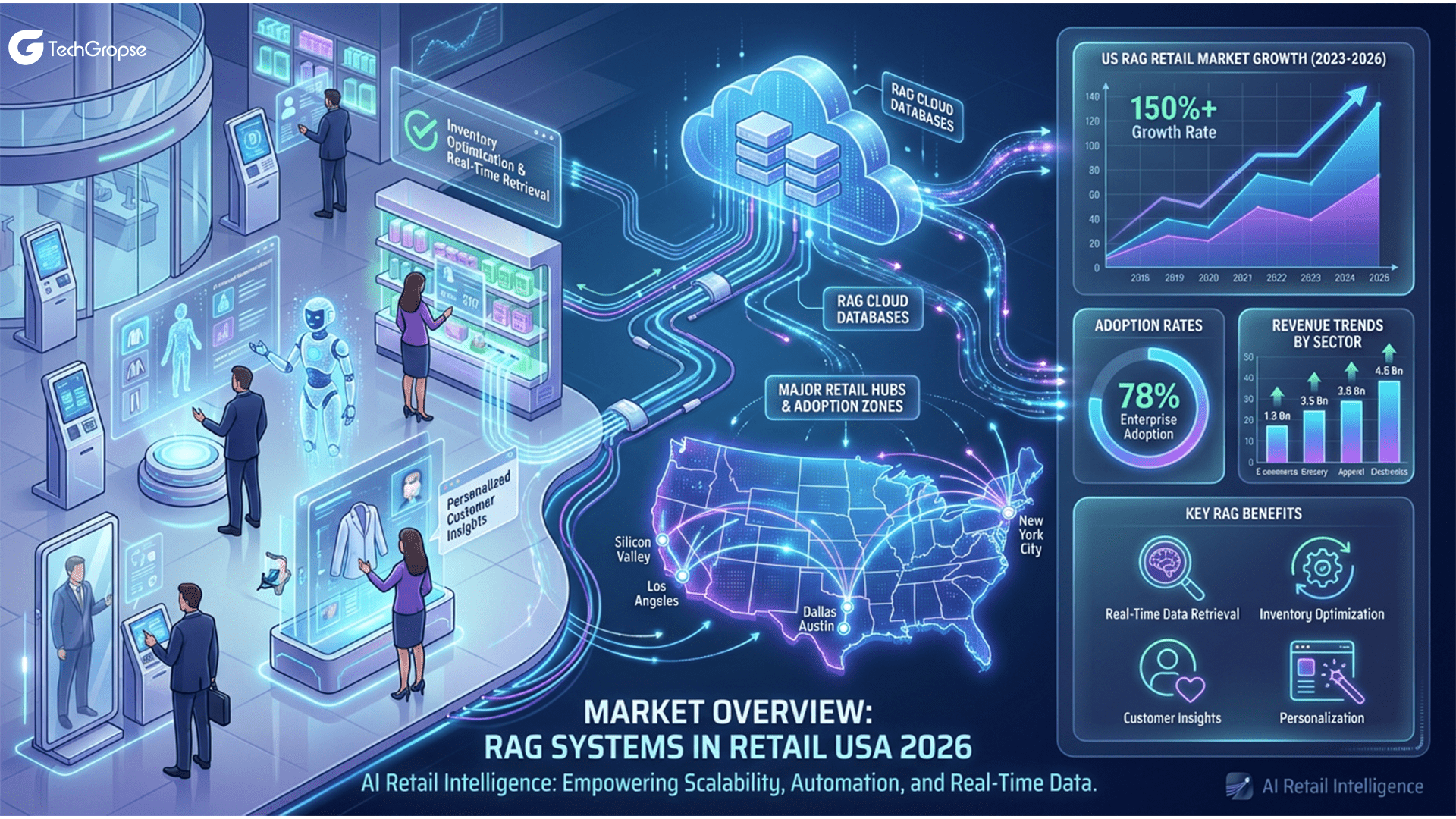
A study report from the GRAND VIEW HORIZON says that the RAG market generated USD 307.4 million in revenue in 2024 and is projected to grow to USD 2,514.7 million by 2030, expanding at a 46.3 % CAGR—highlighting strong domestic adoption and investment.Â
A GlobeNewswire report claims that the Retrieval‑Augmented Generation (RAG) market is expected to grow from USD 1.94 billion in 2025 to USD 9.86 billion by 2030, at a strong 38.4 % CAGR, driven by enterprise AI adoption and contextualized outputs.Â
Another GRAND VIEW RESEARCH forecast suggests the global RAG market could reach USD 11.0 billion by 2030, with an even higher estimated growth rate of ~49.1 % CAGR from 2025‑2030 as demand rises for AI that combines retrieval with generative capabilities.
PROPHECY MARKET INSIGHTS says that a longer‑term projection shows the RAG market growing to approximately USD 72.6 billion by 2036, from USD 2.69 billion in 2026, driven by rising enterprise reliance on knowledge‑grounded AI.
Why Do Businesses Require a Scalable RAG System for Retail?Â
Agentic AI is not an optional investment for retail leaders. It reduces frictions, improves operational execution, and supports merchandising. But creating an AI layer without structural datasets would be like beating around the bush. A RAG system for retail would solve this problem.Â
So, let’s understand why retail needs a structured RAG implementation.
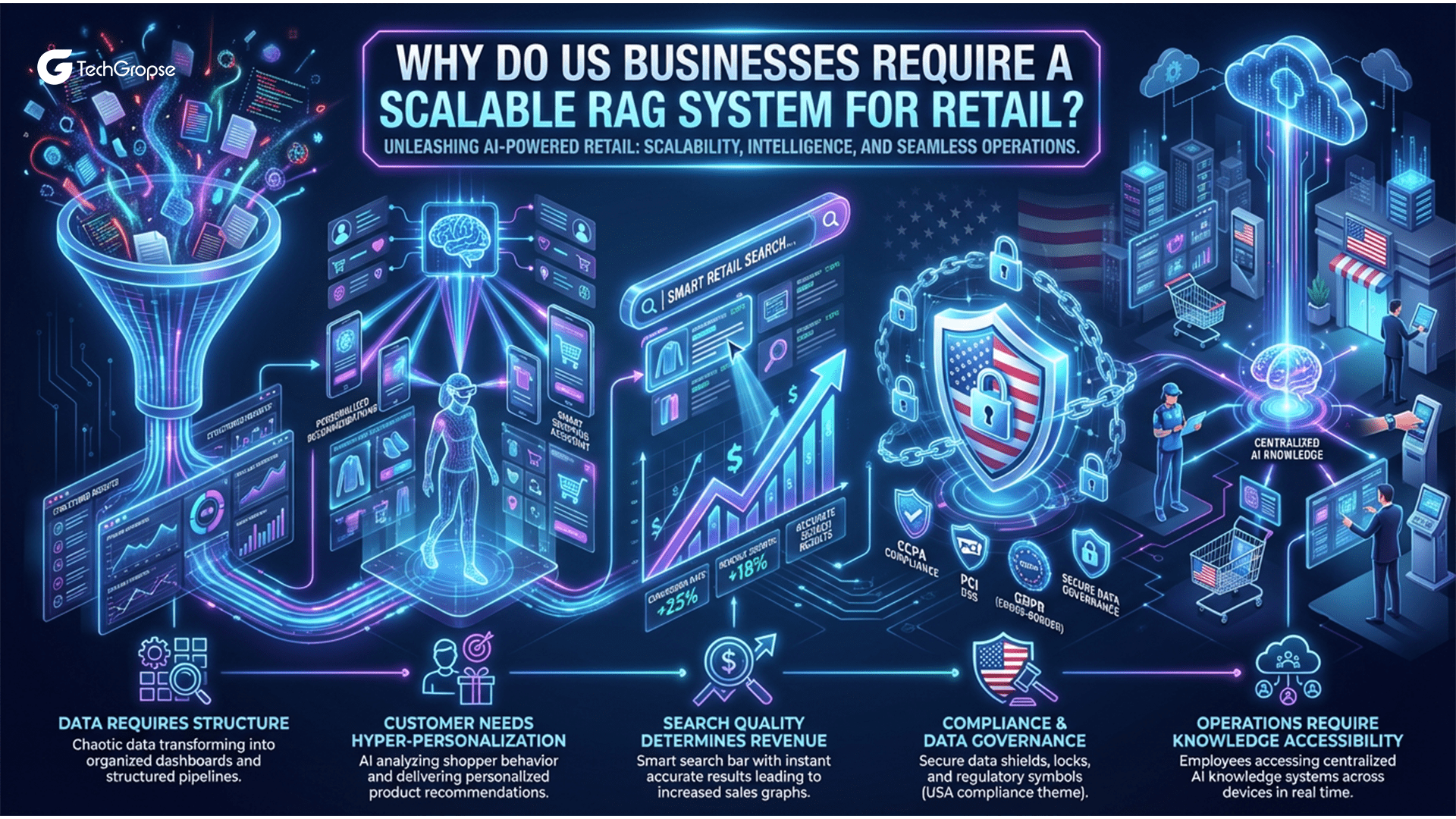
Data Require Structure
Multiple datasets like stock management, inventory updates, price change, product catalogue, and policy shift are loosely informed by a narrow AI software solution. A seamless RAG system for retail would directly connect with information, with accurate retrieval and reliable context-aware insights.Â
Customer Need Hyper-Personalization
Modern-day customers require a tailored experience across retail networks and channels. A structured RAG system for retention would evaluate the customer preference, analyse the demographic intent, and understand the buying behaviour of the customers. Consequently, it will foster contextual interaction, dynamic content pitch, and high consumer engagement for improved conversion rates. This is only possible when you have a decent Generative AI Development Company for your project.Â
Search Quality Determines Revenue
The search performance is directly proportional to the business revenue generation. A structured RAG system for retail enables intent-focused searches, semantic searches, and content-driven searches to help users find better products. This not only elevates the product discovery but also mitigates the bounce rate, eventually improving the retention and selling ratio.Â
Compliance & Data Governance
A structured RAG system in retail enables the retailers to align with the data governance, compliance regulations, and privacy laws. A well-established RAG would incorporate high-end data handling, accessibility control, audit feasibility, mitigated legal risk, and long-term customer trust.Â
Operations Require Knowledge Accessibility
Retail operations depend on quick access to accurate information across systems. Organized RAG centralizes knowledge from multiple sources, enabling employees and AI systems to retrieve insights instantly, improving decision-making, operational efficiency, and overall business productivity.
RAG System for Retail: A Practical Architecture for Every Brand Operation
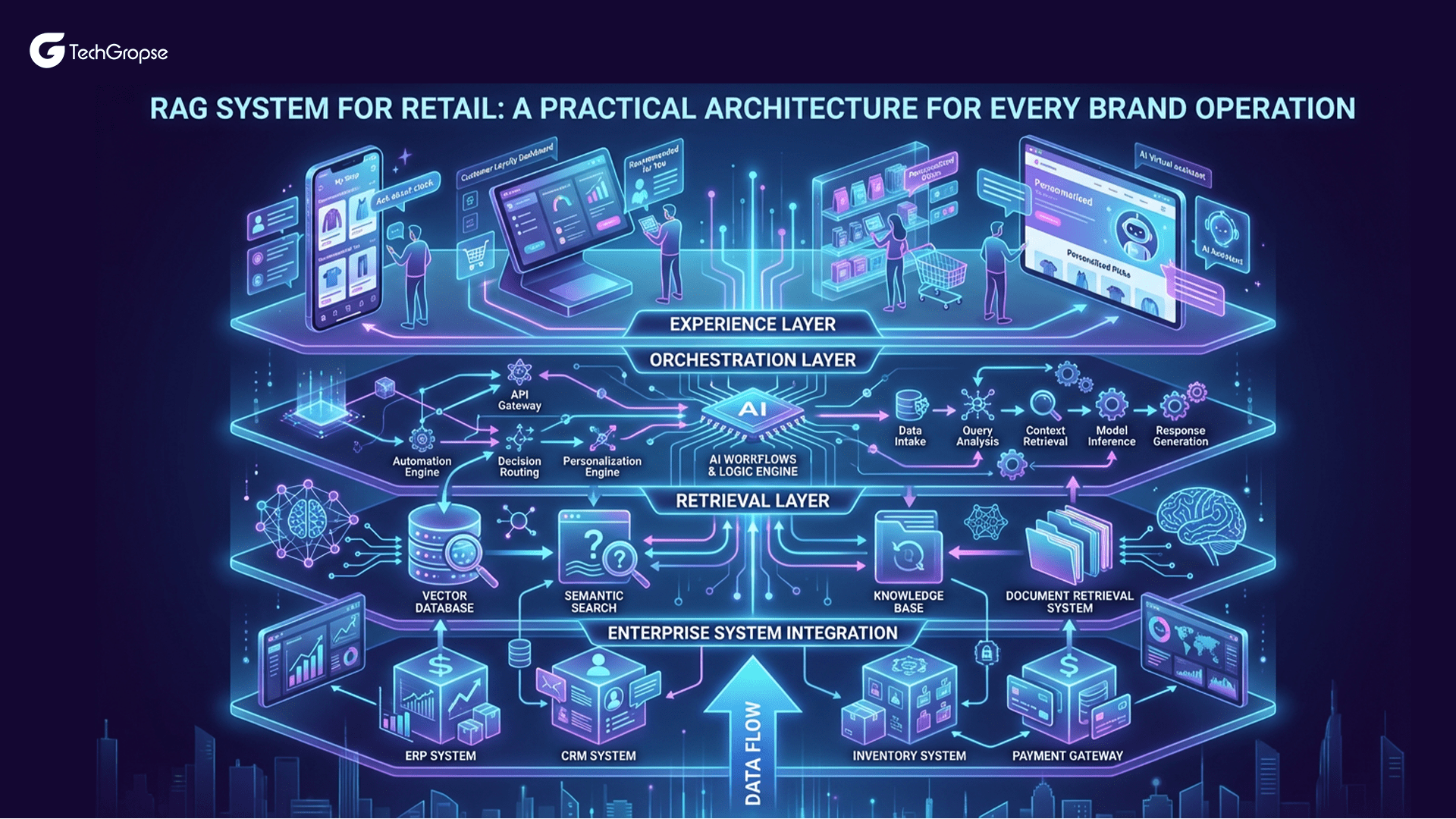
When you start adopting a RAG system for retail, the architecture and layout modelling is the first step to deal with. A strong RAG system is designed with a clear and well-defined layer that showcases how the retail would function.Â
So, let’s explore the 4 significant layers of the RAG system in retail.Â
Experience Layer
- Customer-side interface offering an interaction ecosystem within the RAG boundary.
- AI-focused chatbots offering a real-time and intuitive shopping experience.Â
- Voice enables assistants for seamless product discovery and support.Â
- Hyper-personalized interface based on buying behaviour and preferences.Â
- In-store digital kiosks for seamless omnichannel customer interaction.Â
- Cross-channel feasibility for continuous online and offline support.Â
Orchestration Layer
- Control layer that conditions over the dataflow, queries, and AI-focused responses.Â
- Smart query routing from the retrieval channel to AI models.Â
- Workflow orchestration to streamline pole-to-pole pipelines.Â
- API orchestration to ensure seamless communication between services
- Load balancing and request handling for scalable system performance
Retrieval Layer
- Fetch relevant datasets to AI generated responses.Â
- Contextual answering is relatable to user queries and product information.Â
- Advanced filtering to bifurcate categories and prices.Â
- Hybrid retrieval combining keyword-based and semantic search methods.Â
- Efficient indexing mechanisms for fast and scalable data retrieval.Â
Enterprise System Integration
- Connect the RAG function with the core database of the business ecosystem.Â
- ERP and CRM integration for seamless data accessibility.
- Real-time inventory synchronization across multi-level retail networks and channels.Â
- API-based connections for flexible and scalable system communication
- Data pipeline integration for continuous data flow and updates
Implementation Roadmap of a RAG System for Retail
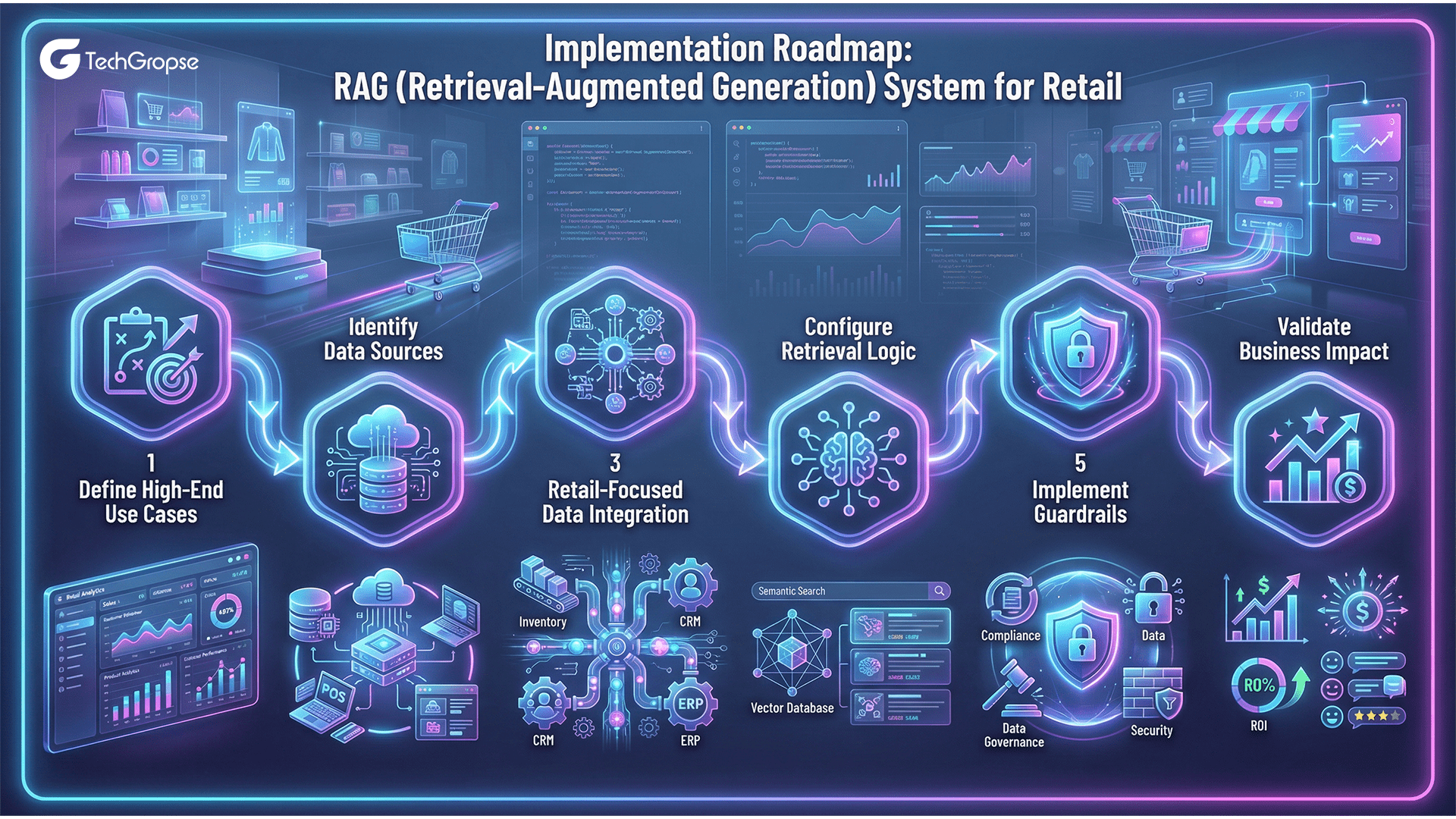
The RAG system in retail is not about flashing demos. It is about real-time problem-solving capability by grounding datasets with ongoing operations of the business. Thus, you must explore the blueprint of the RAG system implementation for retail businesses.Â
Define High-End Use Cases
Identify all the circumstances where a RAG system can add value to your business. Navigate through every possible use case, including actionable inventory insights, hyper-personalized product recommendations, AI-focused customer support, and dynamic price charts. Make sure that the adoption of strategies to capitalize on these use cases augments business priorities and reasonable KPI metrics.Â
Identify Data Source
Align all the valid data points, including CRM, ERP, POS system, product catalogue, inventory logs, eCommerce interaction, and product catalogues. With a comprehensive understanding of structured and unstructured databases, the RAG system for retail retrieves best-in-class, high-quality, and contextual information to improve real-time operations.Â
Retail-Focused Data Integration
Make a consolidated and unified data pipeline by converging multiple datasets, followed by processing, cleaning, and transforming data for RAG utility in the retail ecosystem. Use ETL, APIs, and workflow mechanisms for regular updates. High-end integration facilitates semantic search capabilities, smart recommendations, and AI insights across multiple stores and channels.Â
Configure Retrieval Logic
Establish semantic search algorithms, vector databases, and embeddings to retrieve a seamless flow of information. Set the query expansion criteria, ranking, and filtering aligned to the retail operational requirements. Optimized retrieval logic ensures that AI responses are accurate, context-aware, and actionable, reducing errors and enhancing customer engagement.
Implement Guardrails
Adopt a protected and compliant mechanism to stay away from biased and non-essential results. Integrate continuous monitoring, content moderation, and a retrieval system to ensure that the responses align with retail-focused policies, CCPA regulations, and high-end quality standards for seamless operational reliability.Â
Validate Business Impact
Measure and validate your RAG performance with well-drafted KPIs. This includes cost savings, revenue upliftment, operational efficiencies, and customer satisfaction. Conduct regular A/B testing to iterative improvements and upscale ROI. This stage is just to ensure that your RAG system for retail is completely congruent with the business goals and objectives that strive to improve the retail experience.Â
Calculate Your ROI on RAG System for Retail
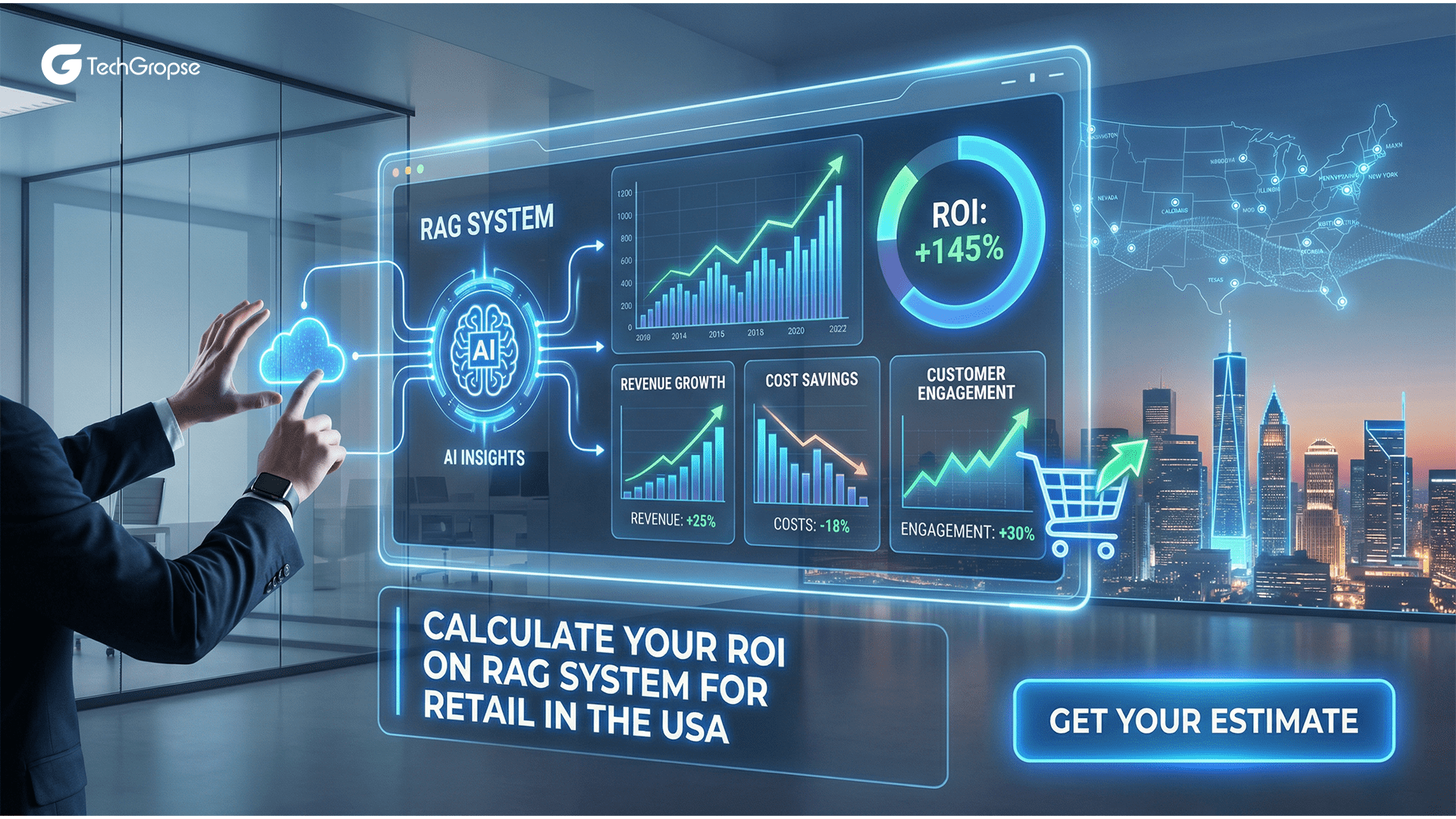
Now, let’s calculate the bifurcated ROI after adopting the RAG system for retail businesses. These calculations would help you adopt the best Artificial Intelligence Development Solution for the RAG system in retail.Â
| Category | Key Metrics | Benchmark Numbers | Estimated ROI Impact | Business Outcome |
|---|---|---|---|---|
| Operational Performance Metrics | Response Time, Automation Rate | 40–70% faster response 60–80% automation | +20–35% ROI | Reduced manual effort, faster workflows |
| Revenue & Commercial Growth Indicators | Conversion Rate, AOV | 15–35% conversion uplift 10–25% AOV increase | +30–60% ROI | Direct revenue growth and higher sales |
| AI Accuracy & Reliability Metrics | Precision, Error Rate | 85–95% accuracy 30–60% error reduction | +15–25% ROI | Fewer errors, improved trust |
| Cost Optimization & Resource Efficiency | Cost per Query, Support Cost | 25–50% cost reduction 20–40% lower infra cost | +25–45% ROI | Significant operational savings |
| Customer Experience & Engagement Metrics | NPS, Retention | +15–30 NPS 20–40% retention increase | +20–40% ROI | Stronger loyalty and engagement |
| Decision-Making Speed & Insight Metrics | Decision Time, Forecast Accuracy | 30–60% faster decisions 20–35% better forecasting | +15–30% ROI | Faster, data-driven strategies |
| Platform & Integration Efficiency | API Latency, Uptime | <200ms latency 99.9% uptime | +10–20% ROI | Seamless, scalable operations |
Future Trends of RAG System for Retail Businesses
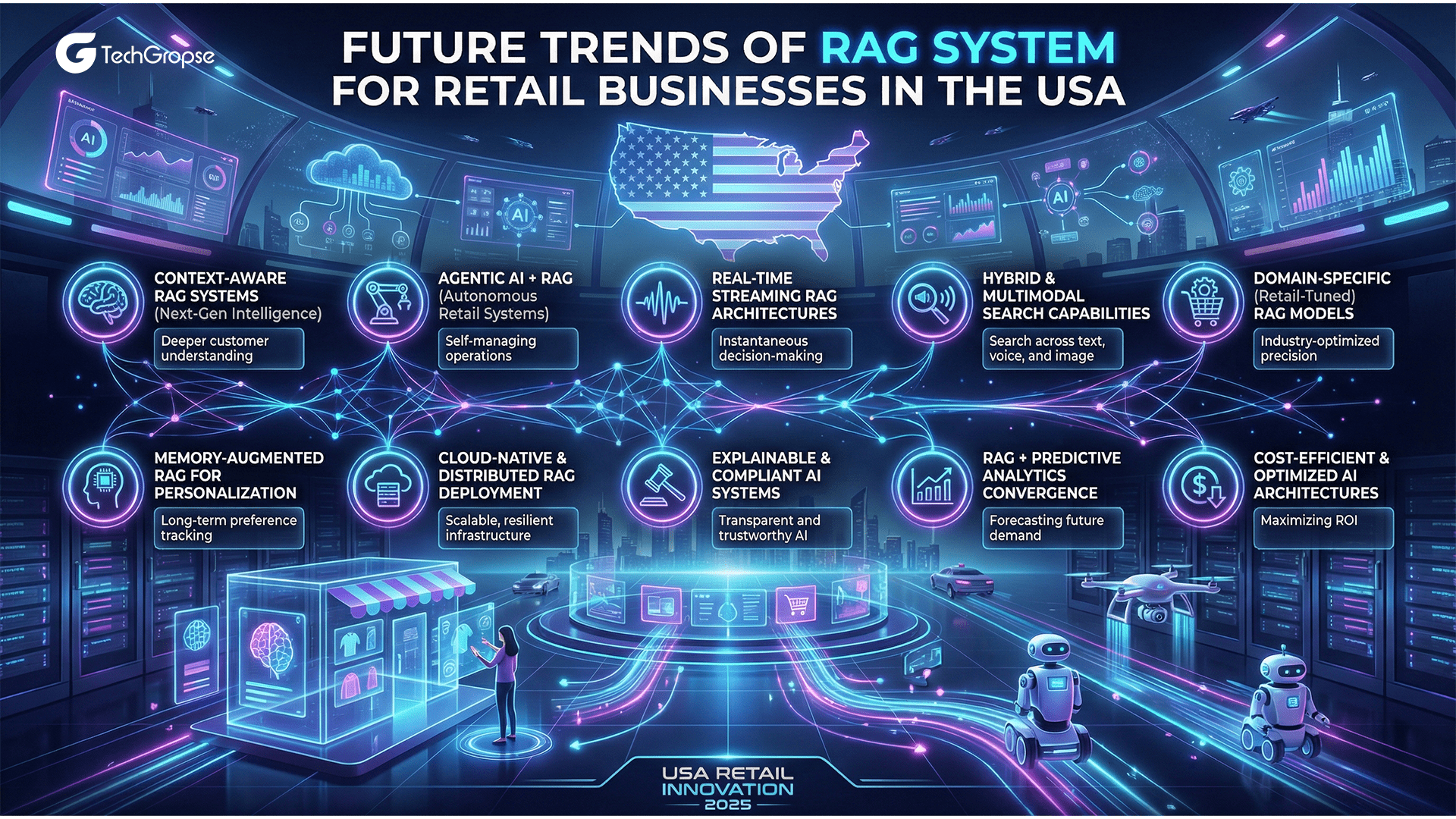
Let’s explore the future trends of RAG that will invariably impact the retail businesses at global scale. A good AI development company can help you integrate all these trends.Â
Context-Aware RAG Systems (Next-Gen Intelligence)
- Session Memory: Short-term context storage | Conversation continuity | Query history tracking | Response relevance boost | Redundancy reduction
- User Intent Tracking: Intent Identification | Query Refinement | Goal Detection | Context Shift Analysis | Personalized Outputs
- Behavioral Context: User Activity Analysis | Pattern Recognition | Preference Learning | Usage Insights | Predictive Behavior
- Dynamic Responses: Real-Time Adaptation | Context-Aware Generation | Tone Customization | Multi-Format Output | Continuous Updating
- Context Retention: Long-Term Memory | Cross-Session Continuity | Personalization Memory | Consistent Responses | Data Compliance
Agentic AI + RAG (Autonomous Retail Systems)
- Autonomous Decisions: Data-Driven Decision Making | Real-Time Insight Utilization | Demand-Based Actions | AI-Assisted Judgments | Reduced Human Dependency
- Task Automation: Order Processing Automation | Customer Query Handling | Inventory Updates | Workflow Triggering | Repetitive Task Elimination
- Inventory Optimization: Demand Forecasting Accuracy | Stock Level Balancing | Automated Replenishment | Overstock Reduction | Supply Chain Visibility
- Dynamic Pricing: Real-Time Price Adjustment | Demand-Supply Analysis | Competitor Price Monitoring | Personalized Pricing | Margin Optimization
- Workflow Execution: End-To-End Process Automation | Cross-System Integration | Real-Time Task Execution | Operational Consistency | Efficiency Enhancement
Real-Time Streaming RAG Architectures
- Live Data Sync: Real-Time Data Integration | Cross-System Synchronization | Unified Data Flow | API-Based Connectivity | Seamless Data Exchange
- Instant Updates: Real-Time Information Refresh | Dynamic Content Updates | Event-Triggered Changes | Zero-Delay Processing | Up-To-Date Insights
- Event Streaming: Real-Time Event Processing | Continuous Data Streams | Scalable Stream Handling | Event-Driven Architecture | Instant Data Pipelines
- Continuous Indexing: Real-Time Data Indexing | Incremental Updates | Search Optimization | Fast Data Retrieval | Always-Updated Indexes
- Low latency: Fast Response Time | Minimal Processing Delay | High-Speed Data Access | Optimized Query Performance | Real-Time User Experience
Hybrid & Multimodal Search Capabilities
- Semantic Search: Context-Aware Retrieval | Intent-Based Understanding | Natural Language Processing | Meaningful Result Matching | Enhanced Search Accuracy
- Keyword Matching: Exact Term Matching | Query-Based Retrieval | Fast Search Execution | Indexed Data Lookup | Basic Search Precision
- Image Search: Visual Product Recognition | Image-Based Querying | Similar Product Detection | AI-Powered Image Analysis | Catalog Search Enhancement
- Voice Queries: Speech-To-Text Processing | Conversational Search Input | Hands-Free Interaction | Real-Time Query Handling | Voice-Enabled Assistance
- Cross-Modal Retrieval: Multi-Format Data Integration | Text-Image-Voice Linking | Unified Search Experience | Contextual Data Mapping | Advanced AI Retrieval
Domain-Specific (Retail-Tuned) RAG Models
- SKU Intelligence: Product-Level Insights | SKU-Wise Performance Tracking | Inventory Visibility | Sales Trend Analysis | Smart Product Mapping
- Retail Datasets: Structured Data Integration | Multi-Source Data Aggregation | Clean Data Processing | Real-Time Data Access | Scalable Data Management
- Seasonal Insights: Seasonal Demand Analysis | Trend-Based Forecasting | Holiday Sales Optimization | Time-Based Patterns | Inventory Planning
- Demand Patterns: Customer Demand Analysis | Buying Behavior Tracking | Trend Identification | Predictive Demand Forecasting | Sales Cycle Insights
- Product Context: Detailed Product Understanding | Attribute-Based Mapping | Category-Level Insights | Contextual Recommendations | Enhanced Product Discovery
Memory-Augmented RAG for Personalization
- Long-Term Memory: Persistent Data Storage | Cross-Session Context Retention | Historical Insight Utilization | User Journey Continuity | Memory-Based Recommendations
- Preference Tracking: User Preference Analysis | Behavior-Based Profiling | Interest Identification | Personalized Experience Mapping | Dynamic Preference Updates
- Purchase History: Transaction Data Analysis | Buying Pattern Tracking | Order History Insights | Repeat Purchase Identification | Customer Value Assessment
- Adaptive Learning: Continuous Model Improvement | Behavior-Driven Learning | Real-Time Feedback Integration | Pattern-Based Optimization | Intelligent System Evolution
- Personalized Outputs: Tailored Product Recommendations | Context-Aware Responses | User-Specific Content Delivery | Dynamic Output Generation | Enhanced Customer Experience
Cloud-Native & Distributed RAG Deployment
- Elastic Scaling: On-Demand Resource Scaling | Traffic-Based Expansion | Cost-Efficient Infrastructure | Auto-Scaling Capabilities | Performance Optimization
- Distributed Systems: Decentralized Data Processing | Parallel Computation | Fault Tolerance | Scalable Architecture Design | High Performance Handling
- Multi-Region Deployment: Geo-Distributed Infrastructure | Global Data Access | Region-Based Optimization | Reduced Latency Delivery | Disaster Recovery Support
- High Availability: Continuous System Uptime | Fault Resilience | Redundant Infrastructure | Minimal Downtime Assurance | Reliable Service Delivery
- Load Balancing: Traffic Distribution Optimization | Server Load Management | Request Routing Efficiency | Performance Stability | Seamless User Experience
Explainable & Compliant AI Systems
- Audit Trails: Activity Logging | Query Tracking | Data Access Records | Change History Monitoring | Compliance Reporting
- Data Transparency: Clear Data Visibility | Source Traceability | Open Data Flow | Trustworthy Insights | Accessible Information
- Explainable Outputs: Interpretable AI Responses | Source Attribution | Reasoning Clarity | Model Decision Insights | User Trust Enhancement
- Privacy Compliance: Data Protection Standards | Regulatory Adherence | User Data Security | Consent Management | Risk Mitigation
- Secure Access: Role-Based Access Control | Authentication Mechanisms | Data Encryption | Unauthorized Access Prevention | Secure System Integration
RAG + Predictive Analytics Convergence
- Demand Forecasting: AI-Driven Demand Prediction | Historical Data Analysis | Real-Time Demand Signals | Seasonal Forecasting Accuracy | Inventory Alignment
- Trend Analysis: Market Trend Identification | Customer Behavior Insights | Pattern Recognition | Emerging Trend Detection | Data-Driven Insights
- Sales Prediction: Revenue Forecasting | Sales Pattern Analysis | Predictive Modeling | Performance Estimation | Growth Projection
- Inventory Planning: Stock Level Optimization | Demand-Based Replenishment | Overstock Reduction | Supply Chain Coordination | Efficient Inventory Control
- Proactive Insights: Predictive Recommendations | Early Trend Detection | Risk Anticipation | Opportunity Identification | Data-Driven Decision Support
Cost-Efficient & Optimized AI Architectures
- Token Optimization: Efficient Token Usage | Context Window Management | Query Compression | Reduced Token Consumption | Cost-Efficient Processing
- Efficient Models: Lightweight Model Design | Optimized Inference Speed | High Accuracy Performance | Resource-Efficient Training | Scalable Model Architecture
- Resource Allocation: Dynamic Resource Distribution | Compute Optimization | Workload Balancing | Memory Utilization Efficiency | Infrastructure Optimization
- Cost Reduction: Operational Cost Optimization | Reduced Compute Expenses | Efficient Resource Usage | Budget Control Strategies | ROI Maximization
- Scalable Infrastructure: Cloud-Native Architecture | Auto-Scaling Systems | Distributed Computing Support | High Performance Handling | Future-Ready Scalability
| Trend | Cost Range | Cost Drivers |
|---|---|---|
| Context-Aware RAG Systems | $50K – $200K+ | Real-time data pipelines, vector databases, and LLM inference usage, AI chatbot for eCommerce |
| Agentic AI + RAG | $100K – $500K+ | Multi-agent AI Systems orchestration, API integrations, workflow automation |
| Real-Time Streaming RAG | $80K – $300K+ | Streaming infrastructure (Kafka), low-latency processing, real-time sync |
| Hybrid & Multimodal Search | $120K – $400K+ | GPU-intensive models, image/video processing, multimodal embeddings |
| Domain-Specific RAG Models | $70K – $250K+ | Data labeling, fine-tuning, and retail dataset preparation |
| Memory-Augmented RAG | $90K – $300K+ | Long-term storage, personalization engines, and user behavior tracking |
| Cloud-Native & Distributed RAG | $60K – $250K/year | Cloud hosting, scaling, load balancing, and multi-region deployment |
| Explainable & Compliant AI | $50K – $180K | Audit trails, governance tools, compliance frameworks |
| RAG + Predictive Analytics | $100K – $350K+ | ML model training, forecasting systems, and data integration |
| Cost-Efficient RAG Architectures | $30K – $150K | Model optimization, caching, embedding compression, infra tuning |
How TechGropse can Help You Build a Future-Ready RAG System for Retail Business?Â
With 10+ years of experience and 1000+ projects delivered, TechGropse is a leading AI development company with 92% retention rate. Our 150+ software professionals have worked in 25+ locations for 500+ industry giants to receive 100+ awards in the mobile app development arena.
Tailored RAG Infrastructural Design
- End-to-end customized RAG system development
- Scalable infrastructure: Vector database + Pipelines + LLM integration
- Cloud-focused deployment for high-end digital availability
LLM Integration
- LLMs, GPT-4, LLaMA integration
- Context-aware product recommendation and customer support
- Retail dataset tuning for maximum efficiency
Vector Database & Embedding Setup
- Semantic search results using Milvus and Weaviate
- Embedding creation for inventory and product management
- Smart Recommendation Engine for a hyperpersonalized approach
Data Engineering & Pipeline Development
- Real-time pipeline streaming
- CRM, POS, and ERP integration
- Automated ETL for structured and unstructured retail data
Cloud Deployment & Architectural Management
- Deploy on Microsoft Azure, AWS, and Google Cloud Platform
- Docker containerization and Kubernetes orchestration
- Scalable infrastructure for high-volume business delivery
AI-Focused personalization
- Personal recommendation and dynamic pricing
- Image and voice search for product discovery
- Virtual assistant and chatbot customer support
Monitor, Analytics, and Reporting
- AI performance, ROI metrics, and operational KPI
- Recommendations and customer support with analytics
- Notifications for performance degradation and anomalies
Compliance, Privacy, and Security
- Data management aligned to compliance regulations
- Encryption, accessibility control, and audit login
- Transparent and trustworthy AI output aligned to CCPA, HIPAA.Â
Continuous Support & Model Optimization
- Ongoing LLM fine-tuning with updated retail data
- System scaling and performance optimization
- Future-proof upgrades for new AI technologies
ROI Alignment with Business
- Improvement of operational efficiency
- Automated workflow and cost optimization
- Personalized and AI-focused customer experience
So, for the best development of RAG System for Retail, hire AI developers from TechGropse.Â
FAQs (Frequently Asked Questions)
A RAG (Retrieval-Augmented Generation) system combines retrieval of structured/unstructured data with AI generation to deliver context-aware insights, powering personalized shopping, intelligent chatbots, semantic search, and real-time retail decision-making.
RAG enhances personalization by analyzing user behavior, purchase history, and search intent. It provides accurate recommendations, dynamic responses, and instant support, resulting in higher engagement, loyalty, and satisfaction in retail.
Retailers face large product catalogs, diverse customer preferences, and real-time inventory demands. RAG organizes data for AI, enabling faster search, smarter recommendations, operational efficiency, and a competitive edge.
RAG combines LLMs (GPT-4, LLaMA), vector databases (Pinecone, Weaviate), embeddings, streaming pipelines (Kafka, Airflow), cloud infrastructure (AWS, Azure), containerization (Docker/Kubernetes), and secure data governance for scalable AI solutions.
By grounding AI responses in verified data retrieved from vector databases and structured pipelines, RAG ensures output accuracy, reducing errors in product info, inventory updates, and customer interactions in retail applications.
Yes. Streaming architectures allow RAG systems to ingest live inventory, pricing, and customer interactions. Real-time retrieval ensures AI outputs are up-to-date, enabling dynamic personalization, accurate search, and responsive decision-making.
RAG improves operational efficiency, reduces support costs, increases sales via personalization, enhances AI accuracy, optimizes infrastructure, and provides actionable insights, delivering measurable financial and strategic ROI for retailers.
With cloud-native deployment, distributed vector databases, containerized services, and modular pipelines, RAG systems can scale horizontally to support millions of queries, multiple channels, and high-traffic periods in retail.
RAG systems connect via APIs to ERPs, CRMs, e-commerce platforms, and inventory management tools. They unify data for AI retrieval, ensuring consistent, accurate, and real-time insights across retail operations.
Key trends include agentic AI, hybrid/multimodal search, domain-specific models, memory-augmented personalization, real-time streaming, predictive analytics integration, cloud-native scalability, and trust-compliant explainable AI systems in retail.

Hello All, Aman Mishra has years of experience in the IT industry. His passion for helping people in all aspects of mobile app development. Therefore, He write several blogs that help the readers to get the appropriate information about mobile app development trends, technology, and many other aspects.In addition to providing mobile app development services in USA, he also provides maintenance & support services for businesses of all sizes. He tried to solve all their readers' queries and ensure that the given information would be helpful for them.

 info@techgropse.com