

























































Why is legacy app modernization vital for the success of today’s business? For instance, a customer opens a digital banking account. The nearest branch is far away from his hometown. Today is the last date of his college NEFT fee deposit schedule. He opens the site and tries to make the payment. Inevitably, the heavy workload has already made the site slow and lethargic. His payment failed, and he ended up paying the penalty for this.Â
Now, will he ever rely on your website or application?Â
Absolutely NO. Thus, it is very much critical to adopt legacy app modernization for any business in today’s competitive era.Â
So, what basically is legacy app modernization?Â
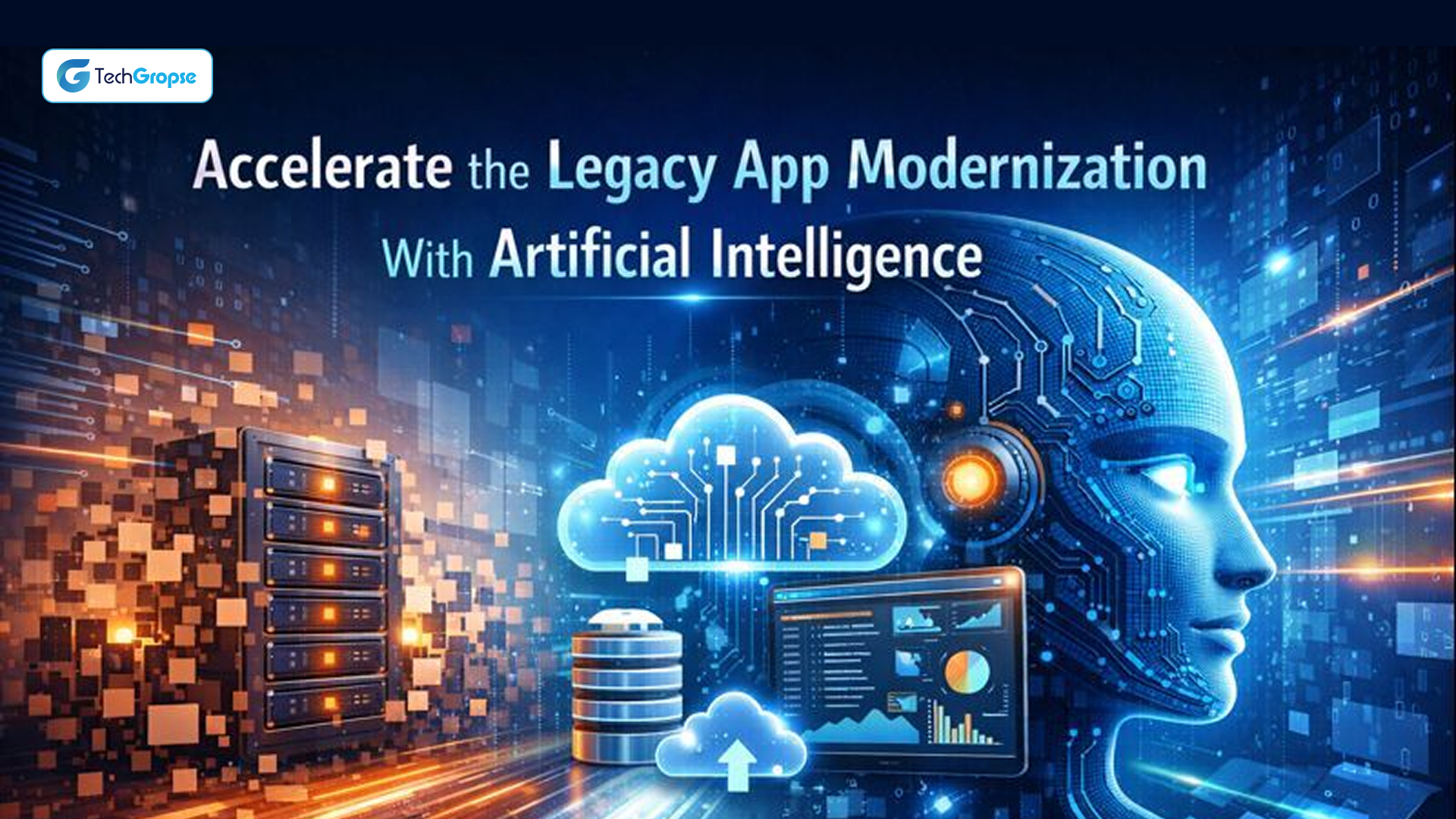
Legacy app modernization is fundamentally the process of updating the outdated system. This encapsulates local to cloud migration, software updates, AI integration, and sustainable tech-adoption for high performance, improved delivery, and an automated operational system.Â
So, in this blog, we will talk about the challenges of legacy applications and how a top-tier mobile app development company in Chicago like TechGropse helps you achieve this vision with localized expertise.Â
Let’s discuss.Â
Old-School Systems Aren’t Relevant Anymore: Complexities, Limitations, and Challenges
Before we move on to the legacy app modernization, know the limited capabilities, highly complex approach, and thriving challenges of the traditional system. You first need to understand why these systems are incompetent to meet the current business needs in terms of agility, scalability, and performance.Â
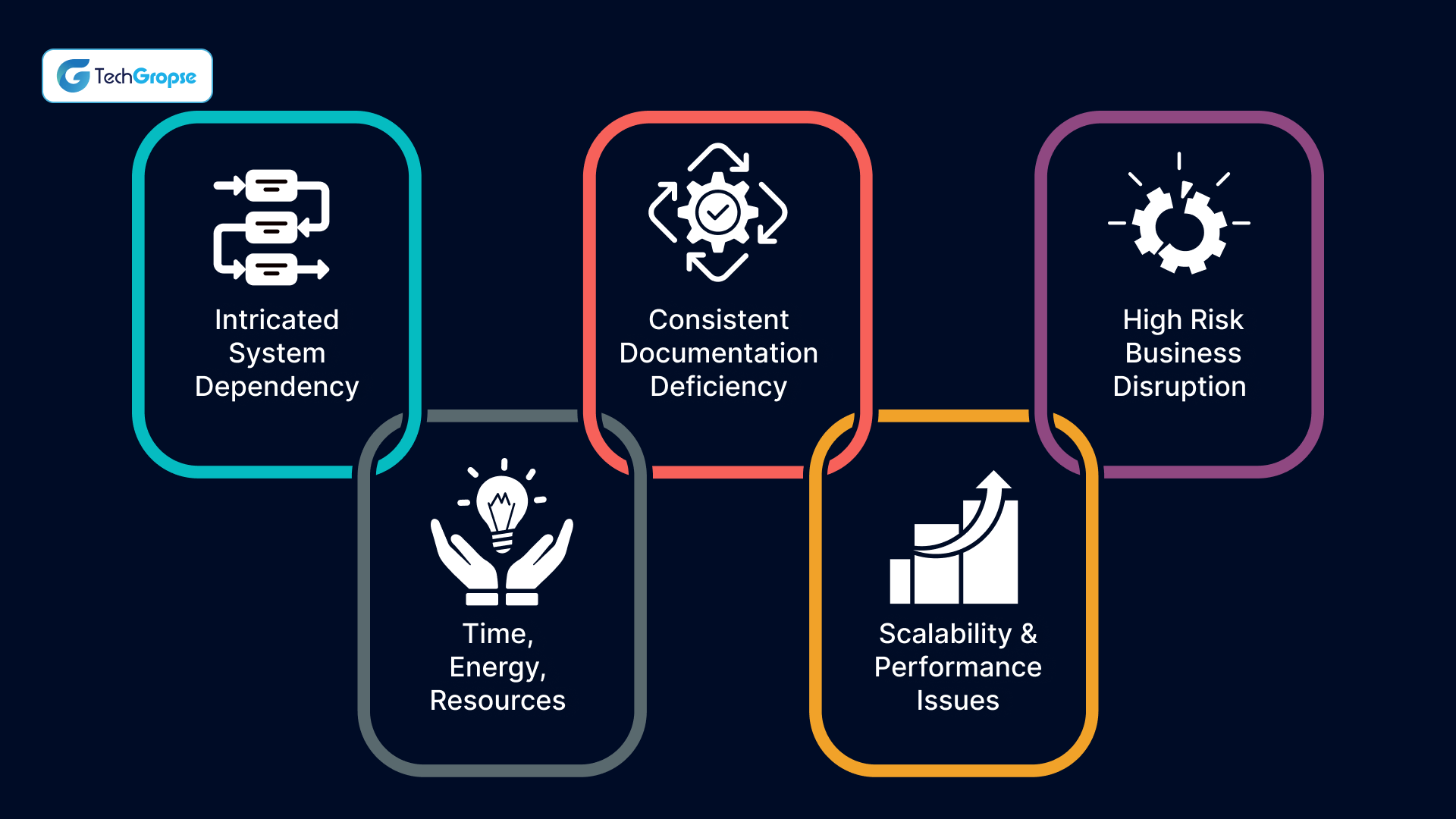
Intricated System Dependency
In the legacy system, the resources are very much interdependent. As a result, the overall infrastructure becomes slow, non-compliant, and time-consuming. This dependency matrix not only restricts the flexibility but also accelerates the possibility of system-wide failure.Â
Time, Energy, Resources
The operations and maintenance of the old-school system require a huge amount of manual effort, continuous human intervention, multiple development cycles, and continuous troubleshooting sessions. These operational bottlenecks are systematically cleared with legacy app modernization.Â
Consistent Documentation Deficiency
Many legacy systems suffer from outdated, incomplete, or missing documentation. Over time, original developers leave, and system knowledge becomes fragmented. This lack of documentation makes onboarding new developers difficult, increases dependency on a few experts, and raises the risk of errors during system modifications or migrations.
Scalability & Performance Issues
Legacy applications are bound to create performance issues with today’s business workloads. Also, scaling up the legacy infrastructure is causing regular downtimes and high business costs investment resulting in unfair ROI.Â
High Risk Business Disruption
Legacy applications are always prone to external threats and malicious attacks. Such a system failure can cause a long-term business disruption and revenue loss. Further integrating third-party APIs and plugins to such systems hikes the operational risks.Â
Practical Applications of Artificial Intelligence for Legacy App Modernization
After knowing the complexities of old-school traditional applications, it is very significant to know about the facilitations when you modernize legacy applications. Â
Code Assessment & Refactoring
Our legacy iOS modernization developers have showcased a phenomenal market performance by assessing and refactoring the code, eventually translating the programming language into a scalable and cloud-feasible ecosystem without major manual intervention. The phenomenon will reduce the time-consuming sessions and make the portal immune to errors.
Automated Quality Testing
Traditional testing is highly dependent on manual resources. However, an AI-driven approach accelerates and automates the quality sessions with regressive testing, faster code analysis, vulnerability identification, automated testing scripts, and critical bug detection. With mitigated app transition risk and zero performance issues, automated testing with Artificial Intelligence is always worthwhile.Â
AI-Focused Data Integration
Data integration is another major thrust of AI-driven legacy app modernization. AI-powered data integration from diverse sources ensures a seamless data discovery, smooth data workflow, intelligent data mapping, semantic data understanding, ETL/ELT Optimization, and AI-based integration enablement. Machine learning automatically aligns mismatched schemas, tables, and fields between legacy and modern systems.
Seamless Document Generation
Seamless document generation uses AI to automatically create accurate, structured, and up-to-date documents from legacy systems, eliminating manual effort, reducing errors, improving compliance, and enabling faster modernization, knowledge transfer, and system maintenance without disrupting existing business operations.
Automated Predictive Maintenance
AI tools are best for real-time predictive maintenance. With Artificial Intelligence, you can systematically forecast possible risks, compliance threats, actionable insights, and resource allocation. Also, with AI integration, you can predict system failures, historical patterns, and logs for fostering impactful operations.Â
Improved Scalability & Edge Computing
Artificial Intelligence helps you process data from the edge server rather than the centralized network. This reduces the latency, speed issues, and low-performing sessions with higher scalability, faster adaptability, and offline connectivity. AI-driven edge computing brings the user closer to the users for fast, smooth, and quick decision-making.Â
Threat Detection & Compliance Adherence
AI-powered security threat detection continuously scans legacy applications to identify vulnerabilities, outdated encryption standards, and misconfigurations. It ensures compliance with regulations like HIPAA, GDPR, and SOC2 by automating audits, monitoring access patterns, detecting anomalies, and reducing security risks during and after modernization.
The Stats Define the Need for Legacy App Modernization
The demand for Legacy App Modernization is not just a fluke. There have been relevant studies made in the market to support the notion.Â
Let’s explore
- A report by Grand View Research says that the market projection of Legacy app Modernization is estimated to reach $24.8 billion by 2029, at a strong growth rate of 16.7% CAGR.Â
- A recent survey of BusinessWire reveals that 87% company owners believe that Legacy App Modernization is essential to holistic business success.Â
- The report also reveals that application modernization had a global market value of $15.5 billion in 2022. It has been estimated to reach $69.8 billion by 2032, with a CAGR of 16.5% from 2023 to 2032.Â
- Another CIO report says that legacy app modernization is among the top 10 CIO priorities in 2025, where 91% CIOs expect to increase their budget for the very same business virtue.Â
- A To the New report says that more than 60% of legacy system upgrades will be driven by Generative AI by 2027, compared with just about 5% in 2022, highlighting a rapid shift toward intelligent modernization strategies.
Industry-Wise Challenges of Legacy Systems
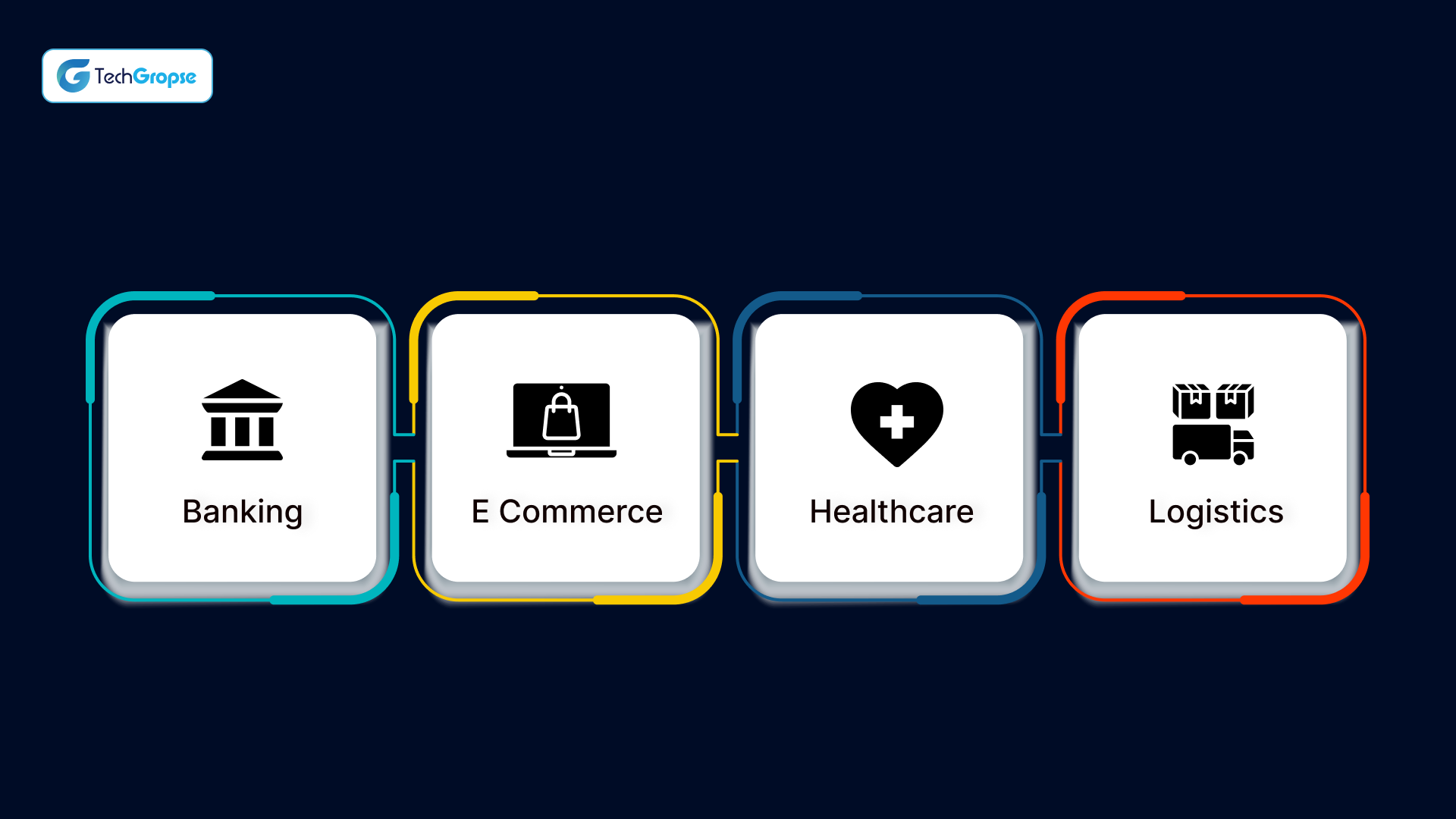
Know how traditional application in the varied industries creates operational blocks for businesses. Also, explore how legacy app modernization solves these challenges.Â
Banking
- Problem: Outdated legacy applications make the system slow, incompetent, and rigid.Â
- Solution: AI-based legacy app modernization incorporates cloud infrastructure that regulates real-time data processing, checks fraudulent activities, fast-tracks operations, and scales up microservices.Â
eCommerce
- Problem: Outdated legacy apps in e-commerce are low-performing with limited personalization and absurd payment methodologies.Â
- Solution: Cloud-based eCommerce apps optimize performance, ensure faster deployment, regulate inventory management, and improve user experience with third-party API integration.Â
Healthcare
- Problem: With no real-time data accessibility, weak compliance, and layman data management, healthcare applications in legacy systems are absurd.Â
- Solution: AI-powered modernization enables secure data integration, EHR interoperability, predictive analytics, automated workflows, and compliance-ready architectures to improve patient care and operational efficiency.
Logistics
- Problem: Traditional logistics applications lack real-time route optimization, system scalability, and IoT integration, leading to high operational costs.Â
- Solution: Modern logistics modernization offers predictive route optimization, IoT integration, automated dispatching, and budget-friendly operations.Â
Retail
- Problem: lack of automated inventory management, stock tracking, digital checkouts, overstocking, and omnichannel support causes poor retail performance.Â
- Solution: App modernization in the retail domain enables real-time inventory synchronization, AI-focused demand forecasting, automated Point of Sale (POS), overstock management, and scalable retail infrastructure.Â
Competitive Advantages of Legacy System Modernization
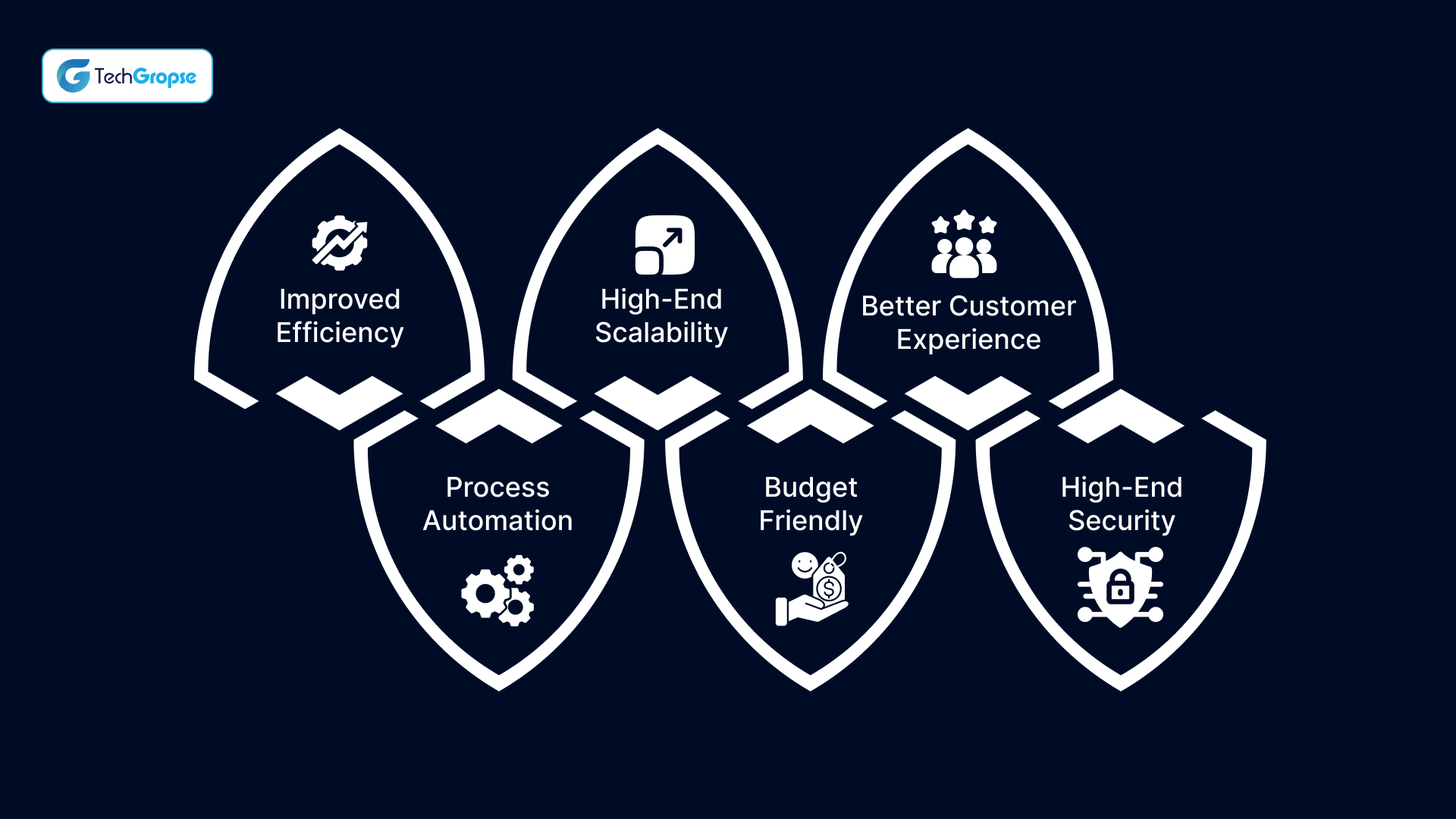
Let’s discuss the competitive advantages of Legacy App Modernization. Among a string of benefits, we have accumulated a few major among them.Â
Improved Efficiency
The fundamental reason why businesses are looking forward to Legacy App Modernization is large-scale operational efficiency. This improves the app performance, reduces system downtime, optimizes resource utilization, and enhances intelligent system architecture.Â
Process Automation
Legacy app modernization brings categorical automation for repetitive task management, manual effort mitigation, better productivity, and a reduced ratio of errors & glitches. AI automation for legacy systems helps you leverage such advantages.Â
High-End Scalability
Cloud infrastructure can be seamlessly scaled for managing high operational and business volumes. This eradicates performance bottlenecks, speed issues, and delayed responses of the entire system. Â
Budget Friendly
Managing local storage is far more expensive than cloud adoption and maintenance. Moreover, the automated operations bring additional benefits to the business, eventually widening the Return on Investment (ROI).Â
Better Customer Experience
Upgraded systems deliver faster load times, modern UI/UX, personalized experiences, and reliable performance across devices, significantly improving user satisfaction and engagement.
High-End Security
Legacy app modernization enables top-notch security functions for the application. This will mitigate the vulnerabilities, real-time threats, and malicious attacks of the application and holistic business ecosystem.Â
Evaluate the AI Consulting Company Focused on Legacy System Modernization
Know how TechGropse helps you in Legacy App Modernization. Whether you are looking for enterprise-grade solutions from a mobile app development company in Atlanta or seeking global AI consulting, our approach is data-driven and results-oriented.
Conduct a System Assessment
Before you start your modernization journey, it’s significant to make a clear system assessment, evaluate the legacy architecture, analyze the codebase, performance loopholes, possible risks, and dependencies.Â
Define Modernization Approach
Make a reliable strategy for modernization. Define the re-engineering, re-architecturing, refactoring, rebuilding, and replacing process throughout the transformation journey aligned to business goals.
AI Data Modernization
Reformat, restructure, and migrate the data that supports modern cloud storage, business analytics, and AI workloads. Make segmented datasets to improve the information transparency, compliance adherence, and quality operations.
System Upgrade Automation
Leverage AI to automate code refactoring, testing, CI/CD pipelines, and infrastructure upgrades, reducing manual effort, minimizing errors, accelerating releases, and ensuring faster, safer, and scalable legacy system modernization.
Cloud Migration & Scalability
Move your data, resources, and applications from legacy to cloud or hybrid ecosystem with greater scalability, high-end mobilization, and bountiful function availability. Leverage competitive migration with TechGropse.
Integrate AI Core Function
Integrate a smart AI algorithm, automation model, and predictive analytics to support the decision-making of your business operations. Embed a systematic AI framework that supports your overall legacy architecture to cloud transformation journey.
AI User Experience
Improve your UI/UX with AI-focused personalization, a smart recommendation engine, and high-end interactive and conversational interfaces across the journey of legacy app modernization.
Security & Compliance Upgrade
Establish an AI-based threat detection system to adopt a modern security framework, compliant with your Legacy app modernization. TechGropse’s developers and QAs are highly acknowledged for ensuring security and compliance throughout the modernization sprints.Â
Monitor & Performance Optimization
Use AI-driven monitoring and analytics to continuously optimize system performance, enhance reliability, predict issues, and control operational costs across modernized legacy applications.
Cost of Legacy App Modernization in 2026
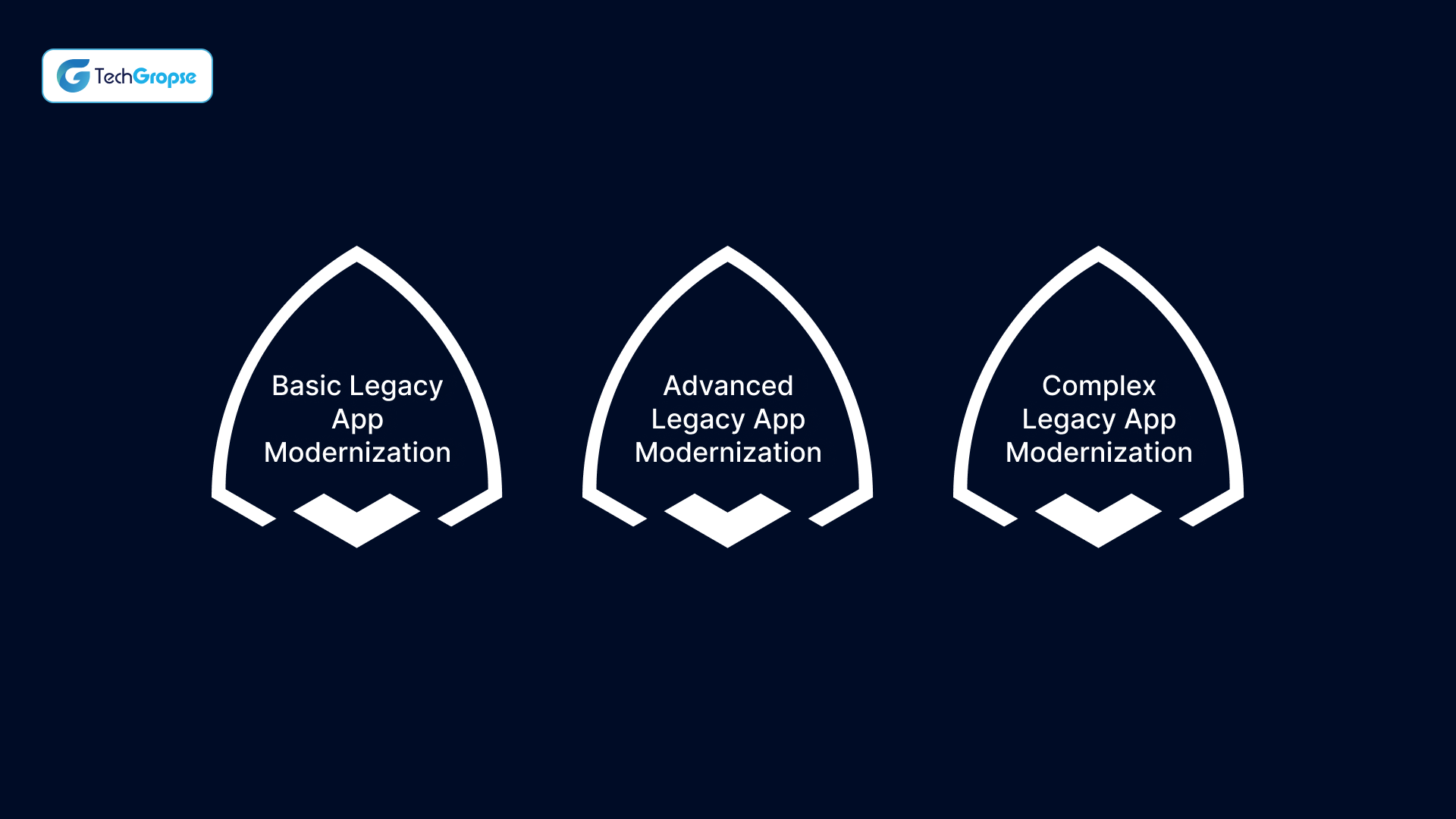
To make a clear budget understanding of the legacy app modernization, we have divided the catalogue into three categories.Â
- Basic Legacy App Modernization
- Advanced Legacy App Modernization
- Complex Legacy App Modernization
| App Modernization Type | Scope of Modernization | Key Activities Included | Typical Tech Stack | Estimated Cost Range | Time-to-Market |
|---|---|---|---|---|---|
| Basic Legacy App Modernization | UI & infrastructure upgrade | UI refresh, minor code refactoring, server upgrade, basic cloud migration | React/Angular, .NET Core, Node.js, AWS/Azure | $15,000 – $30,000 | 1–2 months |
| Advanced Legacy App Modernization | Architecture & performance enhancement | Code optimization, microservices migration, cloud-native setup, API integration, AI-assisted automation | Java/Spring Boot, .NET Core, Docker, Kubernetes, AWS/Azure, ML tools | $30,000 – $70,000 | 3–5 months |
| Complex Legacy App Modernization | Full-scale transformation | Complete re-architecture, legacy code migration, AI integration, data modernization, security & compliance upgrades | Microservices, AI/ML, GenAI, Big Data, Kubernetes, Multi-cloud | $70,000 – $150,000+ | 6–9+ months |
Conclusion
With 10+ years of experience in the software domain, TechGropse is a leading mobile app development company in the U.S. The broad bandwidth of expertise in digital transformation, app modernization, ERP, CRM, eCommerce, and the healthcare industry has made us a true contender for transforming your business from legacy infrastructure to a modern AI ecosystem.Â
Our speciality in the mobile domain encapsulates:
- AI-focused legacy app assessment
- Intelligent re-engineering & refactoring
- AI-ready cloud migration
- AI-based UI/UX modernization
- Workflow automation and optimization
- Data modernization with AI analytics
- Compliance adherence and risk mitigation
- Maintenance, support, and optimization
With a colossal project delivery track record of 3000+ solutions and business applications, we have a client 92% retention rate across the global marketplace. The successful market performance is competitive enough to make you choose us for your legacy app modernization.Â
FAQs
Legacy App Modernization is the broad process of upgrading the complete operational workflow with technology adoption, system upgrades, version updates, architecture modernization, performance, scalability, and security.
The competitive benefits of legacy app modernization are scalable infrastructure, high-end performance, better operational efficiency, effective security, and budget-friendly.
Artificial Intelligence helps in automating code analysis, testing, cloud migration, refactoring, performance optimization, integrating APIs, and risk management.
The best AI aspects are Robotic Process Automation, Natural Language Processing, Machine Learning, Augmented Reality, Virtual Reality, Generative AI, and Conversational AI.
Yes. AI supports seamless cloud migration with readiness assessment, workflow optimization, and end-to-end migration planning.
The overall cost of Legacy App Modernization depends on the complexity of the system and the level of AI integration. The ideal cost would revolve around $15,000-$150,000.
The timeline for legacy app modernization depends on the system complexities, AI integration, technologies used, and developers hired. Ideally, the time-to-market would fluctuate from 2 months to 9 months.
AI analyzes existing codebases, predicts failure points, and automates testing, significantly reducing downtime and migration risks.
AI continuously monitors applications, predicts performance issues, and optimizes resources in real time for consistent system reliability.
Leading companies supporting legacy app modernization include TechGropse, IBM, Accenture, TCS, Infosys, Capgemini, Cognizant, Wipro, HCLTech, and Microsoft, offering AI-driven, cloud-native, and enterprise modernization solutions.
An AI algorithm navigates through multiple factors, including low-value components, system dependency, utility frequency, and business impact. Further, the algorithm determines which components are supposed to be eradicated rather than modernized.
AI reduces modernization risks by simulating transformation scenarios, predicting failure points, and validating system behavior through automated testing, ensuring stability and continuity before deploying changes to mission-critical legacy applications.

Hello All, Aman Mishra has years of experience in the IT industry. His passion for helping people in all aspects of mobile app development. Therefore, He write several blogs that help the readers to get the appropriate information about mobile app development trends, technology, and many other aspects.In addition to providing mobile app development services in USA, he also provides maintenance & support services for businesses of all sizes. He tried to solve all their readers' queries and ensure that the given information would be helpful for them.

 info@techgropse.com