



























































Before any experienced executive signs off on a serious investment, there is always a pause. Not a dramatic one. Just a practical question asked in a meeting room: will this actually work?
That question is the foundation of what is proof of concept.
Suppose you plan to open a new restaurant. You would not immediately lease a large space, hire a full staff, and invest in branding. A prudent operator would host a small pop-up first. Test the menu. Observe customer reactions. Adjust pricing. Refine operations. That pop-up functions as your proof of concept. You are validating demand and operational flow before scaling.
In business, a POC in business serves the same purpose. It helps teams validate business ideas, confirm technical feasibility, and reduce strategic risk before major investment.
Let’s define it properly.
What is Proof of Concept?

A proof of concept is not a finished product. It is not a marketing rollout. In most cases, it is not even a prototype.
Many organizations confuse proof of concept with product development. The distinction matters. Product development focuses on execution and scaling. Proof of concept focuses on validation.
A formal proof of concept definition would describe it as a small-scale initiative designed to demonstrate that a proposed solution is technically and commercially feasible.
The POC business meaning centers on feasibility assessment before significant investment. It generates evidence that informs decision-making at the executive level.
What is POC in Business?
When we discuss POC in business meaning, we are addressing concept validation from a strategic perspective.
A well-designed POC generally includes:
- A clearly defined objective
- Measurable outcomes
- A constrained budget
- A defined timeline
- A predetermined decision point
Without these elements, the exercise becomes exploratory rather than evaluative.
A business proof of concept examines whether a proposed opportunity has genuine potential. That may involve testing customer demand, assessing pricing sensitivity, or confirming operational capability.
The process of concept validation needs to be done because it represents the most important aspect of early-stage company development. The analyses which study why startups fail show that missing market demand represents the main reason why businesses collapse. The POC serves as a testing method which protects against operational risks by verifying business assumptions before the company builds its complete operational system.
The POC provides actual decision-making information because it delivers empirical evidence rather than unproven assumptions.
What does POC stand for in Software Development?
The software POC acronym used in technology projects has a more specialized meaning.
The proof of concept which testing team used at the software development stage showed whether the designed solution worked within established technical specifications. The evaluation process assesses architectural design elements, integration points with other systems and various performance limits as well as the system’s ability to work with other systems.
The POC stage appears as the second step in the Software Development Life Cycle because it comes after the initial idea creation and before the major development phase. The method connects strategic planning with practical implementation.
The main element which establishes technology stack credibility exists as the primary requirement. The development team needs to check whether their chosen programming languages and cloud platforms and database systems and external services will meet their project requirements.
For example, the organization needs to test its POC system when it wants to test machine learning functionalities in its operational platform.
- Model accuracy using real data
- Processing latency under expected load
- Integration with existing APIs
- Infrastructure cost projections
In POC software development, the objective remains narrow. The goal is not to feature completeness. It is a risk reduction.
If the system performs effectively in a controlled test, leadership can proceed with confidence. If limitations emerge, teams pivot early. That early correction often prevents months of wasted effort and significant financial loss.
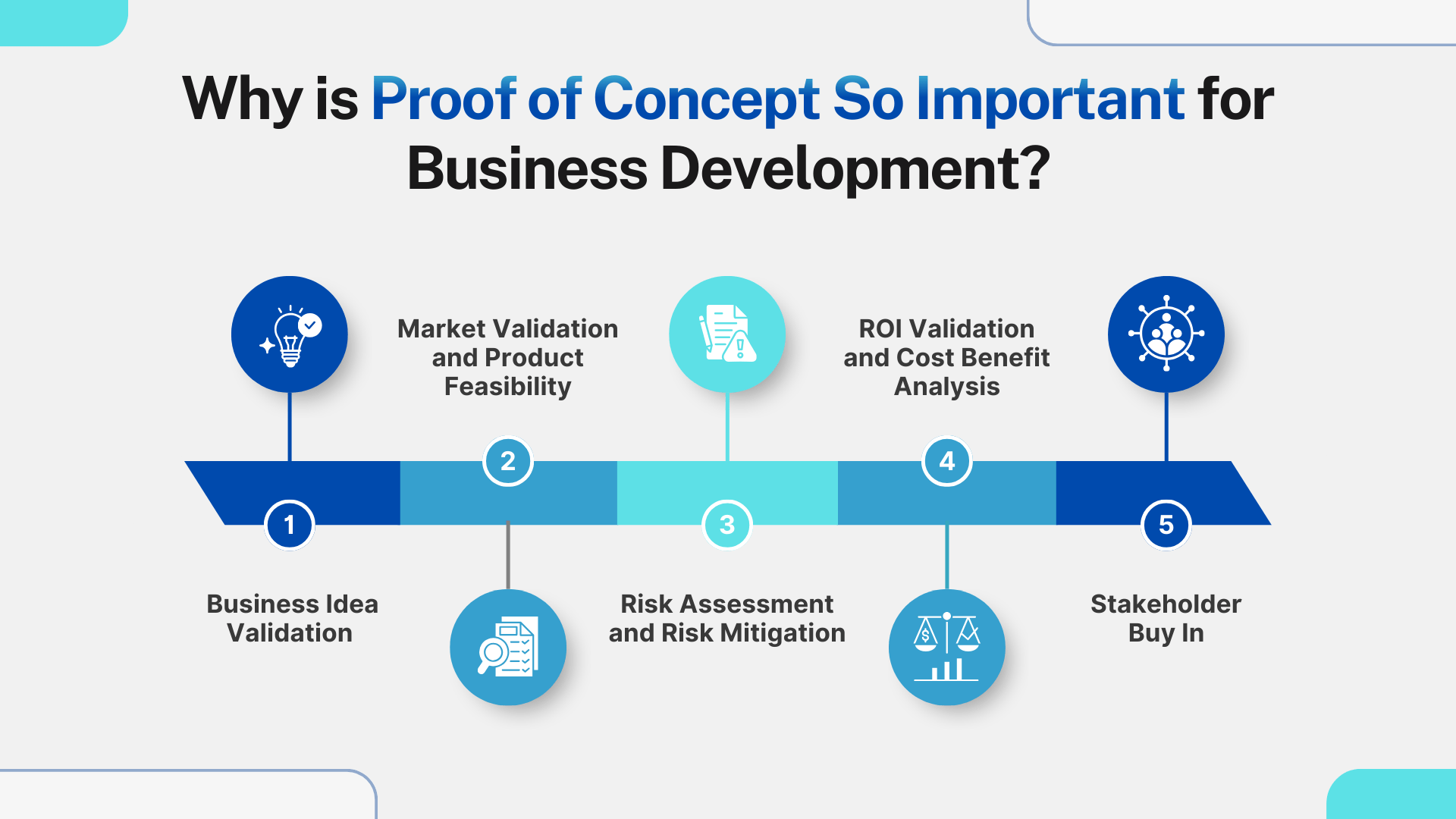
Why is Proof of Concept So Important for Business Development?
Let’s be honest. Most ideas sound great in a strategy meeting.
The slides look sharp. The projections look optimistic. Everyone nods. And then reality shows up.
That’s where proof of concept becomes critical.
At some point, every idea has to face the real world. Customers either care or they don’t. The technology either works or it doesn’t. The economics either make sense or they fall apart. A proof of concept is how you test those truths early, before you spend serious money.
If you look at startup failure data, one theme shows up again and again: no real market need. Founders build something they believe in, but customers never asked for it. That alone explains why proof of concept is important for startups.
A POC forces you to stop debating and start testing. Instead of arguing in conference rooms, you run experiments. Instead of forecasting in spreadsheets, you gather evidence.
1. Business Idea Validation
Business idea validation sounds obvious, but it’s surprisingly rare.
Founders fall in love with their concepts. Corporate teams trust brainstorming sessions too much. The result? Decisions based on enthusiasm instead of data.
A proof of concept introduces discipline. It pushes you to ask uncomfortable but necessary questions:
- Do customers actually feel this problem?
- Are they actively looking for a solution?
- Will they pay for it?
Let’s say you’re building a SaaS tool for small medical clinics to automate appointment reminders. You could spend six months building a polished platform. Or you could manually offer the service to 10 clinics for 30 days and see what happens.
If engagement is low, that insight is gold. If adoption is strong, now you have proof. That’s the idea of feasibility testing in real life. You test first. You scale second.
2. Market Validation and Product Feasibility
There’s a difference between liking an idea and having a market for it. Market validation answers the big question: are there enough customers who care?
Imagine a logistics company exploring drone delivery in cities. It sounds innovative. But then reality steps in. Airspace regulations. Battery limits. Weather conditions. Urban infrastructure. Cost per delivery.
A proof of concept lets the company test these variables in a controlled setting. Maybe they pilot in one district. Maybe they limit delivery weight. Maybe they test only during specific hours.
Without that step, they could invest millions before discovering a fatal flaw.
3. Risk Assessment and Risk Mitigation
Every new initiative carries risk. Technical risk. Financial risk. Operational risk. Sometimes reputational risk.
A proof of concept doesn’t eliminate risk. It contains it.
Instead of rolling out a solution nationwide, you test in one region. Instead of deploying across the whole organization, you experiment with one department. That controlled environment limits damage if something goes wrong.
This is proof of concept risk mitigation in action. You’re still moving forward, but you’re doing it intelligently.
Risk is part of innovation. Unmanaged risk is what destroys budgets.
4. ROI Validation and Cost Benefit Analysis
At some point, someone in leadership will ask a simple question: is this worth the money? That’s where ROI validation comes in.
A proof of concept generates early performance data. Not projections. Not theoretical models. Actual numbers.
Picture a manufacturing company considering robotic automation. Instead of automating the entire assembly line, they test robotics on one segment. They measure:
- Reduction in labor hours
- Change in defect rates
- Maintenance requirements
- Implementation time
Now they can run a realistic cost benefit analysis. The numbers tell the story. The decision becomes rational instead of emotional.
Without a POC, ROI discussions rely too heavily on assumptions.
5. Stakeholder Buy In
Let’s talk about something people rarely mention openly: internal resistance.
Every company has skeptics. And honestly, they’re often right to question new initiatives.
A well-executed proof of concept helps secure stakeholder buy in because it replaces opinions with evidence. Instead of saying this will work, you can say it already worked in a controlled test.
That changes boardroom conversations. It strengthens executive reviews. It builds confidence across departments.
Data is far more persuasive than enthusiasm.
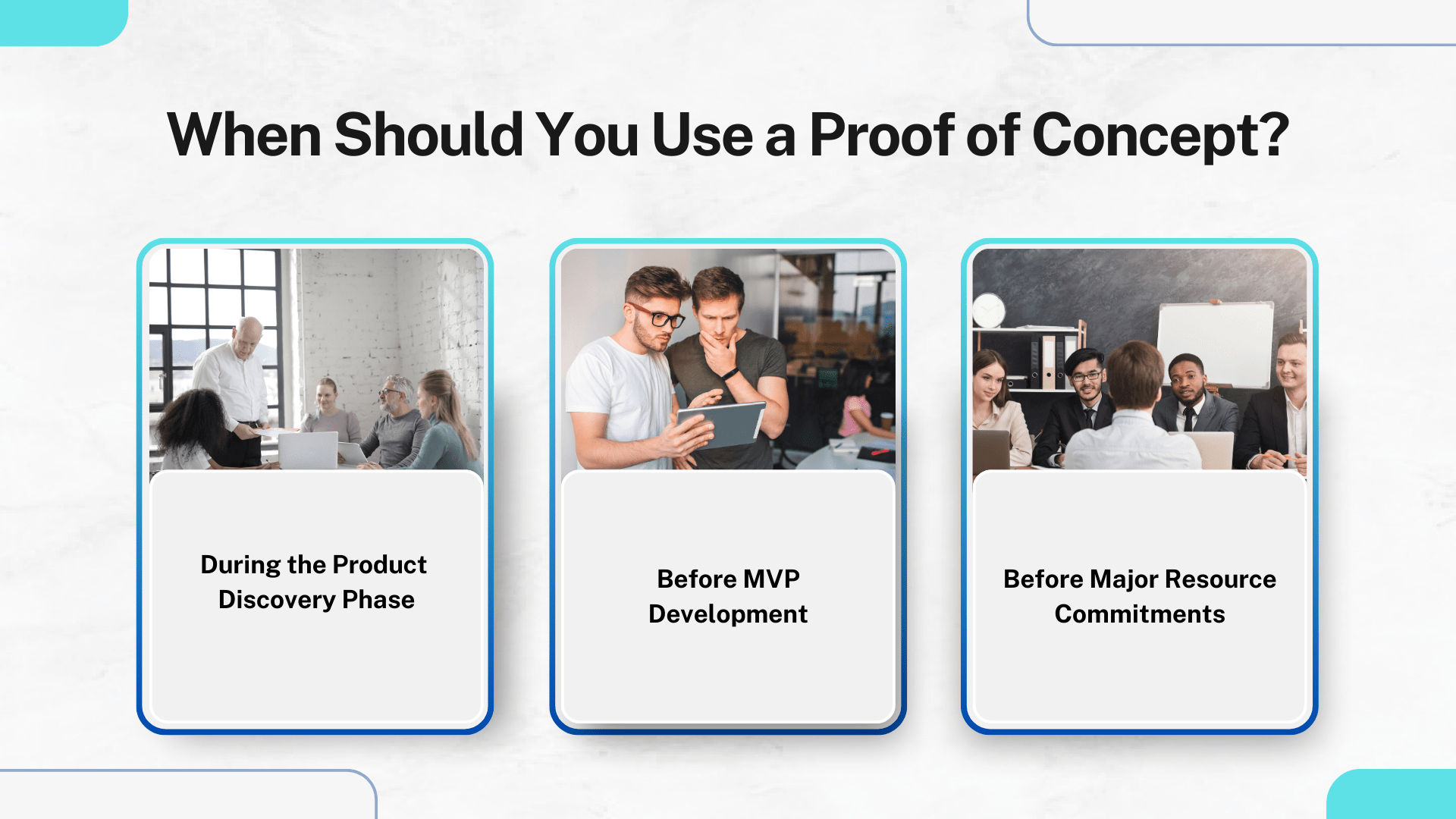
When Should You Use a Proof of Concept?
Timing matters more than people think. Run a POC too late and you’ve already spent too much. Run it too early and you may not even know what you’re testing.
Generally, a proof of concept makes the most sense when uncertainty is high but your core idea is clear enough to evaluate.
1. During the Product Discovery Phase
The product discovery phase is about understanding users and identifying real problems. This is the perfect moment for validation.
You have a hypothesis. Now you need to test it.
At this stage, you’re not building a full product. You’re checking whether your core assumption holds up in the real world.
Skipping this step is how teams end up rebuilding later.
2. Before MVP Development
Many teams rush into MVP development because they want momentum. That urgency can backfire.
A proof of concept should come before MVP development when there’s serious technical or market uncertainty. The POC confirms feasibility. The MVP tests adoption at scale.
Think of the sequence like this:
- Proof of concept validates the idea
- Prototype explores usability
- MVP tests real customer behavior
If you skip the first step, the rest of the roadmap becomes unstable.
3. Before Major Resource Commitments
Whenever a project requires significant hiring, infrastructure, regulatory approval, or capital investment, pause.
If you’re about to commit major engineering hours, deploy new technology architecture, or launch an expensive marketing campaign, that’s your signal.
A proof of concept acts as a checkpoint. It gives you one last opportunity to validate before making irreversible decisions.
In business development, speed matters. But disciplined validation matters more.
How to Create a Successful Proof of Concept?

A strong idea might open the door. But structure is what gets a proof of concept approved.
If you’re wondering how to write a proof of concept that leadership actually takes seriously, the answer is clarity. Let’s walk through a practical framework you can use immediately.
Step 1: Define the Problem and the Solution
Every credible POC starts with precision.
Before anyone writes code or builds a mockup, you need a sharply defined problem. Vague goals like improving engagement or optimising efficiency sound productive, but they produce weak validation.
Next comes the KPI definition. What specific metrics will determine success? Choose a small set of measurable outcomes, such as:
- Conversion rate increase
- Cost reduction percentage
- Time saved per workflow
- Error rate improvement
Limit yourself to two to four KPIs. Too many metrics dilute focus. Too few create ambiguity.
If you’re asking how to write a proof of concept document, this is the section that deserves the most rigor. Clear hypothesis. Clear metrics. No gray areas.
Step 2: Define Scope and Resources
This is where most POCs fail. Teams try to validate everything at once.
A proper proof of concept plan keeps the scope narrow. You are not building the final solution. You are isolating and testing a core assumption.
- Start with project scope definition:
- What exactly are we testing?
- What are we intentionally not testing?
- What constraints apply?
Suppose you’re validating a new payment gateway integration. Your POC does not need a redesigned interface or advanced analytics. You focus strictly on transaction processing, system compatibility, and failure handling.
Then assemble a small cross functional team. Product, engineering, and one business stakeholder are often enough. Keep it lean. Too many voices slow momentum.
Now address resource allocation:
- Budget ceiling
- Timeline
- Tools and infrastructure
- Estimated personnel hours
Most proof of concept initiatives run between two and eight weeks, depending on complexity. Set a fixed timeline. Open ended experiments tend to drift and lose executive confidence.
Step 3: Build and Test
This is where execution begins, but restraint still matters.
Use rapid prototyping principles. Build only what is necessary to validate feasibility. Not more. Not prettier. Just functional enough to test.
In software environments, agile development and iterative development are ideal. Short cycles. Quick releases. Fast feedback loops.
If your POC involves technical systems, conduct integration testing early. Make user feedback collection systematic. Combine qualitative insights from interviews with quantitative analytics. The combination strengthens your evaluation.
Step 4: Evaluate Results Objectively
This step requires discipline. Once testing ends, resist the urge to defend the idea. Let the data guide the conclusion.
Data driven decision making means comparing actual outcomes against your predefined KPIs. Did you achieve the 15 percent lift? Did processing time drop as expected? Were error rates meaningfully reduced?
There are only three legitimate outcomes:
- The POC met or exceeded targets
- Results were mixed and require iteration
- The hypothesis did not hold
If the proof of concept validates feasibility, you move toward product iteration and scaling. If results are inconclusive, refine and retest. If the data clearly contradicts your assumption, stop. That is still a success. You avoided scaling a flawed idea.
In some cases, organizations move from proof of concept to proof of value. While a POC confirms feasibility, proof of value demonstrates measurable business impact in a broader operational setting.
The key is making a clear decision. A successful proof of concept is not defined by success metrics alone. It is defined by clarity. It produces evidence strong enough to guide the next move with confidence.
Proof of Concept Template Overview
| Section | What It Means |
|---|---|
| 1. Executive Summary | A short overview of the POC objective, what is being tested, and the expected outcome. |
| 2. Problem Statement | A clear description of the business problem or opportunity supported by relevant data. |
| 3. Proposed Solution | A concise explanation of the concept or approach being tested, limited to core functionality. |
| 4. Technical Approach | Details of how the POC will be executed, including tools, architecture, integrations, and testing setup. |
| 5. Success Metrics KPIs | Specific, measurable outcomes that define whether the POC succeeds or fails. |
| 6. Risk Assessment | Identification of potential risks along with mitigation strategies. |
| 7. Timeline | Defined duration of the POC with key milestones and completion date. |
| 8. Budget Estimate | High-level cost breakdown covering resources, tools, infrastructure, and contingency. |
| 9. Final Recommendation | Summary of findings and a clear next step such as proceed, refine, or stop. |
POC vs MVP vs Prototype Key Differences
People often use these terms interchangeably, but they solve very different problems. If you misunderstand them, you risk building the wrong thing at the wrong time.
When comparing POC vs MVP, or proof of concept vs prototype, the easiest way to think about it is this:
- A proof of concept tests feasibility
- A prototype tests usability and design
- An MVP tests real market demand
What Comes First POC or Prototype?
In most cases, the proof of concept comes first.
You start with a POC to confirm that the core idea works from a technical or business standpoint. Once feasibility is proven, you move to a prototype to explore user experience and workflows. Only after that do you build an MVP to launch into the market with minimum features.
This sequence reduces risk step by step. Skipping the proof of concept stage often leads teams to build beautiful prototypes for ideas that are technically impossible or commercially weak.
| Criteria | Proof of Concept POC | Prototype | Minimum Viable Product MVP |
|---|---|---|---|
| Primary Goal | Validate feasibility | Test design and usability | Test market demand |
| Focus | Technical or business viability | User experience and interaction | Real customer adoption |
| Audience | Internal teams, stakeholders | Test users, designers | Early adopters, paying customers |
| Feature Set | Very limited, core function only | Visual or interactive model | Functional product with minimal features |
| Risk Level Addressed | Technical and strategic risk | UX and workflow risk | Market and commercial risk |
| Stage in Development | Earliest validation stage | After feasibility is confirmed | After validation and design testing |
Real World Proof of Concept Examples
Understanding theory helps, but real proof of concept examples make the concept stick. Let’s look at well-known companies that validated ideas before going all in.
Example 1- Tesla Battery Feasibility Testing

Before Tesla became a global electric vehicle leader, it had to solve a massive technical challenge: battery performance.
Early proof of concept work focused on whether lithium ion battery packs could deliver sufficient range, safety, and durability for electric cars. Engineers tested battery configurations in controlled environments before scaling production.
That initial feasibility testing proved electric vehicles could compete with combustion engines on performance. Without that technical validation, scaling manufacturing would have been reckless.
Example 2- WhatsApp Early Messaging Validation

When WhatsApp first launched, it was far from the full-featured platform we know today.
The founders focused on one simple function: real time messaging without SMS fees. The early version tested whether users would adopt internet based messaging and rely on it consistently.
That early experiment functioned as proof of concept for startups. It validated product feasibility and market demand simultaneously. User growth in the first months showed clear traction, which later supported funding rounds.
It is one of the strongest POC examples for startups because it started small, validated quickly, and scaled only after evidence appeared.
Example 3- Netflix Streaming Infrastructure Test

Before streaming became mainstream, Netflix operated primarily as a DVD rental service. Moving to streaming required major infrastructure changes.
The company conducted internal proof of concept experiments to test bandwidth requirements, content delivery systems, and server capacity. They needed to confirm that streaming video at scale was technically viable.
That streaming infrastructure test was essentially a proof of concept in software and network engineering. It validated system compatibility and performance under real conditions.
Once feasibility was confirmed, Netflix invested heavily and transformed the entertainment industry.
Conclusion
At its core, proof of concept is about disciplined thinking. It transforms assumptions into tested evidence.
Whether you are building a SaaS platform, launching a startup, or implementing AI automation, a structured POC in business strengthens business viability. It supports concept validation and drives risk reduction before major investments occur.
If you want to apply this approach systematically, make a proof of concept template and standardize the process across teams. And if your initiative involves complex integrations or AI systems, consult software development experts who understand feasibility testing at both technical and strategic levels.
The principle is simple, even if execution requires discipline.
Validate before building.
FAQ
A proof of concept is a small, controlled test that shows whether an idea can actually work. Instead of building the full product, teams validate one core assumption first. The goal is simple: reduce uncertainty. If the concept proves feasible, the business moves forward with more confidence.
POC in business refers to testing whether a business idea is viable before investing heavily in it. Companies use a proof of concept to validate demand, confirm technical feasibility, and assess potential ROI. It helps leaders make informed decisions based on evidence, not assumptions.
The difference between POC and MVP comes down to purpose. A proof of concept checks if something can work. A minimum viable product tests whether customers actually want it. The POC focuses on feasibility. The MVP focuses on real-world adoption and feedback.
To write a proof of concept, clearly define the problem, state your hypothesis, outline the scope, and set measurable success criteria. Keep it focused and time-bound. A strong proof of concept document explains what you are testing, how you will test it, and how you will evaluate results.
A proof of concept validates feasibility, while a prototype demonstrates design and user flow. The POC answers this idea. The prototype answers how it will look and feel. They serve different stages of product development and should not be confused.
Most proof of concept projects take anywhere from two weeks to three months. The exact timeline depends on complexity. The key is to keep it short and focused. If a POC drags on too long, it usually means the scope was not clearly defined.
Proof of concept is important because it reduces risk. It allows businesses to validate assumptions, test feasibility, and avoid costly mistakes. Instead of committing full resources to an unproven idea, companies gather data first and make smarter decisions.
A POC tests feasibility in a controlled environment. A pilot project tests a near-final solution in real-world conditions with actual users. The proof of concept answers can work. The pilot answers how well this works at scale.
In most cases, the proof of concept comes first. It validates feasibility. Next comes the prototype to test usability and experience. Finally, the MVP launches to real users to measure market demand and gather feedback.
To create a successful proof of concept, start with a clear hypothesis, define measurable KPIs, limit scope, assign resources, and evaluate results objectively. Keep the process structured and data-driven. The goal is clarity, not feature completeness.
The typical steps in a proof of concept include defining the problem, forming a hypothesis, setting success criteria, designing a small test, executing it, analyzing results, and making a go or no-go decision. Each step should remain focused and measurable.
Short answer? Absolutely. Investors don’t fund ideas. They fund validation and traction. A strong proof of concept for investors signals maturity. For example, if a health tech startup can show that 200 early users actively used its platform and experienced measurable improvements, that data strengthens the product pitch deck significantly.

Hello All, Aman Mishra has years of experience in the IT industry. His passion for helping people in all aspects of mobile app development. Therefore, He write several blogs that help the readers to get the appropriate information about mobile app development trends, technology, and many other aspects.In addition to providing mobile app development services in USA, he also provides maintenance & support services for businesses of all sizes. He tried to solve all their readers' queries and ensure that the given information would be helpful for them.


 info@techgropse.com