





























































Do you know why Custom ERP Software Development is such a hot topic in the market? Imagine you have made a business solution that precisely works with the operational workflow, delivery approach, and process change. What will happen? Inevitably, your operational alignment would be streamlined, user engagement will scale up, and returns from digital investment will reach the maximum.Â
That’s the strength of Custom ERP Software Development. But approaching such a venture is not an easy task. You have to take care of multiple factors like tech-stack selection, market scope, possible advantages, feature considerations, development blueprint, and budget availability. If you are seeking such wisdom, this blog is a one-stop solution for you.Â
Key Takeaways:
- Market Size of Custom ERP Software Development at a Global Scale
- What is Custom ERP Software?
- Competitive Advantages of Custom ERP Software Development in 2026
- Get a Seamless Comparison: Custom Vs Off-the-Shelf ERP
- Step-by-Step Guidelines for Custom ERP Software Development
- Cost of Custom ERP Software Development in 2026
- Top 5 Custom ERP Software Development Companies in 2026
- Bottomline: Choose TechGropse as a Custom ERP Software Development Company
- FAQs (Frequently Asked Questions)
Market Size of Custom ERP Software Development at a Global Scale
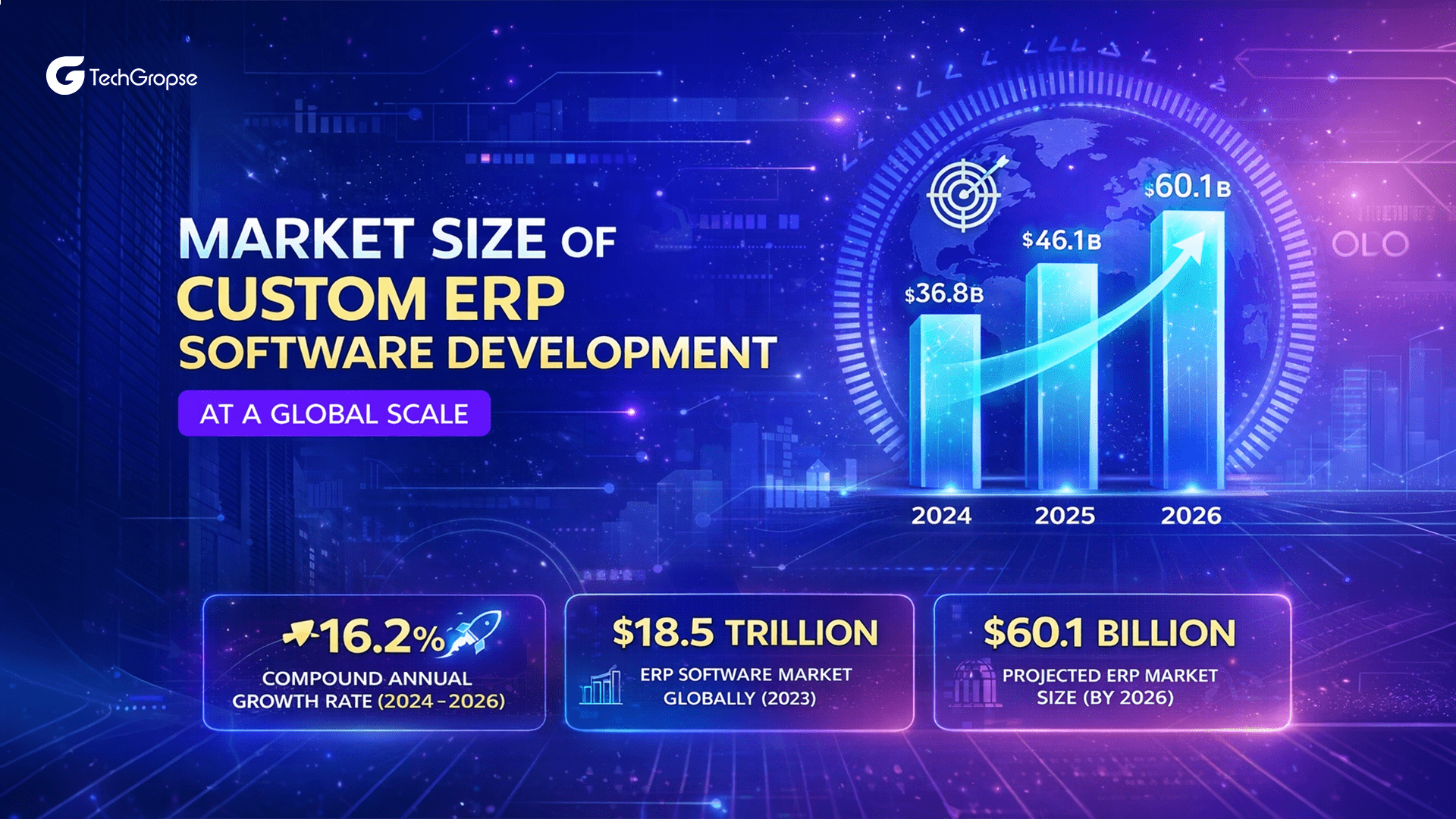
Before we go ahead with ERP software development for our business, let’s look at some of the relevant market stats from trusted websites. These data claims with perfection that the ERP solution would be the next big thing across all marketplaces.Â
Grand View Research claims that the global ERP software market was valued at about $64.83 billion in 2024 and is projected to reach $123.41 billion by 2030, growing at a CAGR of 11.7%.
A Precedence Research report says that the market is expected to grow from $63.76 billion in 2026 to around $116.54 billion by 2035, reflecting strong demand for enterprise automation and digital transformation.Â
Another report from Business Research Insights forecasts that the ERP solutions market will be at $70.83 billion in 2025, which may expand to $149.02 billion by 2035 with a 9.25% CAGR globally.Â
A study from Global Growth Insights projects that over 72% of organizations worldwide have adopted ERP systems to streamline operations and improve real-time decision-making.Â
A SaaSworthy report says that more than 70% of large enterprises worldwide currently rely on ERP systems to integrate core business processes such as finance, supply chain, and human resources.
What is Custom ERP Software?
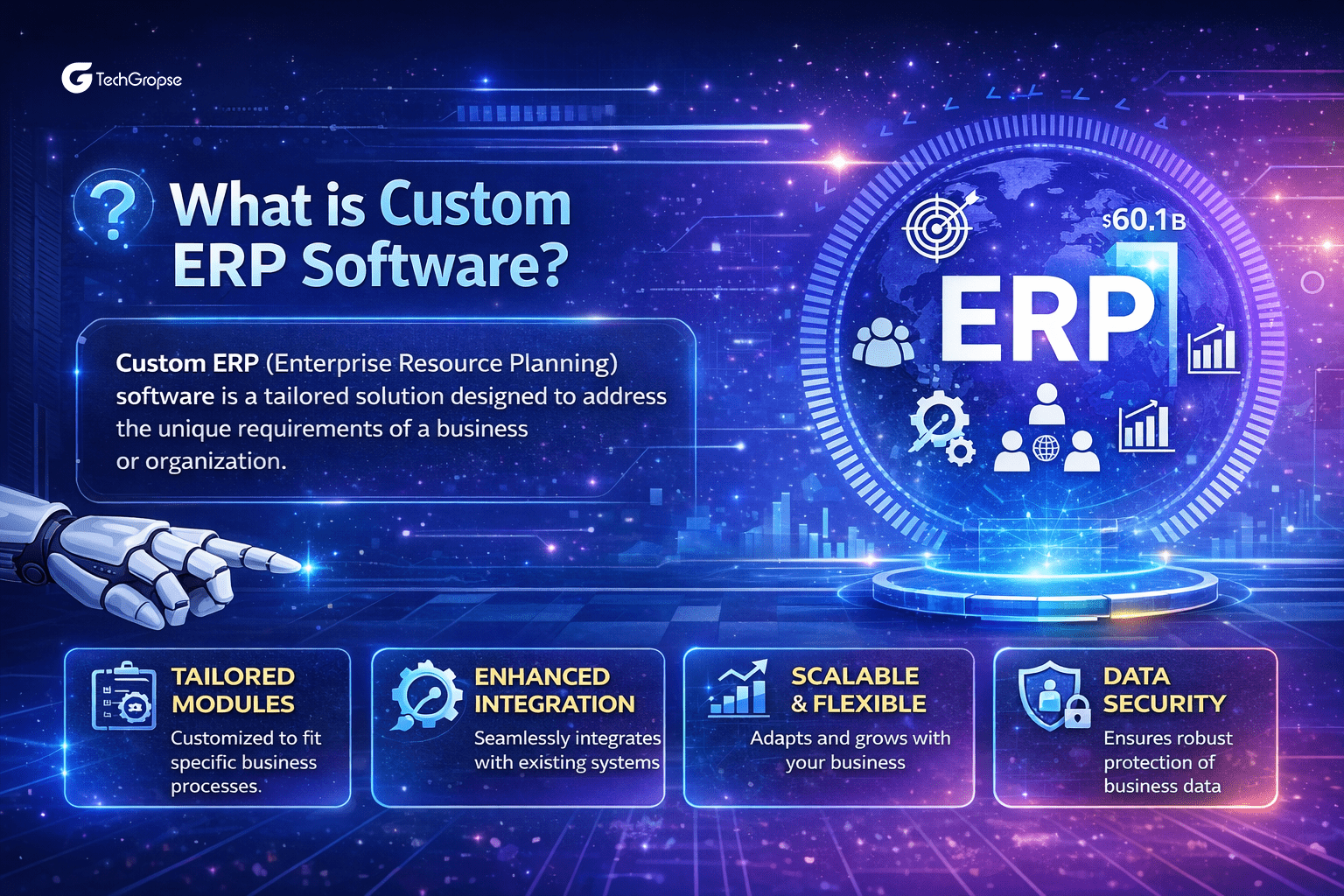
Custom ERP software is a full-fledged personalized solution, designed to support workforce, workflow, and business goals. Unlike the traditional ERP system that was crafted to holistically cater to every industry operation, Custom ERP Software Development is invariably approached to fulfill the operational needs of a specific business. It seamlessly aligns with the unique process, operational needs, and organised infrastructure of your workflow chronology.Â
Fundamentally, custom ERP software enables businesses to automate processes, improve data accuracy, and enhance decision-making through real-time insights. As organizations grow, custom ERP systems can easily scale and adapt to evolving business demands.
Competitive Advantages of Custom ERP Software Development in 2026
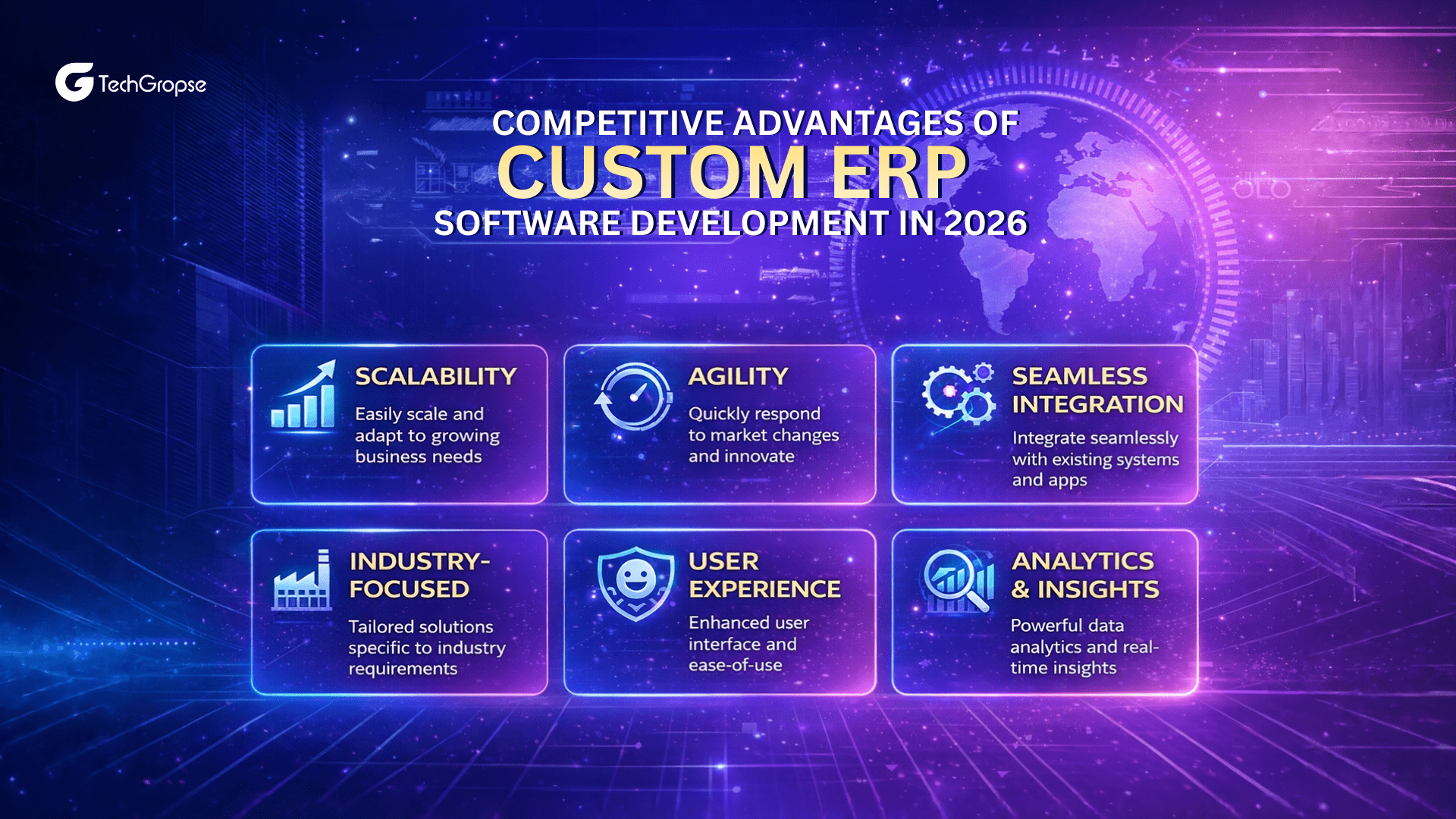
Now, let’s explore the competitive advantages of ERP software solutions in 2026.Â
ScalabilityÂ
Scalability is the major virtue of custom ERP app development for enterprises. As the business keeps on expanding, you need new features, functions, high-volume data management, and sustainable workflow. This is only possible when you have a scalable infrastructure by your side.Â
Key Highlights
- Flexible modules
- Modular architecture
- Performance optimization
- Business expansion
- Data scalability
Agility
The agile nature of custom ERP software development allows it to adopt the changing market trends, conditions, and needs. Businesses with a tailored ERP application can significantly modify the workflow and update the flexible modules based on operational needs.Â
Key Highlights
- Fast deployment
- Rapid customization
- Workflow adaptability
- Flexible processes
- Quick updates
Seamless Integration
The easy integration with the software platforms and business tools is another competitive virtue of the custom ERP solution. Businesses can seamlessly connect with new inventory platforms, third-party accounting software, and supply chain tools. This ensures consistent data flow, improved collaboration, and mitigation of operational silos across the solution ecosystem.Â
Key Highlights
- Cross-software integration
- API connectivity
- Data synchronization
- System connectivity
- Unified platforms
Industry-Focused
We already discussed that the Custom ERP Software Development is crafted in accordance with the specific industry requirements. ERP for banking, logistics, healthcare, manufacturing, eCommerce, and FMCG is skillfully crafted to meet the specialized workflow requirements, compliance features, and operational segments.Â
Key Highlights
- Specialized tools
- Domain features
- Industry workflows
- Compliance support
- Sector modules
User Experience
In contrast to the traditional ERP solution, the custom ERP software development is voraciously focused on the user experience of clients. The operation-focused navigation, interactive dashboards, role-based accessibility, and departmental functional integration are all combined to elevate the experience of users.Â
Key Highlights
- Intuitive dashboards
- Role-based access
- Easy navigation
- Mobile accessibility
- User-friendly interface
Analytics & Insights
Real-time accessibility to actionable insights is the key factor for the popularity of custom ERP software development in 2026. With advanced analytical tools and predictive dashboards, you get to forecast the ongoing performance and deliveries, vital for strategic planning and data-driven decision-making.Â
Key Highlights
- Real-time analytics
- Performance reports
- Predictive insights
- Data visualization
- Business intelligence
Third-Party API Integration
Custom ERP platforms support seamless integration with third-party APIs and external business applications. Businesses can connect tools such as payment gateways, marketing platforms, eCommerce systems, and CRM solutions. These integrations streamline operations, improve data accuracy, and enable organizations to create a connected digital ecosystem for better efficiency.
Key Highlights
- CRM integration
- Payment gateways
- Cloud connectivity
- External APIs
- Platform interoperability
Operational Efficiency
With all the above-discussed functions and facilitations, the operational efficiency of your business is certain to be improved. The seamless automation of repetitive tasks, HR management, inventory management, procurement, and resource management eventually leads to the elevation of business operational efficiency.Â
Key Highlights
- Workflow automation
- Process optimization
- Error reduction
- Resource management
- Productivity improvement
Get a Seamless Comparison: Custom Vs Off-the-Shelf ERP
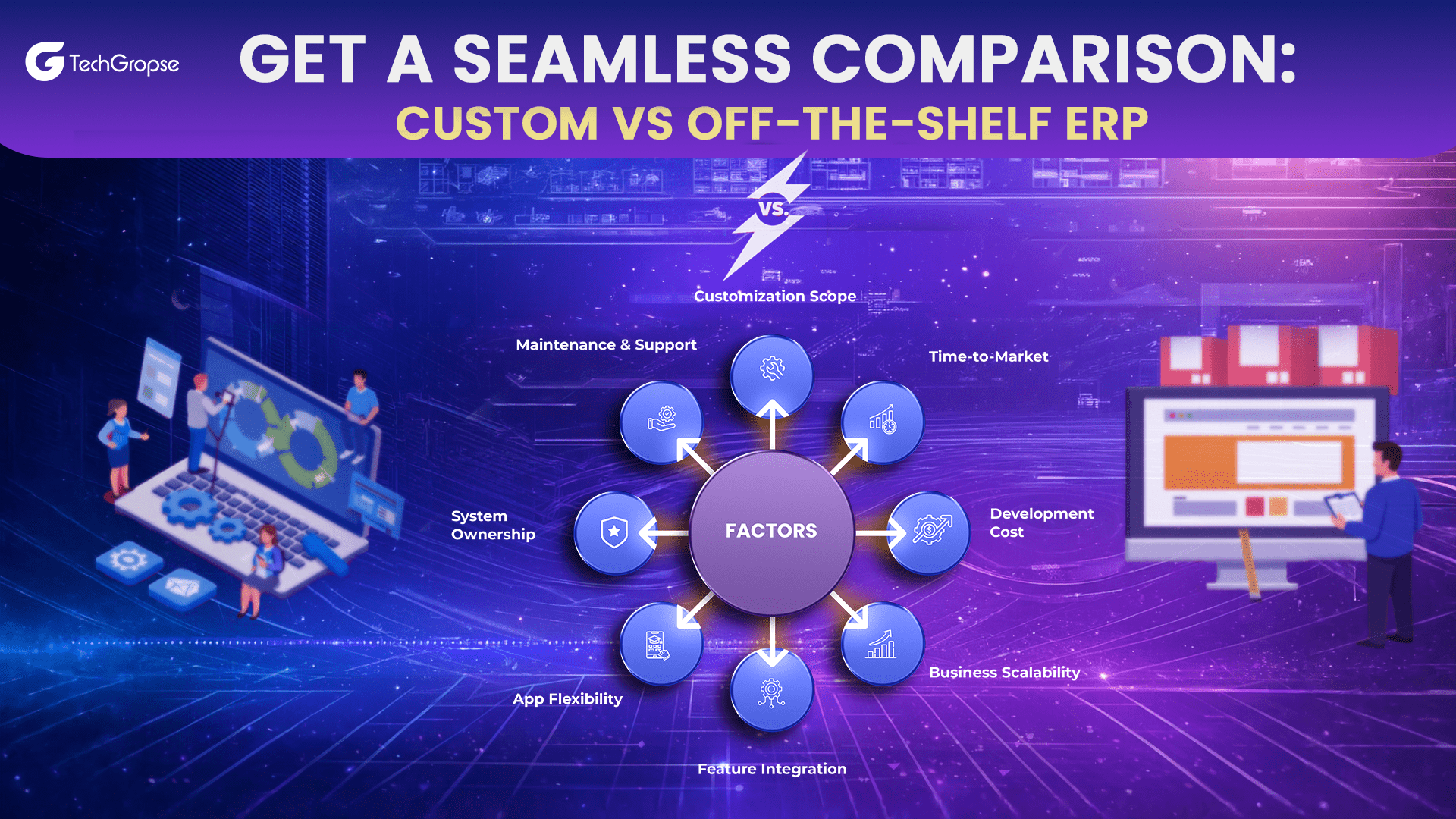
Let’s make a transparent comparison of the Custom ERP vs Off-the-Shelf ERP solution. Depending on the feasibility, you can choose one for your business.Â
| Factors | Custom ERP | Off-the-Shelf ERP |
|---|---|---|
| Customization Scope | Highly customizable to specific business needs | Almost zero customization scope |
| Time-to-Market | Longer time-to-market for custom deployment | Quick time-to-market due to a ready-made approach |
| Development Cost | High upfront development cost with tailored input | Low development cost, as no alteration is required |
| Business Scalability | Highly scalable with continuous business growth | Limited scalability |
| Feature Integration | Easy feature integration with the existing system | Additional tools required for feature integration |
| App Flexibility | Agile and adaptive to workflow alteration | Limited flexibility due to a fixed structure |
| System Ownership | Full ownership of the system | Vendor-owned software solution |
| Maintenance & Support | Managed and supported by your in-house team | Vendor offers updates and maintenance services |
| Security Updates | Tailored security stipulations & controls | Security standard set by the vendor |
| Best Suited For | Business looking for specific and unique workflows | Businesses seeking a quick software solution delivery for operations |
Step-by-Step Guidelines for Custom ERP Software Development
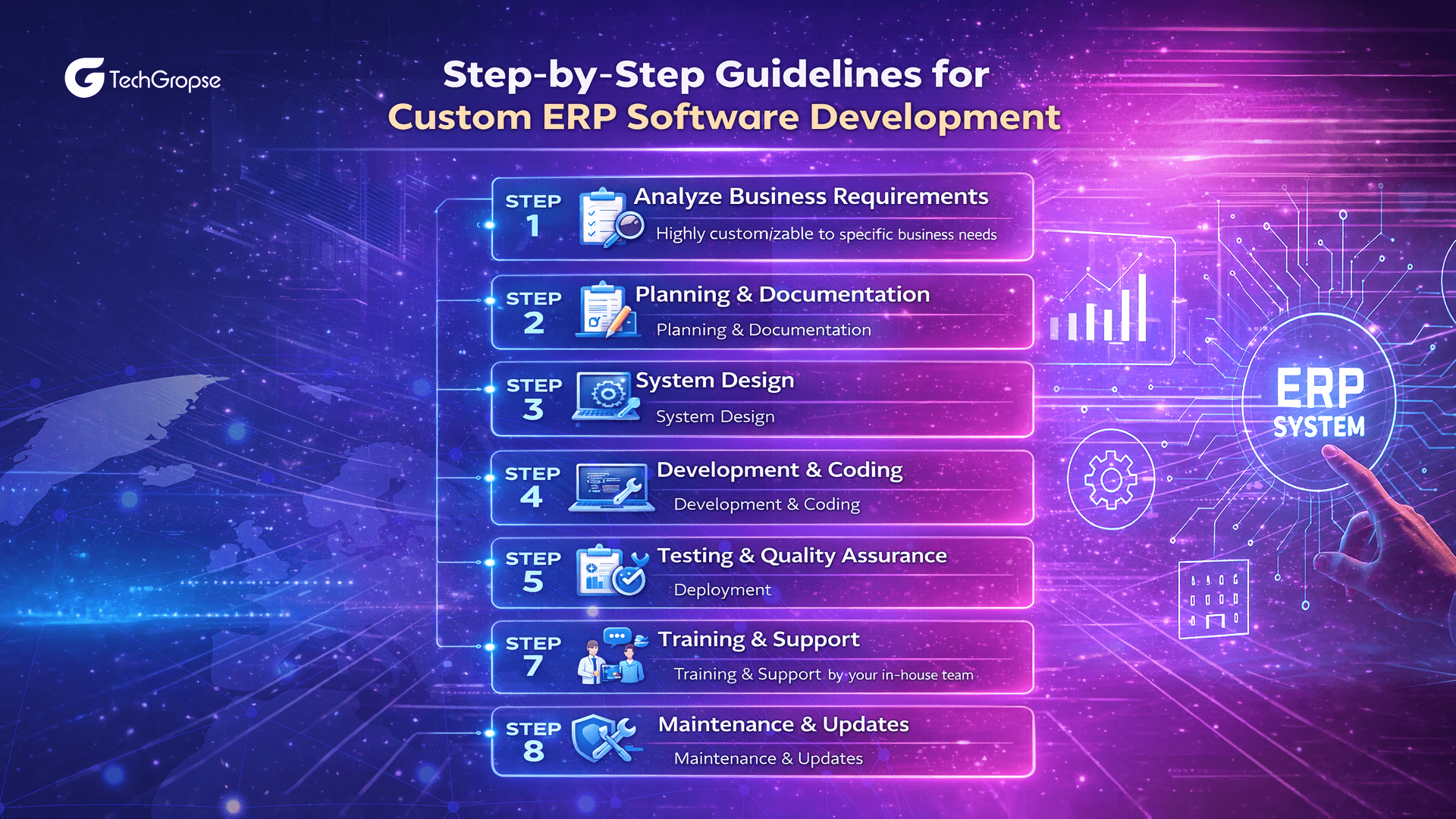
Well, there are many competitive service providers in the market. However, not every software identity is capable of planning the right pathway of development.Â
Requirement Analysis
Requirement analysis is fundamental to Custom ERP software development. Here, we define the business requirements, functional goals, data structure, integration needs, and tech-stack selection. In this initial stage, the developers collaborate with the research team and stakeholders to finalize the essence of your ERP software, followed by the solution it will offer to the users.Â
System Planning
System planning encapsulates ERP infrastructure design, development roadmap blueprint, tech-stack finalization, risk assessment, and resource allocation. In this step, you have to make sure of the timeline and the end-to-end alignment of resources to be capitalized on. A well-planned ERP system helps reduce development risks and ensures smooth coordination between design, development, and implementation stages.
UI/UX Design
Right away, from the interface layout design to the dashboard visualization, user journey mapping, to responsive design creation, a good Custom ERP software development company would take care of all the necessary aspects in the UI/UX arena.Â
Backend Development
Backend development builds the core functionality of the ERP system. Developers create databases, server-side logic, APIs, and security protocols that manage business data and system processes. This stage ensures reliable performance, secure data handling, and seamless communication between different ERP modules and integrated platforms.
ERP Module Development
This is to build a custom ERP with core functions. Here, the development team focuses on aligning the different operational modules with distinctive business verticals. The process might include finance management modules, inventory management modules, HR modules, CRM integration modules, and supply chain management modules.Â
Third-Party Integration
A custom ERP software development is only complete when you integrate your solution with third-party APIs and plugins. Businesses can link their ERP with CRM platforms, accounting tools, payment gateways, and cloud services to create a unified and efficient digital ecosystem. Today, external API implementation has become the integral forte of a custom software solution.Â
Testing & Quality Assurance
Testing and QA sessions make sure that your Enterprise Resource Planning software solution is ready to be deployed and launched in the market. It involves functional testing, security vulnerability testing, bug detection, bug fixing, and user acceptance testing. A full-fledged testing and quality assurance also ensures that the ERP application will run as per the expectations of the users.Â
Deployment & Implementation
Deployment and implementation involve launching the ERP system within the business environment. Data migration, system deployment, user training sessions, system configuration setup, and go-live support are some of the prominent initiatives of this stage.Â
Support & Maintenance
Support and maintenance ensure the ERP system continues to perform efficiently after deployment. Regular updates, security patches, and feature enhancements are provided to maintain system stability. Continuous monitoring and technical support help businesses resolve issues quickly and adapt the ERP system to evolving operational requirements.
Cost of Custom ERP Software Development in 2026
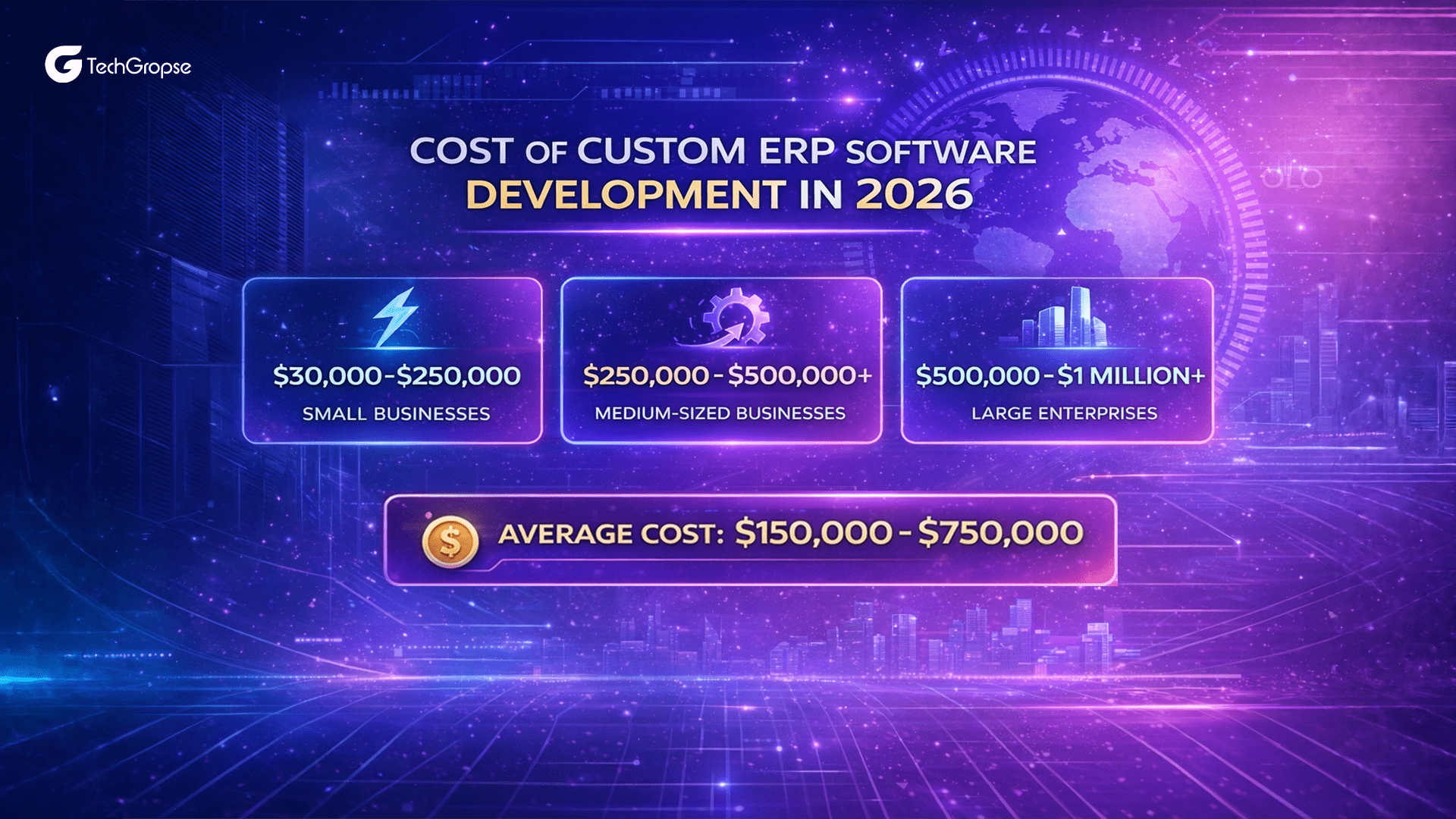
Now, let’s discuss the custom ERP development services price in 2026. To make the catalogue a bit more understandable, we have segmented the custom ERP software into three categories: basic, advanced, and complex.Â
So, let’s get the custom ERP software quote.Â
| ERP Software Type | Estimated Development Cost | Best Suited For | Key Features | Time-to-Market |
|---|---|---|---|---|
| Basic Custom ERP Software | $30,000 – $80,000 | Startups & small businesses | Finance management, HR module, inventory tracking, basic reporting | 3 – 5 months |
| Advanced Custom ERP Software | $80,000 – $180,000 | Growing mid-size companies | CRM integration, supply chain management, analytics dashboards, API integrations | 6 – 9 months |
| Complex Custom ERP Software | $180,000 – $500,000+ | Large enterprises | Multi-department modules, AI analytics, IoT integration, automation workflows, and enterprise security | 9 – 15+ months |
Top 5 Custom ERP Software Development Companies in 2026
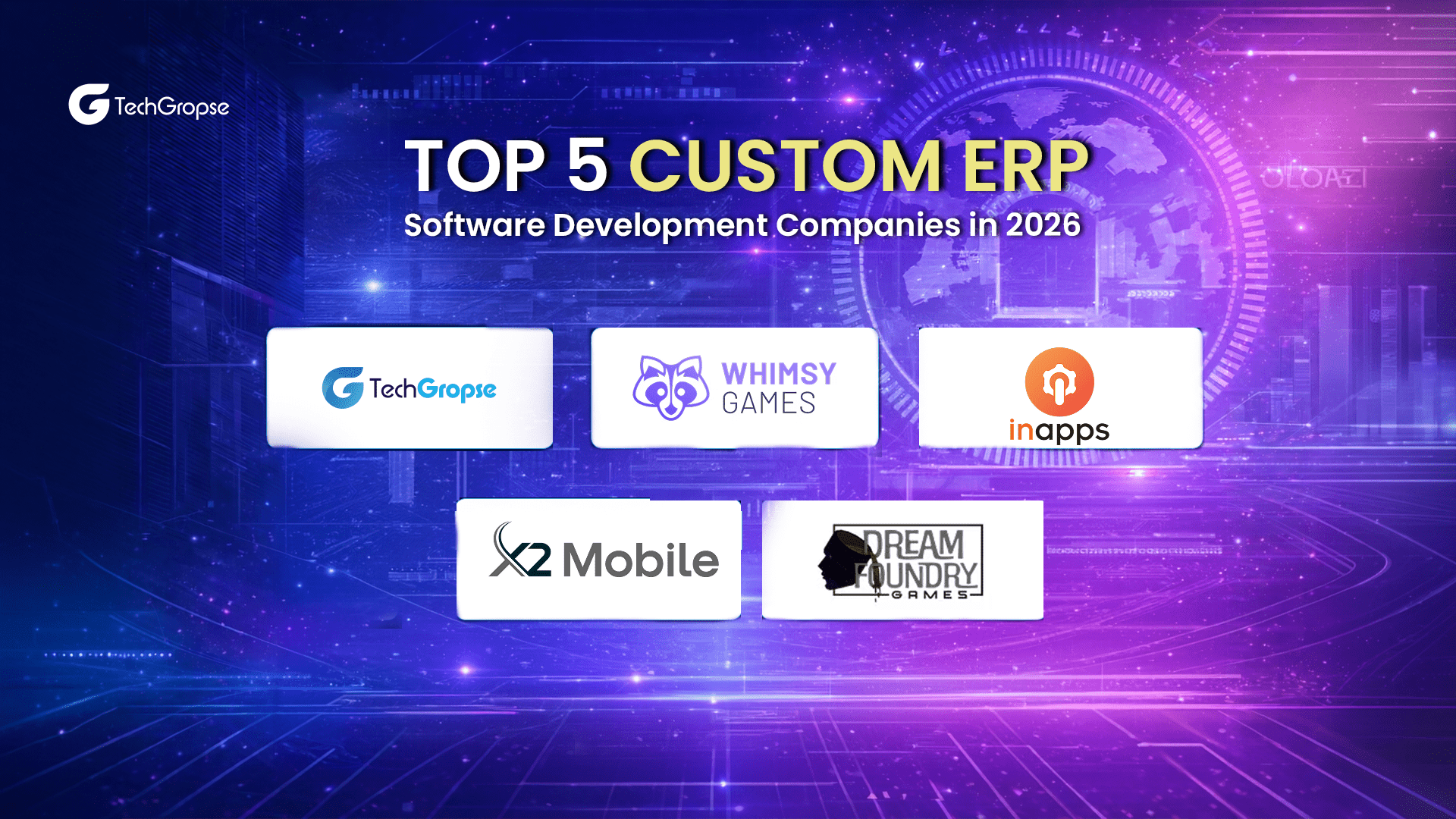
Let’s explore the top 2 brands that offer the best custom ERP software development services for modern-day businesses.Â
-
TechGropse
Location
- Dubai, United Arab Emirates
Founded In
- 2015
No. of Employees
- 50 – 249
Hourly Rate
- $25 – $49 / hr
Industries
- eCommerce
- Information technology
- Business services
- Education
- Financial services
- Government
- Medical
- Automotive
- Manufacturing
- Real estate
ServicesÂ
-
Panorama Consulting GroupÂ
Address
- Denver, CO
Founded In
- 2005
No. of Employees
- 50 – 249
Hourly Rate
- Undisclosed
Industries
- Business services
- Government
- Legal
- Non-profit
- Other industries
Services
- ERP Consulting and SI
- IT Strategy Consulting
-
Ultra Consultants
Address
- Chicago, IL
Founded In
- 1994
No. of Employees
- 50 – 249
Hourly Rate
- Undisclosed
Industries
- Manufacturing
- Food & Beverage
- Other industries
- Consumer products & services
Services
- ERP Consulting and SI
- Business Consulting
- Logistics & Supply Chain Consulting
- Manufacturing Consulting
-
Kodershop
Address
- Toronto, Canada
Founded In
- 2016
No. of Employees
- 10 – 49
Hourly Rate
- $50 – $99 / hr
Industries
- Government
- Information technology
- Other industries
- Real estate
- Supply Chain, Logistics, and Transport
ServicesÂ
- Custom Software Development
- ERP Consulting and SI
- AI Development
- E-Commerce Development
- IoT Development
- Mobile App Development
- Web Development
-
Simform
Address
Orlando, FL
Founded In
2010
No. of Employees
1,000 – 9,999
Hourly Rate
$25 – $49 / hr
Industries
- Advertising & marketing
- Business services
- Consumer products & services
- Financial services
- Information technology
- Legal
- Medical
- Retail
- Supply Chain, Logistics, and Transport
- eCommerce
ServicesÂ
- Custom Software Development
- E-Commerce Development
- ECM Consulting and SI
- ERP Consulting and SI
- Enterprise App Modernization
- Mobile App Development
- Unified Communications Consulting & SI
Bottomline: Choose TechGropse as a Custom ERP Software Development Company
With 10+ years of experience and 1000+ projects delivered, TechGropse is a leading software brand with a retention rate of over 92%. Our 150+ tech professionals have worked in 25+ countries to partner with 500+ global giants, eventually receiving 100+ awards in the software domain.Â
As a custom ERP software development company, we offer:Â
- Tailored ERP software solutions according to the business objectives and goals.Â
- Scalable ERP solutions to support the business during expansion.
- Customized modular development for different verticals of the operations.Â
- Modern-day analytics and a real-time reporting dashboard.Â
- Mobile-focused custom ERP for seamless remote accessibility.Â
- Build custom ERP software from scratch.
- Continuous support, feature upgrades, and post-delivery services.Â
- Enterprise-grade data security and role-based access control.Â
- Seamless third-party API integration with existing software system.Â
- Custom ERP system for small businesses.
- Cloud-based and on-premise ERP deployment options.Â
- Best custom ERP development services in 2026
FAQs (Frequently Asked Questions)
Custom ERP development creates tailored enterprise systems designed specifically for unique business workflows.
Costs vary from $30,000 to $500,000 depending on complexity, modules, integrations, and features.
Development typically takes 3–12 months, depending on project complexity, modules, and integrations required.
Common modules include finance, HR, CRM, inventory, supply chain, procurement, and analytics.
Custom ERP offers better flexibility, scalability, and alignment with specific organizational processes.
Manufacturing, healthcare, retail, logistics, construction, and finance industries widely use ERP systems.
Popular technologies include React, Angular, Node.js, Python, Java, .NET, and cloud platforms.
Yes, custom ERP systems easily integrate with CRM, accounting, and third-party enterprise tools.
Cloud ERP offers scalability, remote access, lower infrastructure costs, and easier system maintenance.
Evaluate experience, portfolio, technology expertise, scalability capabilities, and post-launch support services.

Hello All, Aman Mishra has years of experience in the IT industry. His passion for helping people in all aspects of mobile app development. Therefore, He write several blogs that help the readers to get the appropriate information about mobile app development trends, technology, and many other aspects.In addition to providing mobile app development services in USA, he also provides maintenance & support services for businesses of all sizes. He tried to solve all their readers' queries and ensure that the given information would be helpful for them.
 info@techgropse.com